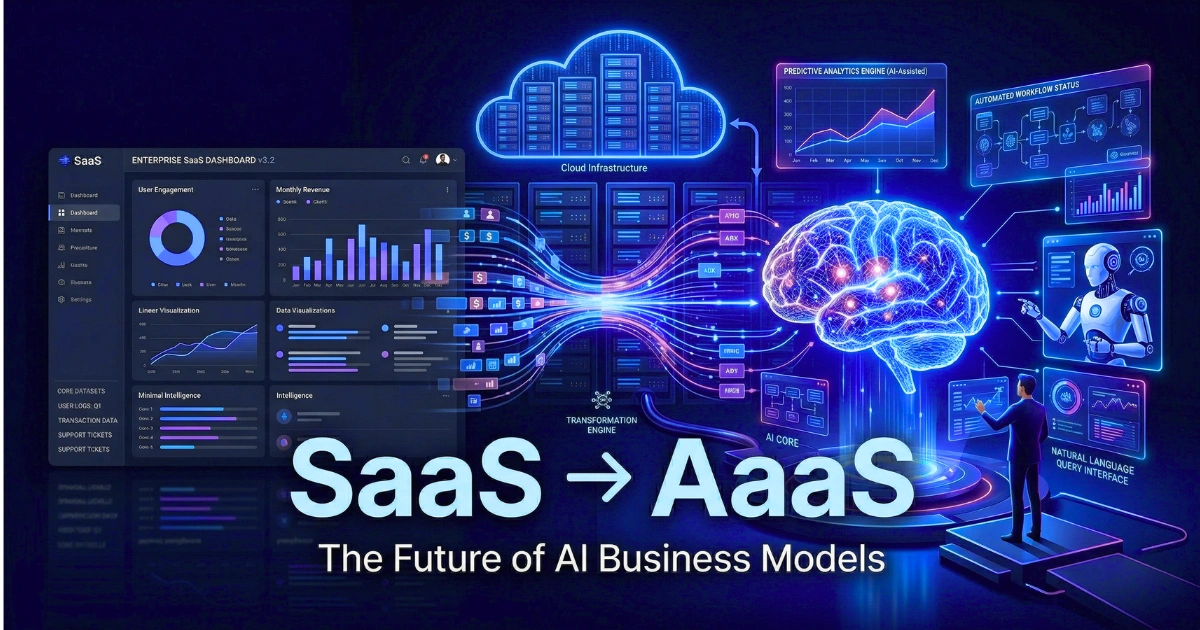

For more than two decades, Software-as-a-Service (SaaS) transformed how businesses use software.
Instead of installing applications locally, companies shifted to cloud-based platforms with subscription pricing, faster deployment, and scalable access. As a result, SaaS fundamentally changed software distribution.
However, by 2026, enterprises are facing a different challenge. Rather than simply accessing tools, organizations now need to execute work more efficiently.
Although businesses already rely on dashboards, CRMs, analytics platforms, and workflow systems, execution remains fragmented. Teams are often overloaded with repetitive tasks, disconnected tools, and constant manual coordination. Consequently, productivity gains from SaaS are beginning to plateau.
Because of this shift, a new model is emerging: Agent-as-a-Service (AaaS).
Unlike SaaS platforms that wait for user input, AaaS systems operate autonomously. These AI-powered agents can understand objectives, make decisions, execute workflows, and continuously improve performance . In other words, software is no longer just a tool—it is becoming a digital operator.
The Evolution of Enterprise Software
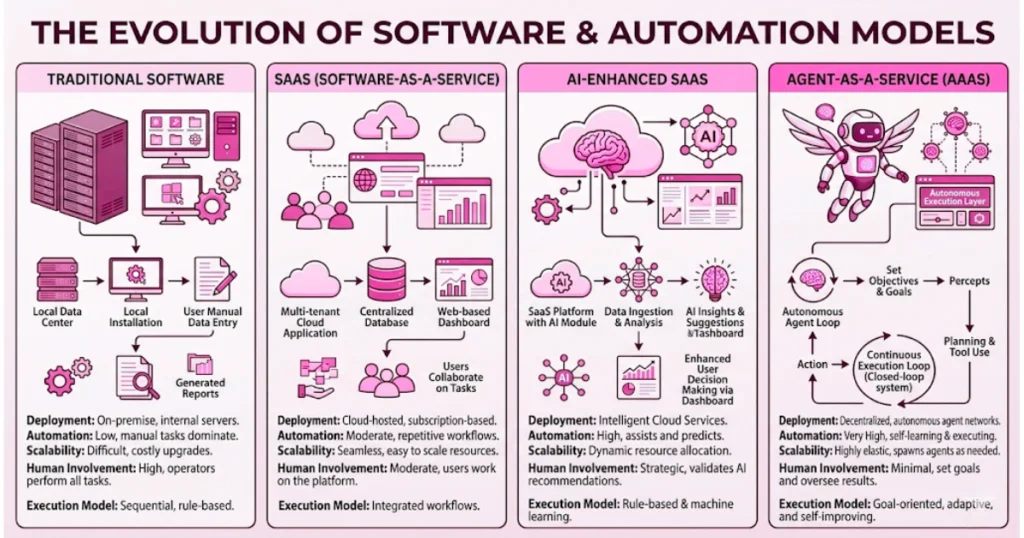
Phase 1: Traditional Software
- Installed locally
- Operated manually
- Feature-driven systems
- Heavy infrastructure requirements
Phase 2: SaaS
- Cloud-hosted platforms
- Subscription pricing
- Remote accessibility
- Faster scalability (While SaaS improved delivery, execution still depended on humans.)
Phase 3: AI-Enhanced SaaS
- AI copilots
- Smart recommendations
- Workflow automation
- Predictive insights (AI started assisting users, but humans still initiated most actions.)
Phase 4: Agent-as-a-Service (AaaS)
- Autonomous AI agents
- Goal-based execution
- Continuous optimization
- Multi-system orchestration
- Outcome-focused operations
At this point, the shift becomes fundamental. AaaS is not SaaS with AI layered on top; instead, it represents software that acts independently.
What Is Agent-as-a-Service (AaaS)?
Agent-as-a-Service is a cloud-based model in which autonomous AI agents perform tasks, manage workflows, and deliver outcomes on behalf of users.
Instead of navigating multiple tools manually, businesses define goals, constraints, priorities, and desired outcomes. The AI agent then handles execution.
Furthermore, these agents can analyze information, create plans, interact with APIs and enterprise tools, monitor results, and adapt decisions in real time., monitor results, and adapt decisions in real time.
In simple terms, SaaS gives you software to operate, whereas AaaS provides systems that operate for you.
Why SaaS Is Reaching Its Limits
SaaS successfully solved software accessibility; however, it did not eliminate operational overload.
Today, most enterprises manage dozens of platforms simultaneously, including CRM systems, analytics dashboards, collaboration tools, marketing platforms, finance software, and customer support systems. As a result, complexity has increased rather than decreased.
Instead of focusing on meaningful work, employees spend significant time switching between systems. Consequently, productivity suffers despite having better tools.
This is where autonomous agents create leverage. Rather than adding another dashboard, AI agents reduce the need to interact with dashboards altogether. In other words, the focus shifts from tool usage to task completion.
How AaaS Systems Actually Work
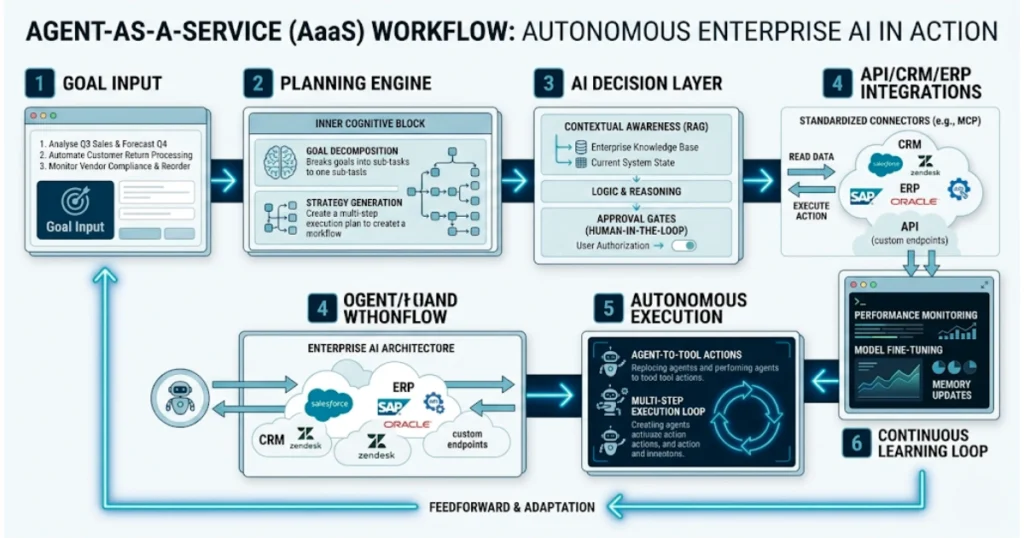
Modern AaaS platforms are built on agentic AI architectures that combine reasoning, memory, planning, and execution.
1. Goal Interpretation
First, the system converts business objectives into executable tasks.
For example, a goal like “Improve lead conversion by 15%” is broken down into actionable workflows.
2. Planning & Decision-Making
Next, AI agents prioritize actions based on context, historical performance, constraints, and business rules.
3. Autonomous Execution
Then, agents interact with CRMs, ERPs, APIs, and cloud platforms without constant human input.
4. Continuous Learning
Finally, the system improves over time by learning from outcomes, failures, and behavioral patterns. As a result, a continuous optimization loop is created.
Real Enterprise Use Cases of AaaS
For example, autonomous agents are already transforming multiple business functions:
- Sales Agents: Identify leads, personalize outreach, automate follow-ups, and optimize pipelines.
As a result, conversion rates increase without expanding sales teams. - Marketing Agents: Generate campaigns, test variations, optimize budgets, and personalize messaging at scale.
Consequently, campaigns improve continuously with faster iteration cycles. - IT & Security Operations: Monitor infrastructure, detect anomalies, and trigger automated remediation.
Therefore, downtime decreases and response times improve. - Customer Support Agents: Resolve tickets autonomously and escalate complex issues intelligently.
This leads to faster resolution and lower operational costs. - Finance & Compliance: Monitor transactions, detect fraud, enforce policies, and generate reports automatically.
Ultimately, governance improves while manual workload decreases.
The Pricing Shift: From Seats to Outcomes
At the same time, pricing models are evolving alongside this shift.
Traditional SaaS relies on per-user subscriptions; however, AI agents do not behave like human users. Because of this, companies are rethinking monetization strategies.
Emerging models include:
- Usage-based pricing
- Task-based billing
- Compute-based pricing
- Outcome-based pricing
Instead of paying for access, businesses increasingly pay for completed work and measurable results. As a result, software value becomes directly tied to outcomes.
The Biggest Advantage: Operational Scale Without Headcount Growth
One of the primary drivers of AaaS adoption is scalability. AI agents can operate continuously across departments, regions, and workflows.
Therefore, businesses can increase operational capacity without expanding team size proportionally. The outcome is lower overhead, faster execution, higher efficiency, and continuous optimization.
The Risks Enterprises Still Need to Solve
However, this transition is not without challenges.
Governance & Oversight
First, organizations need clear accountability frameworks, human review systems, and explainability mechanisms. Without these safeguards, AI autonomy can become a liability.
Data Readiness
In addition, AI agents depend heavily on structured, connected, and real-time data. Poor data quality significantly reduces effectiveness.
Trust & Reliability
Finally, many enterprises remain hesitant to allow fully autonomous decision-making. Therefore, most organizations are adopting human-in-the-loop systems, where AI executes tasks while humans retain strategic control.
The Future: Software That Executes Work
Looking ahead, enterprise software is likely to evolve dramatically. By the end of this decade, dashboards may become less central, while interfaces fade into the background.
Instead of operating software manually, businesses will supervise networks of autonomous agents. Meanwhile, humans will focus on strategy, creativity, and governance.
Ultimately, this marks the true transition from SaaS to AaaS.
Closing Perspective: From Tools to Autonomous Workforce
SaaS changed how businesses access software, whereas AaaS changes what software actually does.
This shift moves enterprise technology from:
- Tools → Operators
- Workflows → Autonomous Execution
- Software Access → Outcome Delivery
In the long run, companies that adapt early will not just automate tasks—they will build entirely new operational models around intelligent systems that execute work continuously. As a result, AaaS may become the defining competitive advantage of the decade.