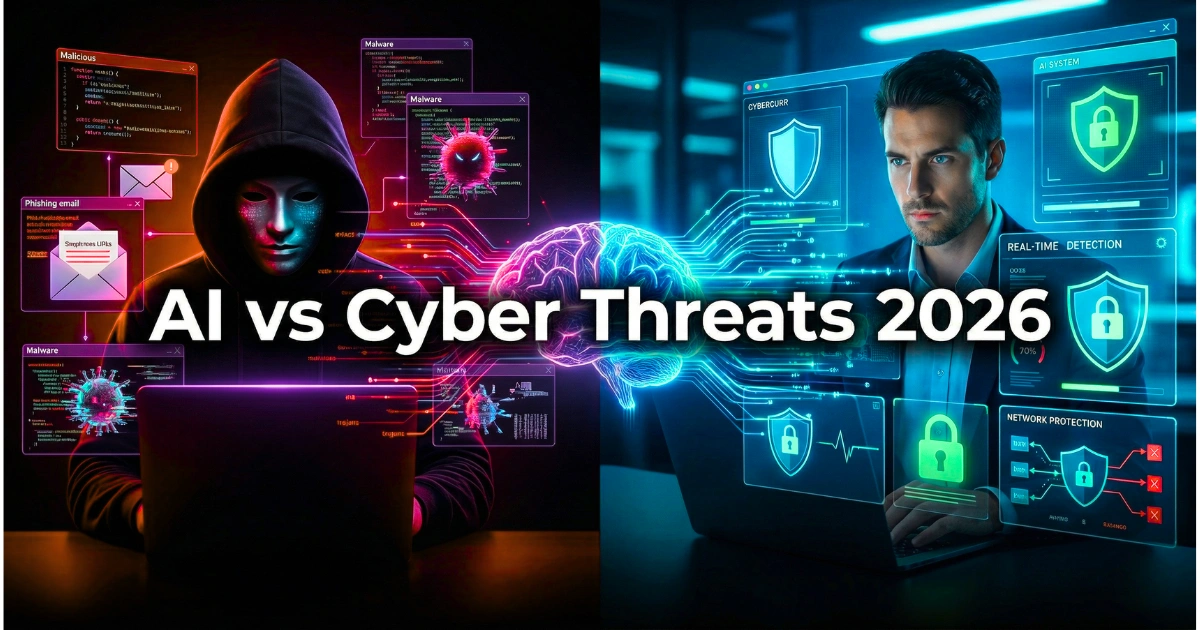

Cybersecurity in 2026 isn’t just about firewalls and antivirus software anymore. It’s a continuous, high-speed battle between intelligent systems—where both attackers and defenders are powered by AI.
Artificial intelligence has shifted security from reactive defense to predictive and autonomous response. But there’s a catch: the same technology protecting systems is also being weaponized to break them.
This isn’t a tool upgrade. It’s an arms race.
What AI in Cybersecurity Actually Means Today
At its core, AI in cybersecurity refers to systems that can:
- Process massive volumes of data in real time
- Detect anomalies and hidden patterns
- Automate threat detection and response
- Continuously learn from new attack behaviors
Unlike traditional security tools that rely on predefined rules, AI systems adapt. They evolve with the threat landscape, making them far more effective against modern attacks.
How AI Is Strengthening Cyber Defense
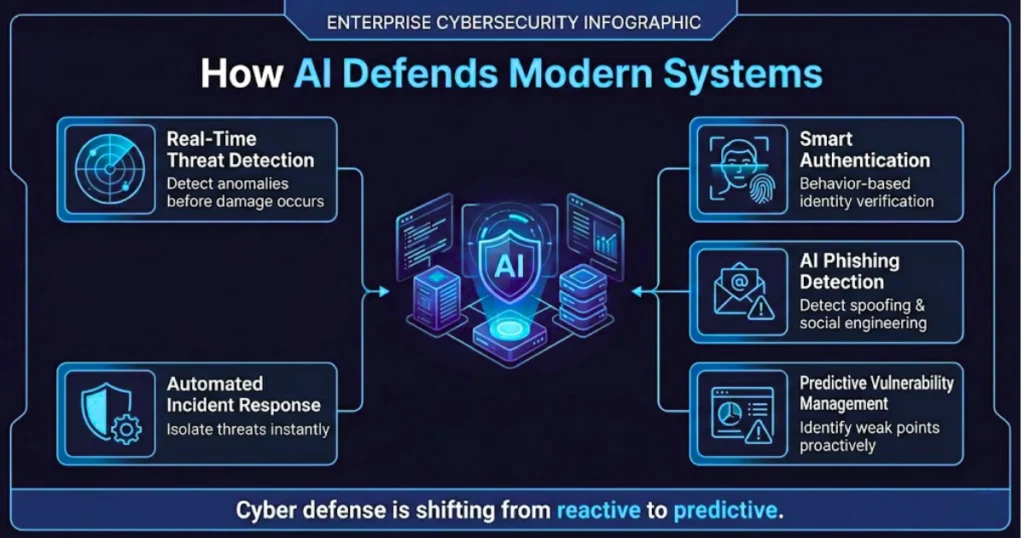
1. Real-Time Threat Detection
AI systems monitor networks, endpoints, and user behavior continuously. Instead of waiting for known attack signatures, they detect unusual activity patterns—often catching threats before damage occurs. Example: Suspicious login behavior, unusual data transfers, or abnormal device activity.
2. Automated Incident Response
Modern AI doesn’t just detect threats—it acts. It can isolate compromised systems, block malicious traffic instantly, and trigger alerts or escalate to human teams. This reduces response time from hours to seconds.
3. Smarter Authentication Systems
AI enhances identity verification using behavioral biometrics such as typing patterns, voice recognition, and device usage behavior. If something deviates, the system can trigger additional verification steps automatically.
4. Advanced Phishing Detection
AI scans emails, links, and attachments in context—not just keywords. It can identify spoofed domains, social engineering patterns, and subtle language manipulation. This is critical as phishing attacks become more personalized and harder to detect manually.
5. Predictive Vulnerability Management
Instead of reacting to known vulnerabilities, AI predicts where breaches are most likely to occur. Security teams can prioritize high-risk areas, fix weaknesses before exploitation, and reduce attack surfaces proactively.
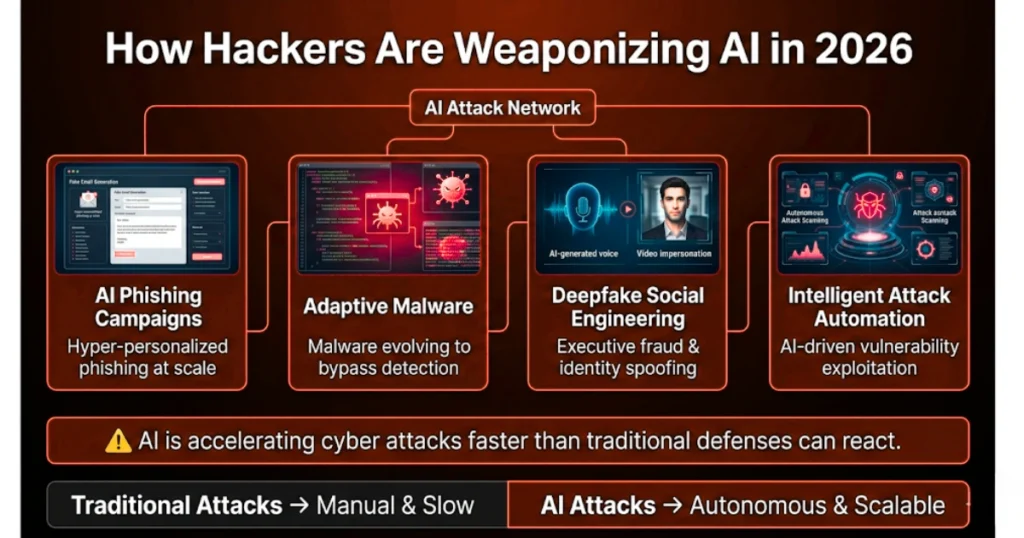
How Hackers Are Using AI (The Other Side of the War)
AI isn’t just helping defenders—it’s making attackers smarter.
1. AI-Generated Phishing Campaigns
Attackers now use AI to create highly personalized phishing messages that mimic real communication styles. Result: Higher success rates, harder detection, and scalable attacks.
2. Automated Malware Evolution
AI enables malware to adapt to detection systems, modify its behavior dynamically, and avoid signature-based defenses. This makes traditional antivirus tools less effective.
3. Deepfake Social Engineering
AI-generated voice and video are being used to impersonate executives or trusted contacts. Use cases: Fake approval requests, financial fraud, and internal system access.
4. Intelligent Attack Automation
Hackers use AI to scan systems, find vulnerabilities, and launch attacks automatically—at scale. What used to take days now takes minutes.
The Rise of Autonomous Security Systems
In 2026, cybersecurity is shifting toward self-operating defense systems. These systems monitor continuously, make decisions independently, and execute actions without human intervention.
This is especially critical due to the global shortage of skilled cybersecurity professionals, a gap that is rapidly being filled as autonomous AI employees step into traditional operational roles.
Key Benefits of AI in Cybersecurity
- Speed at Scale: AI processes data far beyond human capability, enabling faster detection and response.
- Reduced Human Error: Automation minimizes mistakes caused by manual intervention.
- Continuous Learning: AI systems improve over time, adapting to new threats automatically.
- Handling Massive Data Volumes: Modern enterprises generate enormous data streams—AI makes sense of it in real time.
The Risks You Can’t Ignore
AI in cybersecurity isn’t risk-free.
1. Data Privacy & Sovereignty
Sensitive business data must not leak into public AI models, making an understanding of foundational AI security, including prompt injections and data leak prevention, an absolute necessity for organizations. Solution: Private deployments and strict access controls.
2. Algorithmic Bias
If AI is trained on biased data, it can lead to flawed security decisions. Overcoming the inherent “black box” problem of AI auditing requires deliberate action. Mitigation: Regular audits and transparent models.
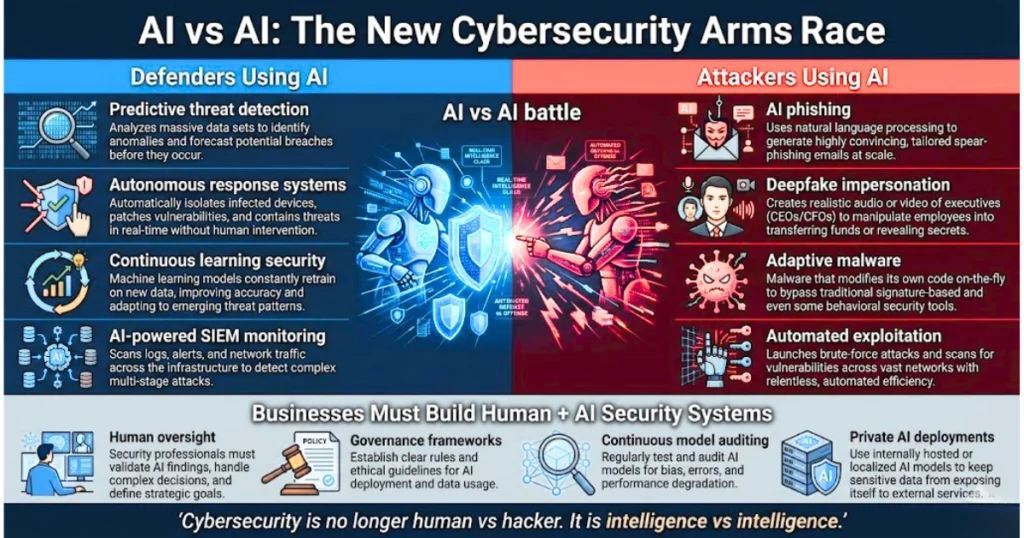
3. AI vs AI Arms Race
As defenders improve, attackers evolve just as fast. Security is no longer static—it’s continuous adaptation.
Generative AI’s Role in Cybersecurity
Generative AI is becoming a powerful tool for defenders.
- Simulating Cyber Attacks: Teams can test defenses using realistic AI-generated attack scenarios.
- Predicting Future Threats: By analyzing past data, AI can forecast likely attack patterns.
- Enhancing Detection Models: Synthetic data improves training, making detection systems more accurate.
Real-World Applications Across Security Layers
- Endpoint Security: AI protects devices from ransomware and malware in real time.
- Network Security: Learns traffic patterns and flags anomalies instantly.
- Cloud Security: Monitors access, detects misconfigurations, and ensures compliance.
- Security Operations (SIEM): Aggregates logs and identifies threats faster than manual analysis.
Where This Is Heading: The Future of AI Security
Cybersecurity is moving toward a fully integrated AI-driven ecosystem where threat detection is predictive, responses are autonomous, and systems continuously evolve. At the same time, attackers will continue leveraging AI to bypass defenses.
The result? A constant cycle of innovation on both sides.
The Strategic Shift for Businesses
To stay secure in 2026, organizations must:
- Adopt AI-powered security systems and build scalable, defensible AI architectures that hold up in production.
- Build strong data governance frameworks.
- Combine automation with human oversight.
- Continuously update and audit AI models.
Security is no longer just an IT function—it requires a calculated AI strategy to protect assets while maximizing business value.
Closing Perspective: It’s No Longer Human vs Hacker
The real shift isn’t just better tools—it’s a change in the nature of conflict.
Cybersecurity is now:
- AI vs AI
- Speed vs speed
- Intelligence vs intelligence
The organizations that win won’t be the ones with the biggest teams. They’ll be the ones that build smarter systems—and evolve faster than the threats targeting them.