
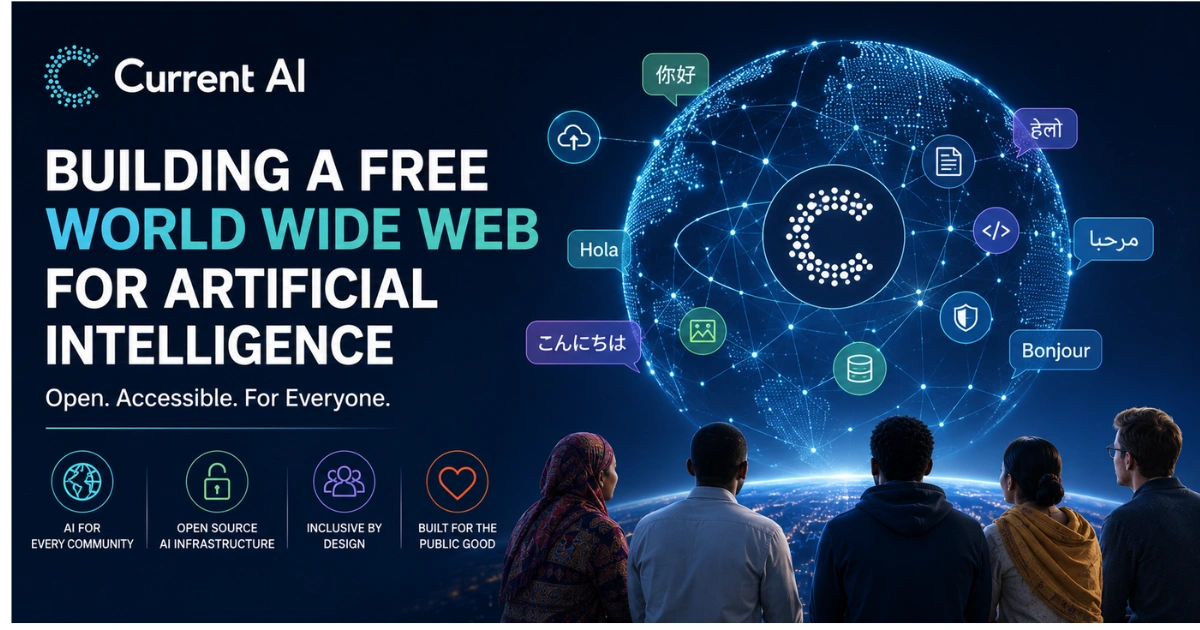

Current AI argues that companies have concentrated most advanced AI systems in wealthier countries, leaving many languages and cultures underrepresented.
Founded in 2025 by Martin Tisné and now led by CEO Ayah Bdeir, the nonprofit aims to create an open AI ecosystem that serves communities often overlooked by commercial AI models.
Its mission focuses on making AI accessible in local languages, preserving cultural knowledge, and ensuring people can use AI even without reliable internet access.
Building Open AI Tools for Underserved Communities
Rather than focusing on proprietary models, Current AI has already launched several open-source initiatives.
One of its flagship projects is Suno Sutra, an offline AI device developed with India’s Bhashini program that supports 22 Indian languages without requiring an internet connection.
The organization has also launched the VYOMA Innovation Challenge, encouraging developers to build new applications on the platform.
Beyond India, Current AI partnered with organizations including Hugging Face, Mozilla, and MIT Media Lab to develop AlphaChat, an open-source chatbot created in just seven weeks.
It has also teamed up with Japan’s Sakana AI to expand open AI tools for Japanese and Global South communities.
Through its first round of grants, the nonprofit is funding projects that develop African-language datasets, preserve Arab cultural archives, support Indigenous AI initiatives in Brazil, and build AI accountability tools across Africa.
Challenging Big Tech’s AI Model
Current AI operates as a public-private partnership backed by the French government, the Ford Foundation, Google DeepMind, Salesforce, and several philanthropic organizations.
The initiative has secured around $400 million in commitments and hopes to mobilize $2.5 billion over the next five years.
Current AI argues that most advanced AI systems remain concentrated in wealthier countries, leaving many languages and cultures underrepresented. Rather than prioritizing commercial expansion, the nonprofit aims to build publicly accessible AI infrastructure that local communities can own and control.
While its resources remain far smaller than those of major AI companies, the initiative represents a growing effort to make AI development more open, inclusive, and accessible worldwide.
Source: TechCrunch, "Nonprofit Current AI Is Racing to Build the World Wide Web of AI, Free for All"