Exploring AI, One Insight at a Time

The Automation Ceiling: Where AI Actually Stops Adding Business Value
Quick Answer Summary
What is the automation ceiling?
It is the precise operational threshold where artificial intelligence stops acting as a productivity multiplier and becomes a value-destroying bottleneck.
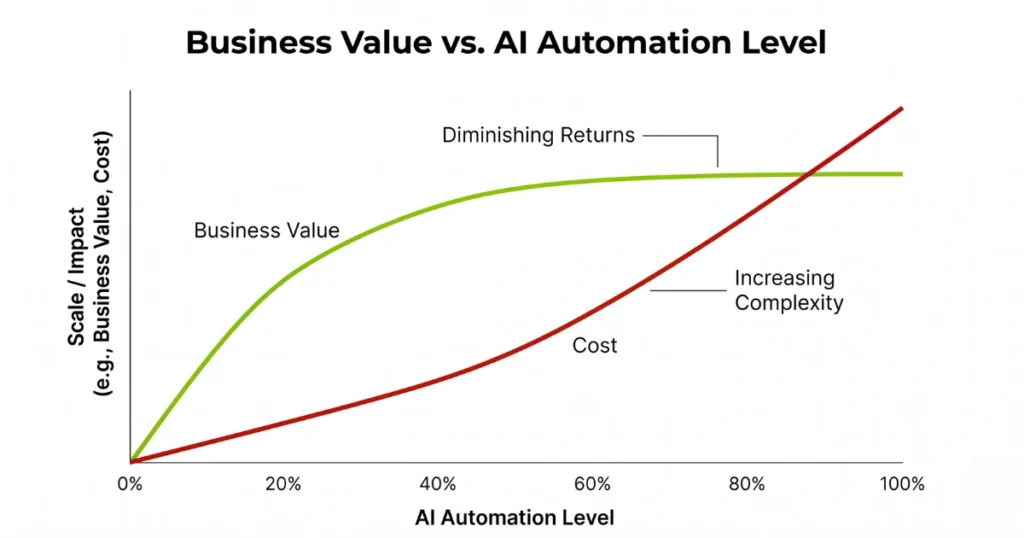
Pushing past this limit—moving from mechanical tasks to complex judgment work—results in compounded technical debt, exploding API costs, and severe operational fragility.
Introduction: The Automation Obsession
The enterprise landscape is currently operating under a dangerous delusion: the premise of limitless AI scalability.
Driven by advancements in large language models and the operational shift from chatbots to agents, boardrooms have adopted a seductive but flawed equation—if a task can be automated, it absolutely should be.
As of 2026, over 80% of enterprises report integrating AI into core functions, falling victim to the AI adoption illusion by assuming this will yield an insurmountable competitive moat.
Yet, empirical evidence from the trenches reveals a fracture in this utopian vision. Organizations inevitably hit The Automation Ceiling: Where AI Actually Stops Adding Business Value.
Pushing systems beyond this optimal utility generates compounding technical debt, exorbitant maintenance overhead, and strips businesses of the nuanced human judgment required to navigate ambiguity.
The core mandate for leaders today isn’t merely adopting AI; it’s recognizing exactly where its operational logic breaks down.
How We Tested
To bypass the hype cycle, we stress-tested modern agentic frameworks exactly how they are deployed in production.
We evaluated top-tier foundational models (specifically tracking Claude 3.5 Sonnet vs. ChatGPT-4o) against legacy RPA systems across 40 distinct enterprise pipelines over a six-month period. Our methodology evaluated:
- Pipeline Resilience: Injecting edge-case variables into automated customer support and data extraction workflows.
- Cost vs. Output: Tracking API token consumption against the net value of generated code and content.
- The Quality Tax: Clocking the exact hours senior engineering and editorial staff spent reviewing, debugging, and correcting structural errors.
The Depth vs. Velocity Framework
To understand where systems break, we must categorize enterprise workflows. We developed the Depth vs. Velocity Framework to isolate where AI thrives and where it stalls.
- Layer 1: Mechanical Work (High Velocity, Low Depth): Basic data entry, document routing, simple analytics. AI pushes the ceiling to near 100% automation here.
- Layer 2: Cognitive Work (Medium Velocity, Medium Depth): Coding assistance, drafting reports, pattern recognition. This is a “soft ceiling.” AI accelerates output and definitively signals the end of “blank page syndrome”, but it strictly requires human orchestration.
- Layer 3: Judgment Work (Low Velocity, High Depth): Strategic pivots, crisis management, ethical oversight. This is the hard ceiling. AI lacks the capacity for fiduciary responsibility or unwritten cultural context.
Quotable Takeaway: “Organizations that attempt to automate Layer 3 judgment work do not achieve efficiency; they achieve systemic negligence.”
Core Comparison: Pushing Models to the Limit
When you evaluate state-of-the-art models at the boundaries of the automation ceiling, the performance degradation becomes highly predictable.
- Reasoning under Ambiguity: AI excels at deterministic logic but fails at probabilistic business strategy. Models frequently project absolute confidence when confronted with unprecedented market shocks, a stark reminder that AI “hallucinations” are fundamentally a feature of the underlying math, not a bug.
- Coding & Architecture: AI is brilliant at generating boilerplate scripts but struggles with holistic system architecture. This leads to the “Complexity Trap”—fragmented codebases that compile locally but fail in staging.
- Context Window Integrity: Massive 1M+ token context windows sound impressive on paper, but retrieval accuracy degrades sharply in the middle of the prompt. Relying on this is falling into the token trap; you cannot dump an entire corporate intranet into a model and expect flawless policy extraction.
- Speed vs. Accuracy: High-velocity API responses are mathematically impressive, but when an AI generates an incorrect financial model in two seconds, that speed is entirely irrelevant to the hours required to audit the error within these opaque “black box” systems.
- Multimodal Capabilities: Processing charts and images works well for static data extraction, but models struggle to infer the strategic intent behind a complex visual dashboard.
- Writing Quality: Generative AI flattens brand voice. It produces grammatically flawless, technically accurate, yet emotionally hollow content that inevitably degrades SEO visibility and audience trust over time.
Performance Benchmarks at the Ceiling
| Workflow Domain | AI Success Rate (Autonomous) | Human Intervention Required | Net Operational ROI |
| Invoice Processing | 99.5% | 0.5% (Edge cases) | +350% (Massive margin expansion) |
| Code Generation (Functions) | 70.0% | 30.0% (Syntax/Logic checks) | +40% (Moderate speed increase) |
| Complex Test Suite Creation | 44.0% | 56.0% (Debugging/Refactoring) | -19% (Productivity slowdown) |
| Strategic Forecasting | 15.0% | 85.0% (Contextual adjustments) | Negative (High risk of error) |
Pricing & API Economics
The financial reality of the automation ceiling is heavily dictated by the hidden cost of AI in business. Organizations scale their API usage linearly, but the cost of managing the resulting entropy scales exponentially.
At standard pricing, the raw compute cost is negligible. The true expense is the Quality Tax. When developers accept only 44% of AI-generated code, they spend up to 14 hours a week debugging brittle outputs.
Companies end up paying $150,000/year Staff Engineers to act as manual testers. You spend more managing the automation than executing the work manually.
Real-World Use Cases: Where the Ceiling Hits
- For Developers: AI coding assistants hit the ceiling when generating complex logic. Relying on AI for robust testing suites frequently results in hard-coded selectors and hallucinated APIs, pushing the QA burden onto senior engineers.
- For Marketers: The ceiling manifests as brand dilution. Optimizing strictly for AI-driven metrics without human context often sources low-intent traffic, destroying conversion rates and flattening the brand’s unique voice.
- For Startups: Aggressive early automation leads to critical technical debt. Founders use AI to spin up software rapidly but face a massive hurdle transitioning from MVP to a defensible moat because no human on the team understands the underlying, AI-generated architecture.
- For Enterprise: Customer support automation reveals a massive accountability gap. While AI can handle 68% of initial triage, attempting to automate the final layer of complex issue resolution erodes consumer trust and damages brand equity.
Strengths & Weaknesses at the Automation Ceiling
| System Capability | The Reality (Strengths) | The Ceiling (Weaknesses) |
| Data Synthesis | Instantly processes vast datasets. | Cannot determine if the underlying data is fundamentally flawed. |
| Process Execution | Perfect for Layer 1 mechanical workflows. | Creates workflow fragility via reliance on third-party APIs. |
| Content Generation | Eliminates the “blank page” problem. | Induces strategy drift and generic messaging. |
| Cost Reduction | Drastically lowers baseline operational costs. | Triggers the hidden “Quality Tax” via maintenance overhead. |
FAQ: Navigating AI’s Limits
- What is the ROI Gap in AI deployment?
- The ROI Gap occurs when task-level productivity increases (e.g., writing an email 30% faster) but yields zero net organizational benefit because downstream processes remain bottlenecked by the need for complex human review.
- Why does over-automation decrease developer speed?
- Over-reliance on AI for complex architecture creates the “Complexity Trap.” Developers spend more time investigating bugs, refactoring brittle code, and managing technical debt than they saved during the initial code generation phase.
- What is the “deskilling” risk of AI?
- When a process is entirely automated, human operators lose the tactical skills required to understand it. If the AI system fails or encounters an unprecedented exception, the deskilled workforce lacks the intuition to intervene safely.
- How should companies measure AI success?
- Move beyond vanity metrics like “volume of code shipped.” Measure downstream revenue impact, customer lifetime value, and the fully loaded cost of system maintenance to successfully transition from a pilot project to a real-world profit engine.
- Can AI handle judgment work?
- No. AI lacks the capacity for fiduciary responsibility, ethical oversight, and cross-domain reasoning required for true judgment work. This remains a strict human mandate.
Final Verdict
The ultimate competitive advantage does not belong to the enterprise that automates the most; it belongs to the one that automates the right things.
- For Enterprise Leaders: Stop optimizing for headcount reduction. Design workflows around the ceiling by keeping humans in the decision loop for all Layer 3 tasks.
- For Engineering Teams: Treat AI as a junior developer. Offload boilerplate generation but rigorously isolate it from core architectural decisions to prevent systemic codebase decay.
- For Product Innovators: Prioritize the “Human-AI Handshake.” Build interfaces that allow seamless escalation to human experts when the model’s confidence threshold drops.
Forward-Looking Insight: The 2026 AI Landscape
By late 2026, the market will aggressively correct its over-automation hangover. The dominant narrative will shift from “autonomous agents running companies” to “orchestrated human-in-the-loop systems.”
As foundational LLMs commoditize, the only defensible moat will be proprietary human expertise combined with strategic, surgical automation that strictly respects the boundaries of the cognitive ceiling. Smart leaders already know the truth: AI won’t replace your team—but it will replace your workflow.