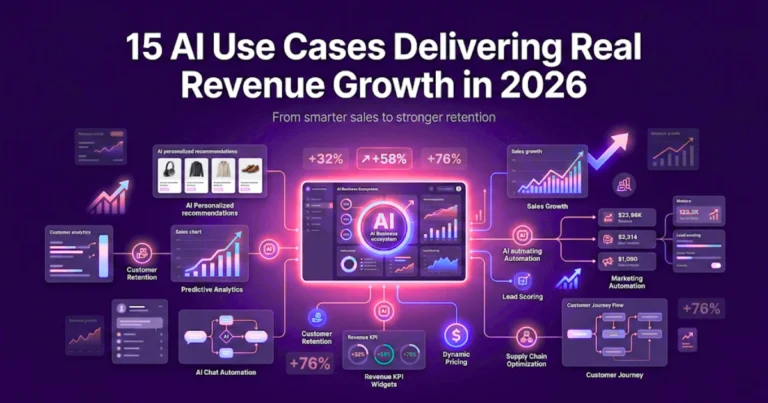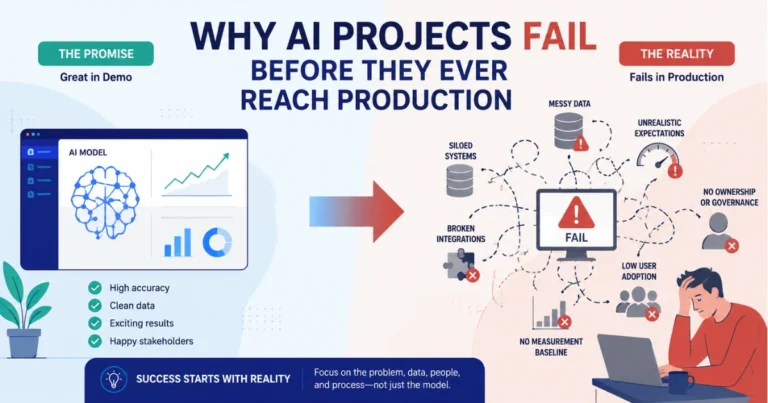


Most small businesses aren’t asking if they should use AI anymore. Instead, they’re trying to figure out where it actually makes a difference.
After all, by now, the barrier isn’t cost. It’s clarity.
The tools are cheap, so that’s not the problem. A few years ago, AI felt expensive and complicated. You needed time, budget, and maybe even technical help.
Fortunately, that’s gone.
Today, you can subscribe to multiple AI tools for less than what you’d spend on a single freelancer task. Setup takes minutes, and results show up instantly.
Sounds great. And it is.
However, here’s the catch—easy access doesn’t mean useful usage. Consequently, a lot of small businesses are paying for tools they barely touch after week one, falling victim to the AI adoption illusion.
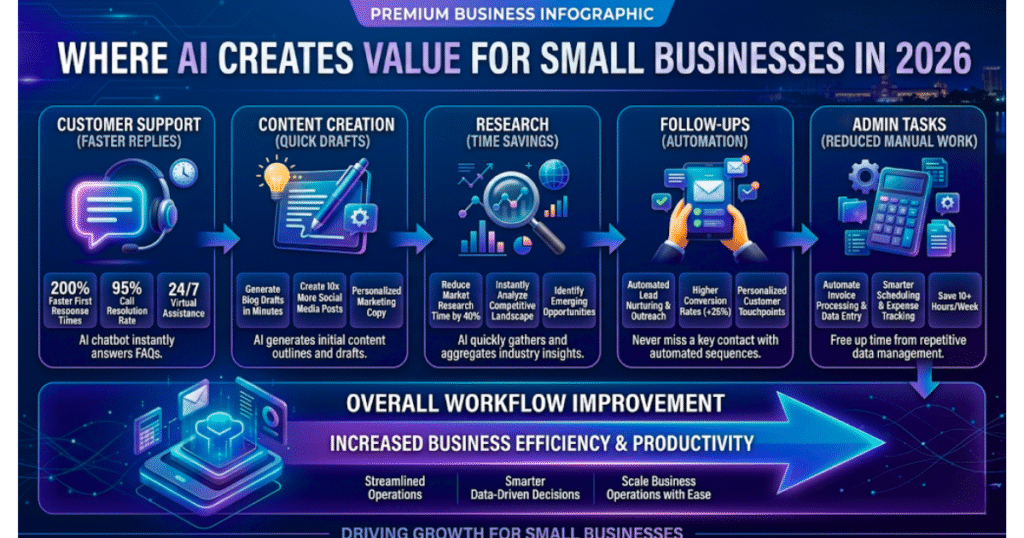
Where it actually starts paying off
Interestingly, the value doesn’t show up in some big, dramatic way. It’s smaller than that. Almost boring.
- Replying to the same customer questions without rewriting everything.
- Turning rough notes into usable content quickly.
- Speeding up research that used to take hours.
- Keeping follow-ups consistent instead of forgetting them.
None of this feels like a “game changer” on day one.
Yet, give it a few weeks and the difference is obvious. You experience less back-and-forth, alongside a reduced mental load. Ultimately, you get more output from the same team.
As a result, that’s the real ROI.
Most businesses use it wrong at first
Usually, what happens is simple. Someone signs up for a tool. They test a few prompts, and it works… kind of. Then, they move on.
Without a real change in workflow, clear use case, or dedicated ownership, the tool simply becomes optional. And inevitably, optional tools don’t last.
Moreover, AI doesn’t fix a messy process. It just makes the mess faster.
The businesses getting real value do one thing differently
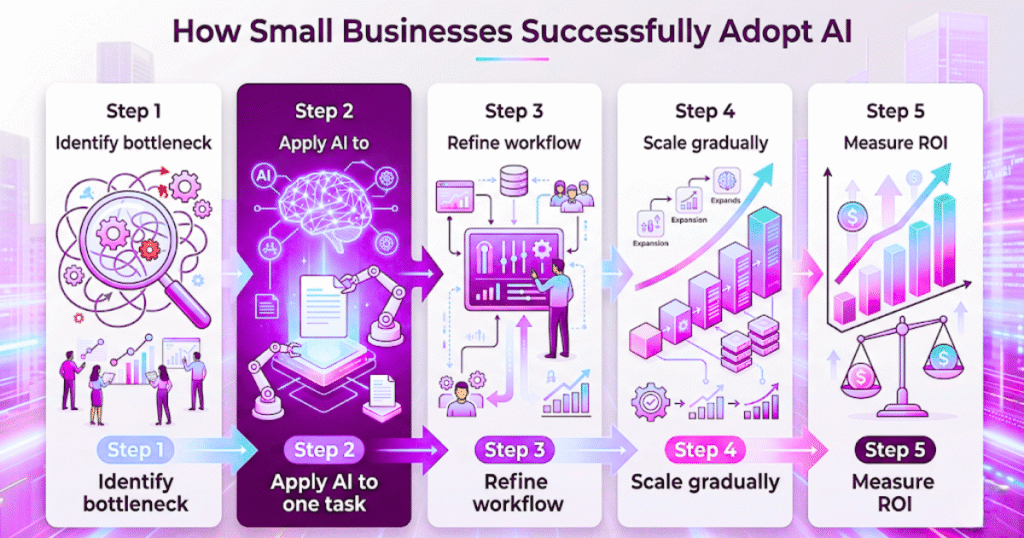
Crucially, they don’t try to “use AI everywhere.” They pick one problem that wastes time—and fix that first.
That’s it. For example, maybe it’s:
- Slow customer replies.
- Inconsistent content output.
- Too much manual admin work.
Specifically, they plug AI into that specific task, refine it a bit, and only then move to the next one. There is no big transformation. Just steady improvements.
There’s a gap people don’t talk about
Furthermore, AI works best when the work is already structured. If your tasks are repetitive, text-heavy, and digital, you’ll see results quickly.
Conversely, if your work is unpredictable, offline, or constantly changing, it’s harder. It is not impossible—just slower to figure out where AI fits. For this reason, marketing teams, service businesses, and online-first companies move faster with AI than others.
The real cost isn’t the subscription
Most importantly, this part gets overlooked. The tools are cheap, but your time isn’t.
Someone needs to test how the tool is used, adjust prompts, check outputs, and refine the process.
Ultimately, if nobody owns that, nothing sticks. That’s usually the difference between a business that says “AI didn’t work for us” and one that quietly gets a lot of value from it.
Same tools. Different approach.
Where people get disappointed
Generally, it comes down to expectations. If you expect instant revenue, full automation, and perfect outputs, you’ll be frustrated.
AI is more like a multiplier than a replacement. For instance, it speeds things up. Additionally, it reduces effort, which ultimately helps you produce more. But it still needs direction.
So… is it worth it?
Yes—for most small businesses in 2026, it is.
However, not because it’s powerful, but because it’s practical.
In conclusion, when used properly, it gives small teams leverage. Not by replacing people, but by helping them get more done without adding headcount.
The businesses that benefit aren’t the ones chasing every new tool. Rather, they’re the ones fixing one bottleneck at a time—and letting the gains compound quietly in the background.