

Most companies don’t struggle with what AI can do — they struggle with proving it’s worth the money.
Under the hood, though, the way serious teams calculate ROI is surprisingly simple. It always comes down to one equation:
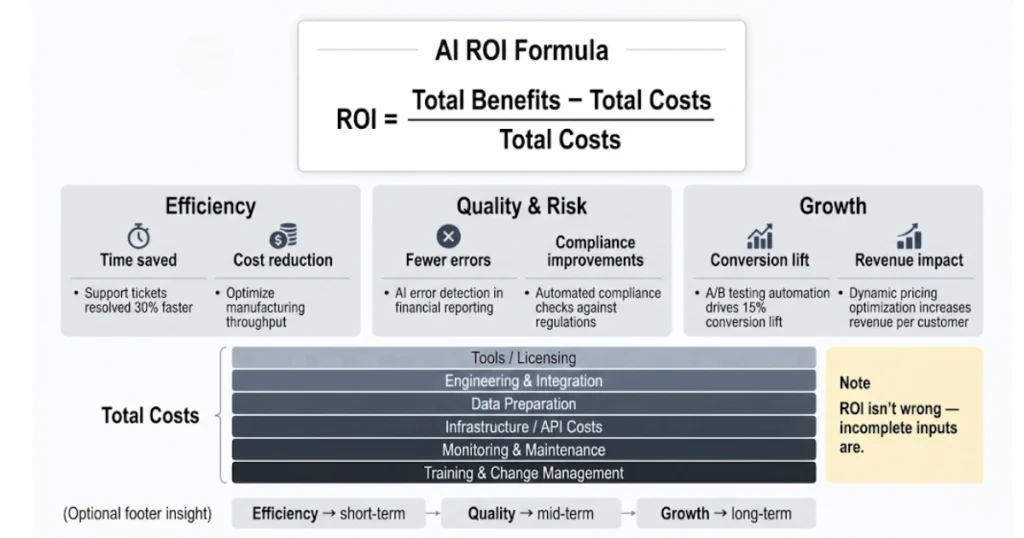
ROI=Total Benefits-Total costs / Total costs
What makes it tricky isn’t the formula. It’s deciding what actually counts as a “benefit” — and what costs people conveniently ignore.
What Companies Actually Count as “Benefits”
In real business cases, benefits are never vague. Nobody gets funding by saying “AI will improve productivity.” Everything is broken into numbers you can defend in a meeting.
Most teams group benefits into three buckets:
- Efficiency:
This is the easiest place to start. If a tool saves time, that time has a cost. Multiply hours saved by the fully loaded hourly rate, and you have a number. This is why automation projects get approved quickly — the math is straightforward. - Quality and Risk:
This is where things like error reduction, compliance improvements, or fewer support escalations show up. It’s less obvious than time savings, but in industries where mistakes are expensive, this can matter even more. - Growth:
The most debated category. Revenue uplift sounds great, but it’s also the easiest to overstate. Companies that take this seriously don’t guess — they test. If AI improves conversion rates or increases average order value, they tie that lift to actual margin, not just top-line revenue.
Costs: Where Most ROI Calculations Quietly Break
If you ever see an ROI number that looks too good, it’s usually because the cost side is incomplete.
Licensing fees are obvious. Everything else isn’t.
There’s the engineering time to build and integrate. The effort to clean and prepare data. Ongoing cloud costs. Monitoring, retraining, support. Even internal training and change management — which often gets ignored — can be significant.
By the time a system is fully operational, the real cost is almost always higher than the original estimate. Teams that do this well assume that upfront.
Why One Big ROI Number is Misleading
A single percentage doesn’t tell the full story.
Efficiency gains show up quickly. You can measure them in weeks. Revenue impact takes longer. Sometimes months. Quality improvements sit somewhere in between.
So instead of chasing one headline number, companies look at timelines. Tracking your specific AI ROI metrics over the lifecycle of the project matters just as much as asking, “How big is the return?”
That’s where payback period comes in. If an AI project pays for itself in 4–6 months, it’s usually easier to approve than something that promises bigger returns over three years.
How the Math Looks in Practice
A typical internal model might look something like this:
- A team saves a few hundred hours per month → clear cost reduction
- Error rates drop → fewer expensive fixes or penalties
- A small lift in conversions → incremental revenue with margin applied
Individually, none of these feel massive. Together, they add up.
And that’s really the point. AI ROI is rarely driven by one dramatic breakthrough. It’s the accumulation of small, measurable gains.
What Separates Credible ROI From Guesswork
The difference isn’t the formula — it’s discipline.
Teams that get this right always start with a baseline. They know what performance looked like before AI.
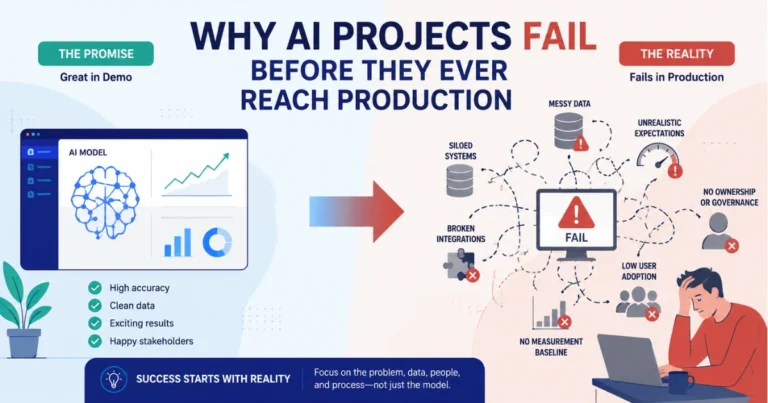
They also avoid optimistic assumptions. Instead of one projection, they model best case, worst case, and something in between. If the project only works under perfect conditions, it doesn’t get approved—which is precisely why 80% of AI projects fail to deliver actual business value.
For anything tied to revenue, they rely on controlled experiments. A/B tests, holdouts, or phased rollouts. That’s how they separate real impact from coincidence.
And once the system is live, they keep tracking. ROI isn’t calculated once — it’s updated as real data comes in.
Where Most Companies Go Wrong
The same mistakes show up again and again, contributing to the AI adoption illusion where businesses think they are transforming but are actually just burning cash:
- Some ignore ongoing costs, especially infrastructure and maintenance.
- Others count “time saved” as immediate savings, even when nothing actually changes financially.
- And revenue attribution is often stretched beyond what the data can support.
None of these issues are technical. They’re just shortcuts.
What Leadership Actually Cares About
When this reaches decision-makers, the conversation usually shifts.
They’re less interested in abstract ROI percentages and more focused on two things:
- How quickly does this pay back?
- How confident are we in these numbers?
A smaller return that’s predictable often wins over a larger one that depends on assumptions. That’s why the strongest business cases don’t just show upside — they show restraint. Conservative estimates, clear measurement plans, and a path to validate everything within the first few months.
The Reality Behind AI ROI
There isn’t a secret formula that top companies are hiding.
It’s the same basic equation anyone can use. The difference is in how seriously they treat the inputs.
- They define benefits narrowly.
- They include every cost.
- They test their assumptions.
- They keep updating the numbers once reality kicks in.
That’s what takes your initiative from a pilot project to a profit engine that actually holds up in a finance review.