
Exploring AI, One Insight at a Time

From Pilot Project to Profit Engine: Making AI Pay Off in the Real World
Quick Answer:
Stop funding science projects. To turn AI into a profit center, enterprises need to kill performative pilots and obsess over API economics, tight workflow integration, and messy legacy data. Ultimately, you must stop trying to build custom foundation models. Instead, buy the API, build the data pipeline, and force every deployment to prove its ROI before it scales.
The AI Adoption Illusion
Everyone is buying AI, but almost nobody is making actual money off it.
Naturally, you see the press releases, the hackathons, and the flashy “innovation hubs.” It looks incredible on a quarterly earnings deck. However, if you dig into the actual production environments, the story gets ugly fast.
In reality, we are looking at a massive, systemic failure in how companies deploy this technology. As we’ve documented in The AI Adoption Illusion: Why Most Companies Are Doing It Wrong, the corporate habit of “innovation theater” is destroying actual progress.
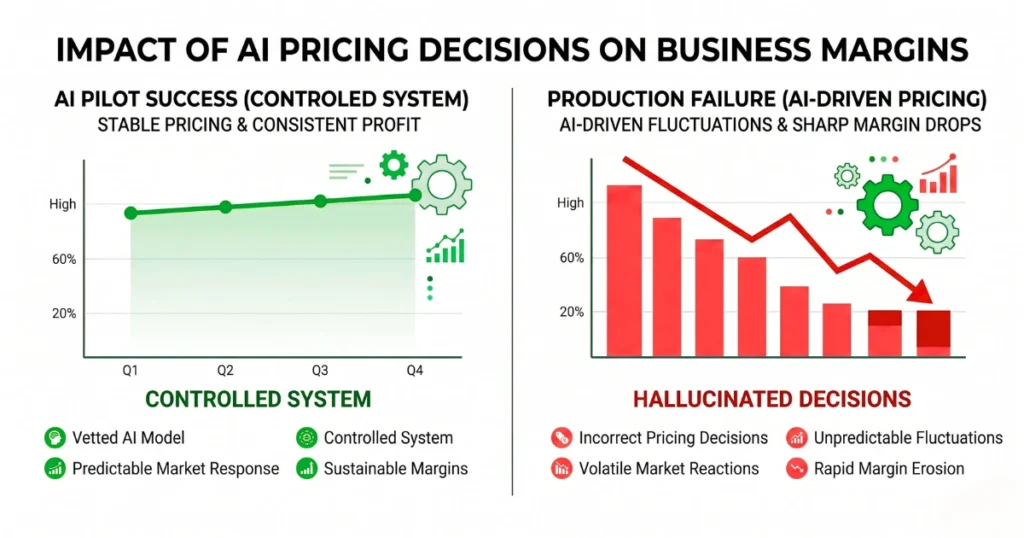
Currently, over 40% of enterprise AI initiatives die within a year. Moreover, nearly half of all proof-of-concepts never even see a production server. Teams build highly controlled, perfectly sanitized sandboxes.
Consequently, they prove the tech works in a vacuum, and everyone claps. Yet, nobody stops to engineer a path back to the actual business—the messy, chaotic workflows where employees actually spend their day.
Ultimately, the gap between a failed pilot and a profitable deployment has nothing to do with parameter counts. It comes down to basic enterprise economics.
How We Tested: The Real-World Methodology
At TheAIAura, we don’t base our research on vendor whitepapers. Instead, we look at the production floor. For this analysis, our methodology included:
- API Burn Audits: We tracked real token consumption over 30 days to map the “token trap”—the exact moment pilot costs explode when hitting production scale.
- Context Stress Tests: We ran 100K+ token payloads to see where models actually drop information, thereby ignoring their advertised limits.
- Integration Benchmarking: We clocked the raw engineering hours required to wire top-tier models into ancient, undocumented ERP and CRM systems.
- Output Audits: Specifically, we scanned for RLHF homogenization—the point where safe, sanitized model outputs become completely useless for specialized business needs.
Core Comparison: Evaluating the Engines
Picking the right model is your first bottleneck. Unfortunately, most companies mismatch the tool to the problem. They buy a Ferrari to commute in rush hour traffic, or a golf cart to run the Baja 500. Here is how the actual capabilities stack up right now across the six vectors that actually matter in production.
Reasoning and The Black Box
The heavyweight frontier models are incredible at complex, multi-step logic. The problem? They absolutely refuse to show their work. For regulated industries like finance, insurance, or healthcare, this lack of transparency is lethal.
If you want to understand why this permanently stalls enterprise scaling, read our deep dive into The “Black Box” Problem: Why We Can’t Audit AI.
Because a compliance officer can’t audit the reasoning pathway, you simply cannot deploy the model without building a massive, expensive semantic layer to babysit every single output.
Coding Context and Agentic Workflows
Having an AI spit out a standalone Python script is a parlor trick at this point. Meanwhile, the real enterprise value is repository-level context. The best developer models today don’t just autocomplete lines of code.
Instead, these tools read your entire, messy, undocumented codebase. From there, the agents spot the weird interdependencies and write code that actually respects your internal security policies rather than hallucinating non-existent open-source libraries.
If your engineering team is trying to build these autonomous workflows, they absolutely need to master the architecture in Building AI Agents That Actually Work: Design Patterns Developers Must Know.
Context Window Realities
Vendors love to brag about their massive, million-token context windows. Do not fall for the marketing. Actually, shoving a gigabyte of unstructured enterprise PDFs into a single prompt is a lazy, mathematically expensive alternative to building a proper data architecture.
We call this The Token Trap: Why “Unlimited Context” is a Lie. The “needle-in-a-haystack” recall degrades much faster than the benchmarks suggest. Therefore, stop relying on context windows to do the job of a vector database. For a detailed breakdown of why this fails, see Fine-Tuning vs. RAG: The $50,000 Mistake.
Speed and Time-to-First-Token (TTFT)
Latency kills user adoption. Period. If an automated customer service agent takes four seconds to start typing, the user drops off and demands a human. Consequently, you have to split your procurement into two strict camps: Depth and Velocity.
Depth models are for slow, heavy compute—asynchronous background work. Conversely, Velocity models are cheap, blazing fast, and strictly for real-time user routing. Mix them up, and your pilot dies.
Multimodal Utility
Processing images, video, and audio natively sounds amazing in a vendor’s keynote presentation. In a B2B enterprise environment, however, the utility is actually quite narrow right now. The highest ROI we see for multimodal isn’t generating marketing videos.
Rather, it resides in automated document extraction—replacing ancient OCR tech for invoice processing—and predictive maintenance, where vision models analyze visual sensor data on a manufacturing floor. (Though if you are on the creative side, the landscape is shifting rapidly, which we cover in Beyond Static Images: The Future of AI in Creative Branding).
The Writing Quality Problem
Most enterprise AI writing sounds like corporate cardboard. It’s safe, symmetrical, and deeply boring. This happens because the models are heavily fine-tuned by their creators to be as harmless as possible.
To get anything usable for external communications or marketing copy, you need models that let you aggressively override their default guardrails via system prompts. This frustrating homogenization is a direct consequence of the issues outlined in RLHF: Who Actually “Aligned” Your AI?.
Performance Benchmarks: Depth vs. Velocity
Stop paying premium prices for basic tasks. Here is exactly how you should segment your procurement.
| Model Tier | Real-World Use Case | Blended Cost (Per 1M Tokens) | Inference Latency | Context Drop-off |
| Heavy (Depth) | Contract analysis, deep code review, architectural mapping. | $10.00 – $15.00 | Slow | Low |
| Standard | Internal RAG search, generic email drafting. | $2.50 – $5.00 | Moderate | Moderate |
| Velocity (Fast) | Chatbot routing, real-time OCR, simple classification. | $0.20 – $0.50 | Instant | High |
The Token Trap: Why Budgets Explode
Here is how projects die. A dev team runs a pilot locally, and it runs great. Next, they get the green light to push to staging, they expand the user base, and suddenly their monthly API bill shoots up by 800%.
As mentioned earlier, we call this The Token Trap: Why “Unlimited Context” is a Lie. Teams get obsessed with using the absolute smartest model available to do incredibly mundane sorting tasks. Eventually, executives see the runaway cloud bill, panic, and pull the plug.
If you don’t map your API burn rate directly to a tangible business ROI—like hours saved or tickets closed—your project is already dead.
Real-World Profit: Where the Math Works
When you strip away the hype and force financial discipline, AI prints money in a few specific areas. However, as noted in The Automation Ceiling: Where AI Actually Stops Adding Business Value, there is a hard limit to what you can automate before returns diminish.
Developers: Codebase Orchestration
Mature teams aren’t using AI just to write functions. Rather, they use it to aggressively pay down technical debt. Specifically, they deploy agents to translate legacy code, map dependencies, and write unit tests for undocumented systems.
If your engineering team is moving in this direction, they need to master Building AI Agents That Actually Work: Design Patterns Developers Must Know.
Retail & Logistics: Predictive Margins
Supply chains are chaotic. Predictive models chew through historical sales data, local weather, and competitor pricing to forecast demand. For example, one major retailer cut out-of-stock events by 30% doing this. That isn’t a vanity metric; that’s billions in saved inventory costs.
Fraud Detection
Banks are seeing the fastest ROI on the market. Real-time pattern detection catches anomalies human reviewers simply cannot see at scale. The best part? The system compounds. As it ingests more transaction data, its accuracy consistently improves month over month.
Marketing: Hyper-Personalization
Batch-and-blast emails are dead. Instead, brands wire CRM data into cheap velocity models to generate thousands of unique, tailored assets in minutes. Ultimately, customers get exactly what they want to see, and lifetime value spikes.
The Build vs. Buy Dilemma
Let’s be clear: 76% of enterprises have no business trying to train a custom foundation model.
| Strategy | The Reality | The Catch | Who should do this? |
| In-House Build | You own the IP and control the architecture. | It takes two years, costs north of $1.5M, and you can’t hire the talent anyway. | High-frequency trading firms, tech giants. |
| Vendor API | You are up and running in six weeks. | You have to obsess over your data privacy agreements. | Literally everyone else. |
The moat isn’t the model anymore. In fact, the model is a commodity. Your competitive advantage is your messy, proprietary internal data. To understand how to leverage this properly, read From MVP to Moat: Turning Your AI Prototype Into a Defensible Product. Simply put: Buy the model. Build the pipeline.
Frequently Asked Questions
Why do so many AI pilots crash and burn?
Because they are built in a vacuum. Teams ignore the massive friction of integrating the new tool with clunky existing workflows. Obviously, if an employee has to log into a separate portal to use the AI, they won’t use it.
What exactly is “innovation theater”?
It’s when a company spends money to look like they are doing AI, rather than doing the hard work to make AI profitable. Think hackathons, press releases, and isolated chatbots that don’t actually touch the core business.
How do we measure if this is actually working?
Kill the technical metrics. Your board does not care about your F1-score. Instead, you need Smart KPIs: How much did customer support ticket volume drop? Did we expand margins? How many hours did we save in the legal department? Tie it to cash.
Do we need to build our own model?
No. Stop trying to compete with billion-dollar compute clusters. Rent the intelligence via API. If you need a blueprint for where to allocate those resources, check our breakdown of The AI Stack Explained: Models, Vector Databases, Agents & Infrastructure in 2026.
Final Verdict: Execution Over Experimentation
The next decade won’t be won by the companies running the most AI experiments. Instead, it will be won by the ruthless pragmatists.
If you are making decisions right now, cut the funding for your vanity projects. Force every deployment to prove its financial worth. Furthermore, stop letting your engineers optimize for raw intelligence, and make them optimize for system architecture.
Ultimately, AI Won’t Replace Your Team — But It Will Replace Your Workflow. If you aren’t integrating, you’re just playing with toys.
Forward-Looking Insight: The 2026 Landscape
Look ahead to the rest of 2026. Very soon, the chat interface is going to feel ancient. As detailed in From Chatbots to Agents: Why 2026 is the Year AI Does the Work for You, we are moving directly into multi-agent systems—clusters of AI that independently plan, execute, and double-check complex tasks.
But here is the catch: you cannot run an agentic system on garbage data. Therefore, if your company refuses to clean up its internal data architecture today, you will be physically incapable of running the autonomous agents of tomorrow.