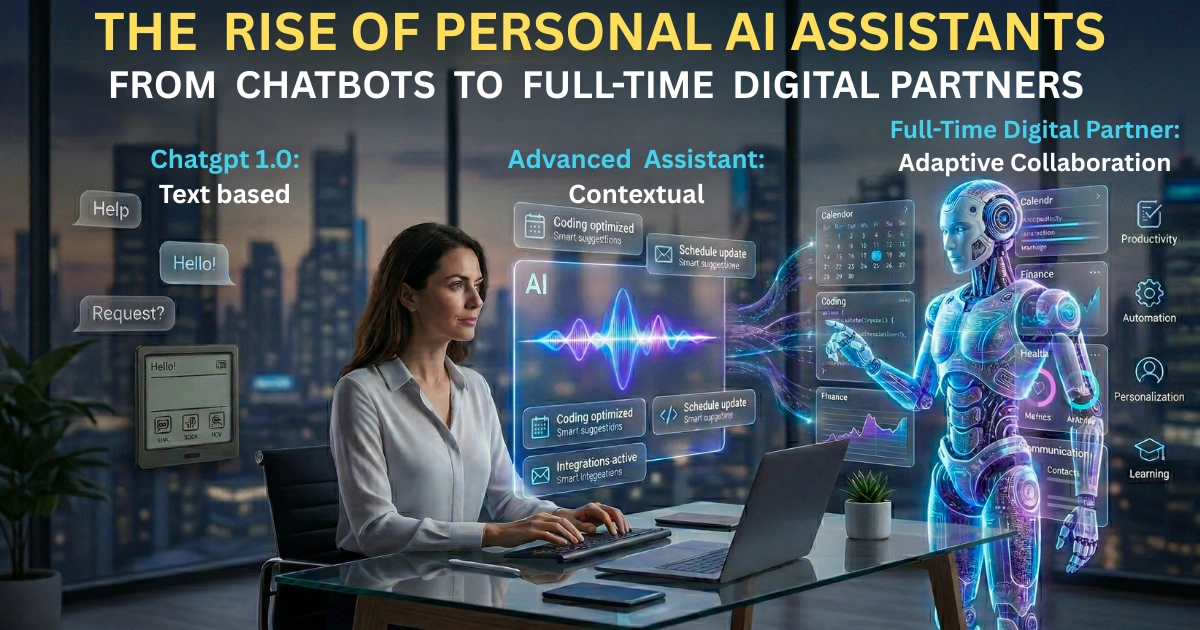
The Rise of Personal AI Assistants: From Chatbots to Full-Time Digital Partners

Quick Answer

The rise of personal AI assistants marks a structural shift from basic chatbots to autonomous agents, transitioning software from a passive tool into an active, collaborative workforce participant.

Modern AI agents leverage persistent memory, cross-platform API access, and advanced reasoning to execute complex, multi-step workflows independently.

Introduction

If you examine the trajectory of enterprise and consumer software, the dividing line is clear: the moment applications stopped waiting for instructions and started initiating workflows. For decades, human-computer interaction was strictly transactional.

We executed a command; the machine complied. Today, that relationship has fundamentally rewired.

We have moved firmly into the era of the personal AI assistant. These are not the fragile, script-bound customer service bots of the 2010s, notoriously trapping users in endless loops of misunderstanding. Instead, they are dynamic systems capable of synthesizing research, drafting production-level code, and orchestrating cross-platform schedules with alarming autonomy.

As we navigate the operational realities of 2026, the novelty of generating text has evaporated. Organizations are actively migrating from experimental deployments to infrastructural ubiquity.

Understanding the mechanics of these digital partners—how to benchmark them, integrate them via APIs, and establish secure operational boundaries—is no longer a peripheral IT concern.

It is the baseline requirement for organizations trying to avoid the AI adoption illusion and survive the modern digital economy.

How We Tested: Our 2026 Evaluation Methodology

To separate architectural reality from vendor marketing, we subjected the current generation of AI assistants to a rigorous, 30-day benchmarking protocol.

  • Context Stress Testing: We evaluated needle-in-a-haystack retrieval across 1-million to 2-million token context windows using massive, unstructured financial datasets.
  • Workflow Orchestration: We tested cross-system autonomy by providing high-level objectives that required the AI to interact with external APIs (GitHub, Jira, Slack, and Outlook) without human intervention.
  • API Economics: We analyzed the cost-to-output ratio, specifically factoring in prompt caching efficiencies and batch processing rates across major model providers.
  • Zero-Shot Reasoning: We measured the models’ ability to correct their own logic when intentionally fed broken code architectures or contradictory scheduling constraints.

Key Takeaway: The defining metric of a modern AI assistant is no longer raw intelligence, but operational reliability—the percentage of tasks an agent can complete before requiring human intervention.

Core Comparison: Evaluating the Modern AI Engine

How Do Modern AI Agents Handle Complex Reasoning?

Early generative models operated on pattern recognition, predicting the next highly probable word. Modern digital partners utilize extended reasoning protocols and adaptive thinking.

When faced with a complex objective, they generate internal chains of thought, breaking tasks down and self-correcting errors before outputting a final response. This has reduced severe logical confabulations by up to 80% compared to legacy models.

What Is the Impact of Expanded Context Windows?

Definition: A context window is the total amount of text, code, or data an AI can hold in its active memory during a single interaction.

Moving from 8K to 2M+ token windows fundamentally changes utility. Instead of summarizing a single article, an assistant can now ingest an entire corporate codebase alongside years of documentation. However, our testing reveals that “active reasoning” degrades slightly near the upper limits of these massive windows.

Strategic data chunking remains necessary, and falling into the token trap of assuming unlimited context often results in degraded performance.

Are They Capable of True AI-Native Coding?

The industry has shifted from autocompleting single lines of code to architectural generation. Modern assistants can take a markdown specification document, scaffold the entire application, and write the unit tests. While they excel at zero-to-one generation, modifying highly abstract, legacy spaghetti code still requires significant human oversight.

How Do Latency and Speed Impact Utility?

Time to First Token (TTFT) dictates user experience. While massive models process deep reasoning tasks, lighter, specialized models (operating at 100+ tokens per second) act as fast-routing triage agents.

The industry standard has shifted toward “agentic routing,” where a fast model determines the intent and delegates complex tasks to a heavier, slower reasoning model.

What Does Native Multimodal Mean in Practice?

Unlike older models that used optical character recognition (OCR) to read images, today’s assistants are natively multimodal.

They process audio waveforms, video frames, and text through the same neural network. This allows an assistant to watch a live screen share, understand user interface navigation, and provide real-time auditory feedback without conversion latency.

Has Writing Quality Overcome the “AI Voice”?

The predictable, symmetrical cadence of early AI—often littered with words like “delve” or “tapestry”—has been engineered out of top-tier models.

Current assistants adapt to specific corporate style guides, demonstrating nuance, mimicking precise authorial tones, and varying sentence structures to evade standard AI detection heuristics.

The Context-Velocity Framework (Original Insight)

To understand deployment, we categorize AI assistants using the Context-Velocity Matrix:

  • High Velocity, Low Context (The Router): Lightweight models used for instant triage, basic email sorting, and rapid data extraction. Highly cost-effective.
  • Low Velocity, High Context (The Architect): Deep reasoning models used for synthesizing quarterly reports, codebase refactoring, and complex strategic planning. Expensive, high latency, but capable of high-level autonomy.

Quotable Insight: “The true value of an AI assistant in 2026 is measured not by how well it answers a prompt, but by how effectively it manages the operational silence between prompts.”

Performance Benchmarks

Feature/CapabilityLegacy Chatbots (Pre-2023)Gen-1 Copilots (2023-2024)Autonomous Digital Partners (2025-2026)
System ArchitectureRule-based, decision treesNext-token prediction, LLMsAgentic workflows, System 2 reasoning
Context MemoryNone (Session resets)Limited (32K – 128K tokens)Persistent & Massive (1M – 2M+ tokens)
Tool ExecutionClosed ecosystem onlyRead-only integrationsRead/Write API access with self-correction
Operational TriggerStrictly user-initiatedUser-initiatedEvent-driven (proactive)
Error HandlingFails and loopsConfabulates / HallucinatesRecognizes missing data, pauses, or searches

Pricing & API Economics

The shift to autonomous agents alters software economics. Instead of paying fixed monthly SaaS licenses per user, organizations increasingly pay for compute utilization.

  • Token Pricing: High-tier reasoning models still command premiums (e.g., $10-$15 per 1 million input tokens), making wasteful loops expensive.
  • Prompt Caching: The most critical economic development in 2026 is prompt caching. By caching massive system instructions and reference documents, developers reduce API costs by up to 80% for repetitive agentic workflows.
  • Batch Processing: For non-urgent tasks (e.g., classifying thousands of daily support tickets), batch APIs allow organizations to run operations overnight at a 50% discount.

Real-World Use Cases

For Developers: AI-Native Engineering

Developers no longer treat AI as a glorified search engine. Using tools conceptually similar to Claude Code or GitHub Copilot Workspace, engineers define the parameters in a terminal, and the AI agent independently navigates the directory structure, reads relevant files, executes code changes, and runs the test suite.

For teams building AI agents that actually work, this means the AI only pauses to ask for human approval before committing to the repository.

For Startups: The Multi-Agent Workforce

Resource-constrained startups are utilizing orchestrator agents to manage entire workflows. A founder can outline a product launch, and the orchestrator spins up subordinate agents: one to draft the technical documentation, one to generate localized marketing copy, and another to scrape competitor pricing data.

For Enterprise: Security-First Knowledge Retrieval

Enterprises are bypassing public models entirely to avoid data exfiltration. They deploy private, fine-tuned models connected to their internal databases via Retrieval-Augmented Generation (RAG). These assistants respect internal access controls, meaning a junior analyst querying the assistant will not see the same financial projections that a C-suite executive does, despite using the exact same interface.

Strengths & Weaknesses of Current AI Assistants

StrengthsWeaknesses
Asynchronous Productivity: Reclaims hours spent on administrative coordination.Brittle Edge Cases: Autonomy fails sharply when APIs change or undocumented errors occur.
Contextual Synthesis: Unmatched ability to summarize unstructured data rapidly.Security Vulnerabilities: Prompt injection attacks can hijack agentic workflows.
Barrier Reduction: Democratizes advanced data analysis and basic software development.Cognitive Offloading: Risk of human operators losing deep domain expertise due to over-reliance.

Frequently Asked Questions (FAQ)

  1. What is the difference between a chatbot and a personal AI assistant?
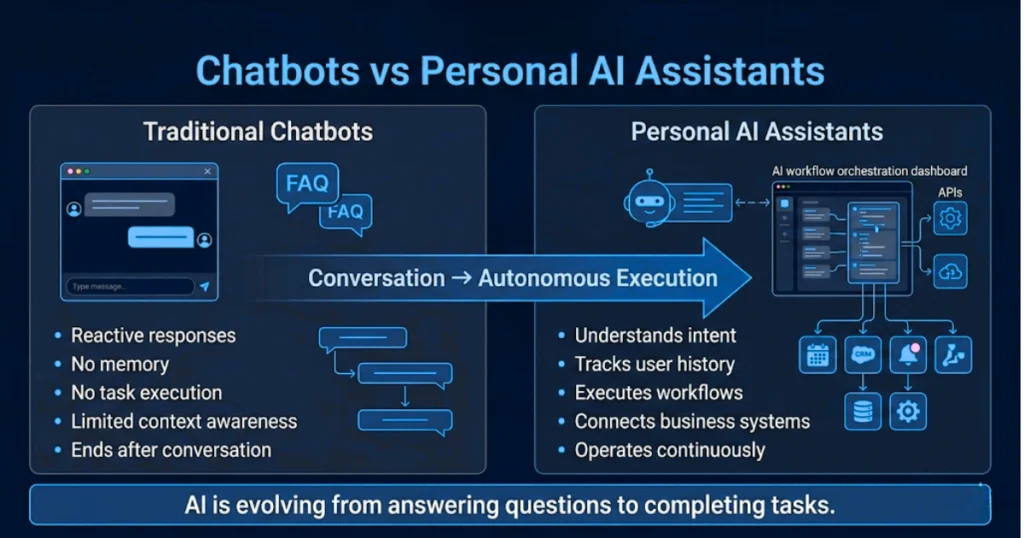
    A chatbot is a reactive, rule-based program designed to answer specific questions within a closed system. A personal AI assistant is an autonomous, API-connected agent that uses persistent memory and reasoning to execute multi-step tasks across different software platforms.
  2. How do AI assistants maintain context across long conversations?
    Modern systems use vector databases and semantic memory frameworks. They continuously index conversation history and user preferences, allowing them to recall specific details from weeks or months prior without needing to be reminded.
  3. Are AI digital partners secure enough for enterprise use?
    When deployed correctly via enterprise-grade APIs with zero-data-retention policies, yes. However, out-of-the-box consumer models pose significant risks if used to process proprietary or sensitive corporate data.
  4. What is “event-driven autonomy” in AI?
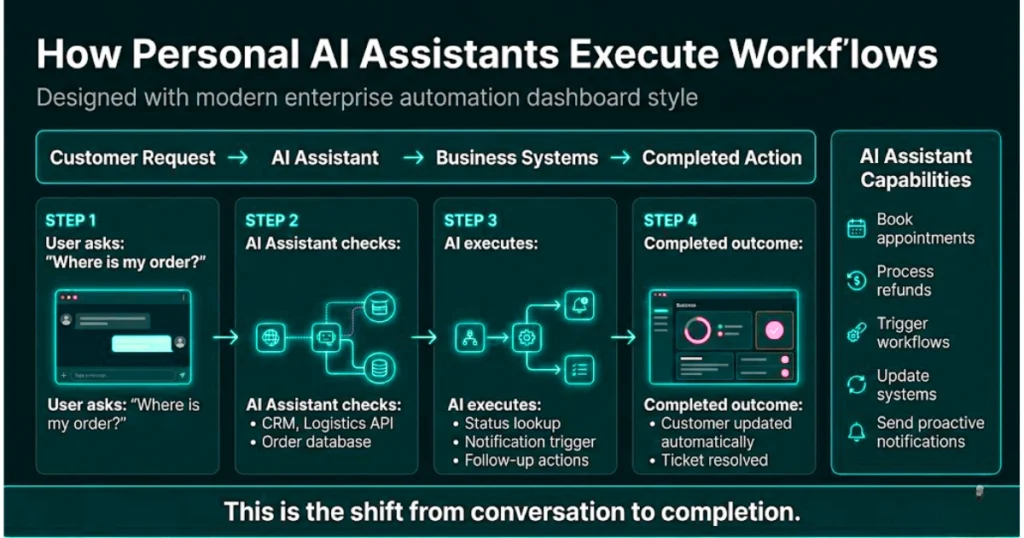
    Event-driven autonomy means the AI does not wait for a user prompt. It is triggered by system events—such as a specific email arriving or a metric dropping below a threshold—and autonomously executes a predefined workflow to address the event.
  5. Will AI assistants replace project managers?
    No. AI won’t replace your team—but it will replace your workflow. They will automate the administrative tasks associated with project management (status chasing, schedule syncing, ticket updating), which forces human project managers to pivot toward strategic alignment, stakeholder management, and complex problem-solving.
  6. How can I reduce the cost of running API-based AI agents?
    Utilize a cascading model strategy: use cheap, fast models for routing and basic extraction, and reserve expensive reasoning models only for complex synthesis. Additionally, implement prompt caching for static system instructions.

Final Verdict & Recommendations

The utility of a personal AI assistant depends entirely on user integration and technical maturity.

  • For Individual Professionals: Transition from web-based chat interfaces to integrated desktop copilots. Establish strict boundaries—use the AI to build frameworks, synthesize data, and format output, but never outsource critical thinking or final review.
  • For Startups and SMBs: Adopt a multi-agent approach immediately. The leverage gained by automating routine marketing, coding, and scheduling tasks is the definitive competitive advantage in the current market. Focus on open-source frameworks to maintain flexibility.
  • For Enterprise: Prioritize data governance over raw capability. Deploy RAG-enabled internal assistants that respect organizational permissions. Treat the AI as an augmentation tool for high-value employees, not a cheap replacement for entry-level labor.

Forward-Looking Insight: The 2026 Landscape and Beyond

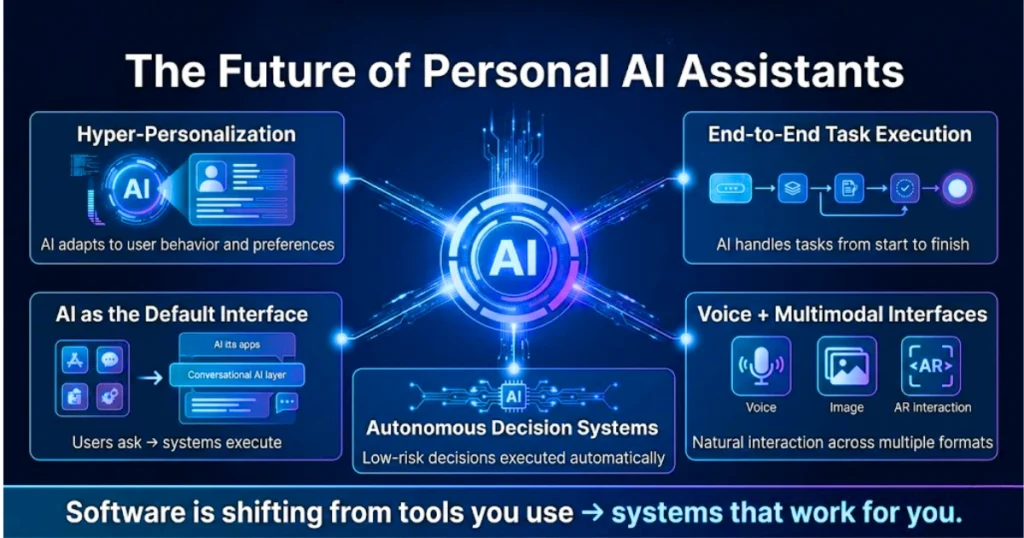
As we look toward 2027, the interface itself is dissolving. We are shifting toward ambient computing, where digital partners operate continuously in the background through wearables and passive audio inputs.

The challenge will no longer be teaching machines how to speak human languages but rather designing governance frameworks robust enough to manage autonomous systems that possess direct read-and-write access to our financial, operational, and social lives.

Key Takeaway: The professionals who will thrive in this environment are those who cultivate “change fitness”—treating AI not as an infallible oracle, but as a highly capable digital colleague that requires clear delegation, rigorous auditing, and strategic oversight.

Pradeepa Sakthivel
Pradeepa Sakthivel
Articles: 23

Leave a Reply

Your email address will not be published. Required fields are marked *