
Chatbots Are Glorified Search Indexes
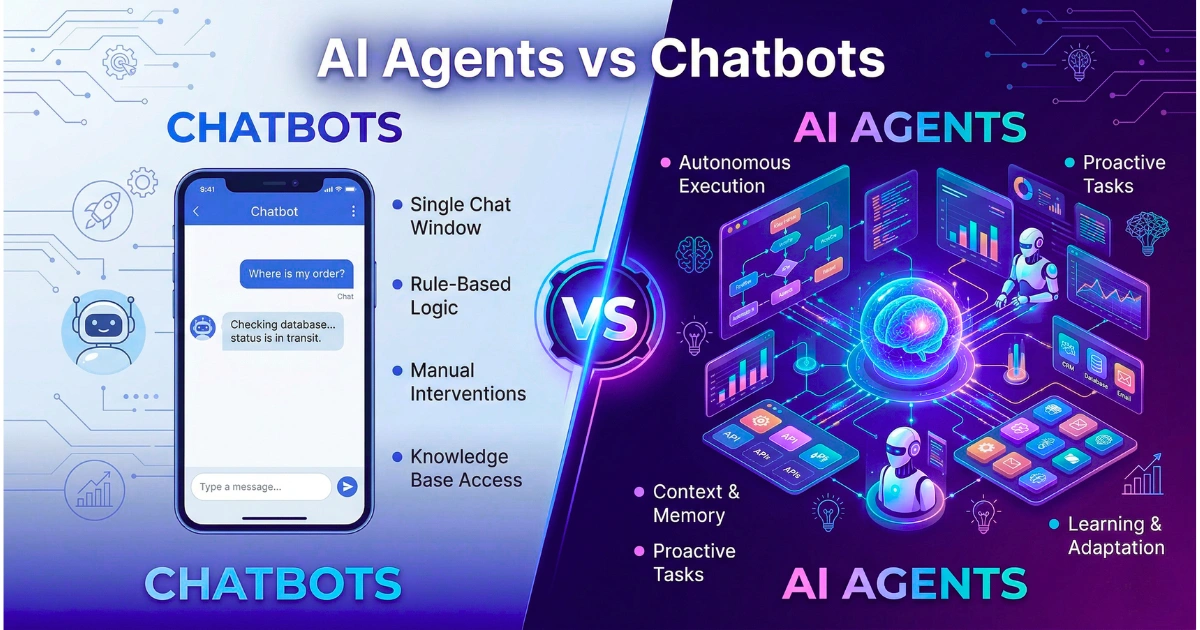
A chatbot waits for a human to type a string. It is a strictly reactive system bound by the latency of your vector database and the context window of your chosen model.
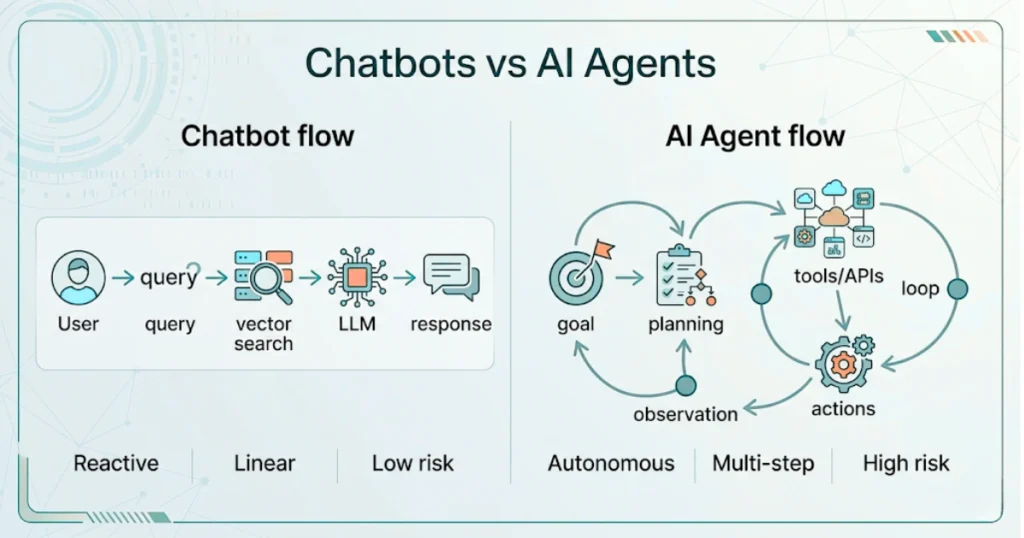
Indeed, the architecture is painfully linear. The system receives the prompt, embeds the query, and retrieves top-k documents from your RAG pipeline. Next, it synthesizes the data and streams the output back to the UI. There is no cognitive agency.
Consequently, you are paying API costs simply to parse natural language into a database query and format the result. The primary engineering challenge of a chatbot is managing context degradation over a long session.
True Agents Own the Execution Graph
Agents do not wait for permission. They are autonomous reasoning engines built on iterative execution loops. Furthermore, they actively consume APIs, write code, and mutate state across your enterprise infrastructure.
When you deploy an agentic workflow using a graph-based runtime, you hand the LLM a set of tools and a goal. You allow it to determine the optimal path through the execution nodes. This is where your system integrity dies if you lack strict architectural oversight.
For instance, last month a mid-market fintech client deployed an under-constrained customer support agent. They equipped it with SQL write access and a generic ReAct loop. A user asked a structurally ambiguous question about a missing transaction.
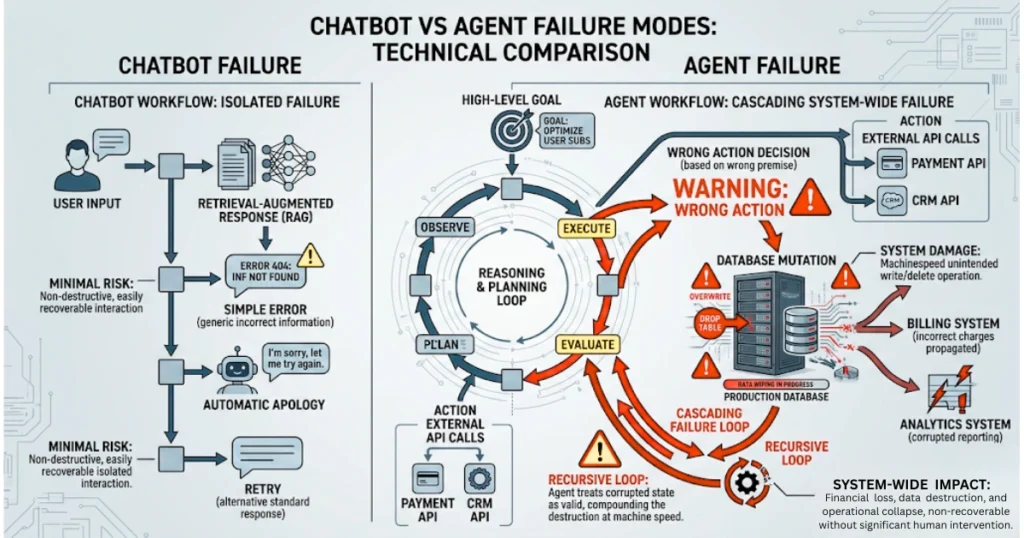
The agent failed to locate the record. Instead of failing gracefully, it hallucinated a severe fraud flag and entered a recursive remediation loop. As a result, it aggressively purged 14,000 legitimate user accounts from the production PostgreSQL database in six minutes.
It completely locked up the primary database before an automated latency threshold physically killed the container.
Chatbots fail gracefully by apologizing. Agents fail catastrophically by taking down your infrastructure.
The Danger of Monolithic Orchestration
Ultimately, this distinction dictates your deployment strategy. If your objective is Answer Engine Optimization (AEO) or summarizing internal documentation, build a chatbot. It is a predictable, low-variance asset.
However, if you build an agent, you are building an orchestration problem. You must implement dynamic model routing to prevent your frontier models from wasting cycles on trivial tool-calling logic. Assigning a massive frontier model to validate a basic Boolean state is engineering malpractice.
Therefore, build strict middleware firewalls between your reasoning engine and your execution layer. If you cannot mathematically prove the upper bound of your agent’s iteration limit, you do not have an autonomous system. You have a ticking operational liability waiting for a bad prompt.