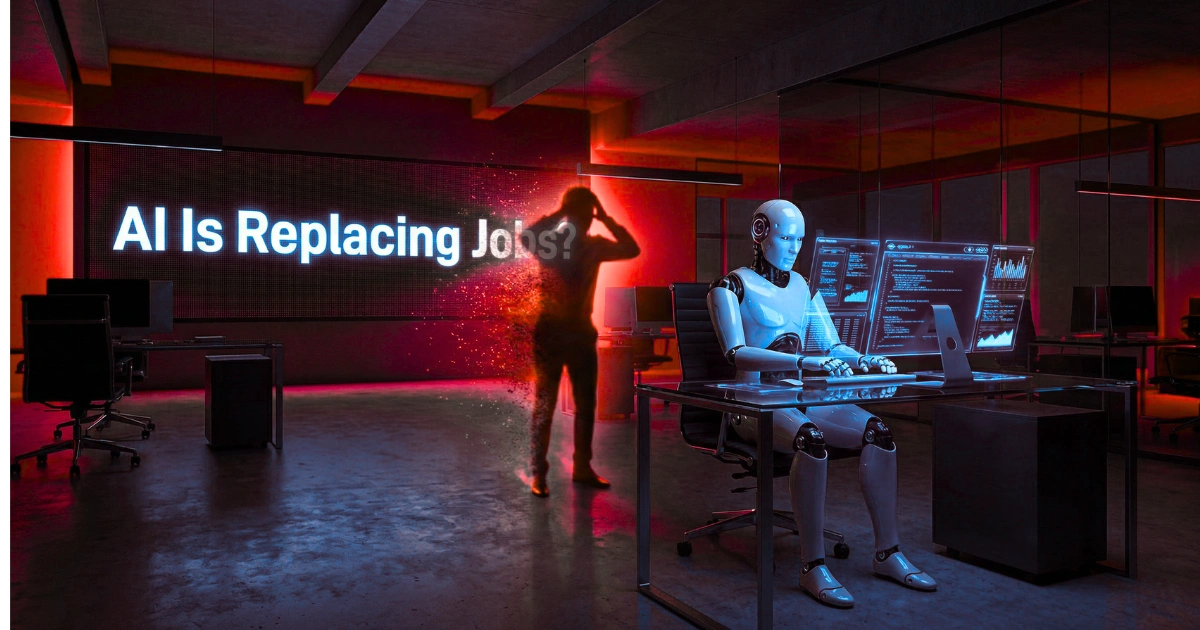

Work isn’t just evolving—it’s being restructured at the system level.
The shift most companies still underestimate isn’t from humans to AI tools. It’s from human-driven workflows to AI-driven execution systems.
Chatbots were the entry point. Autonomous agents are the takeover layer.
By 2026, businesses aren’t asking: “How can AI assist employees?”
They’re asking: “Which parts of the business can run without them?”
The New Definition of Work: From Tasks to Outcomes
For years, AI in the workplace meant:
- Writing emails
- Generating reports
- Answering support queries
That phase is over. Today’s systems don’t just generate—they execute.
Autonomous AI agents can:
- Interpret goals
- Plan multi-step workflows
- Interact with tools (CRM, ERP, APIs)
- Execute tasks end-to-end
- Escalate only when necessary
This isn’t augmentation anymore. It is an operational replacement for your workflow rather than just individual tasks.
From Chatbots to AI Employees
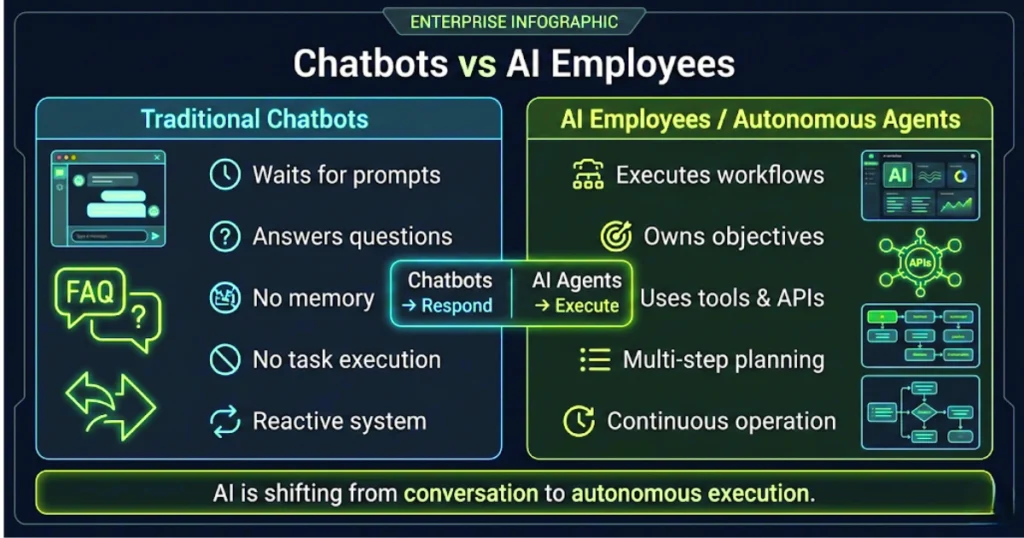
Traditional AI tools were reactive. You asked → they answered.
Autonomous agents operate differently:
- They own objectives
- They take initiative
- They complete workflows
Think less “assistant” and more junior operator that never sleeps.
Example Shift
Old model: Employee pulls data ➔ Writes report ➔ Sends email
New model: AI agent monitors systems ➔ Generates report automatically ➔ Sends insights to stakeholders ➔ Flags anomalies for review
The human is no longer doing the work. They’re overseeing the system.
Why Companies Are Replacing Roles (Not Just Tasks)
The driver isn’t hype. It’s economics. AI agents eliminate what companies call:
“Work about work”
- Copying data between tools
- Writing summaries of summaries
- Manual coordination across teams
These are not high-value activities—but they consume most of the workforce’s time.
What changes in 2026
- Work shifts: from execution → orchestration
- Employees shift: from doers → decision-makers
- AI shifts: from tool → workforce layer
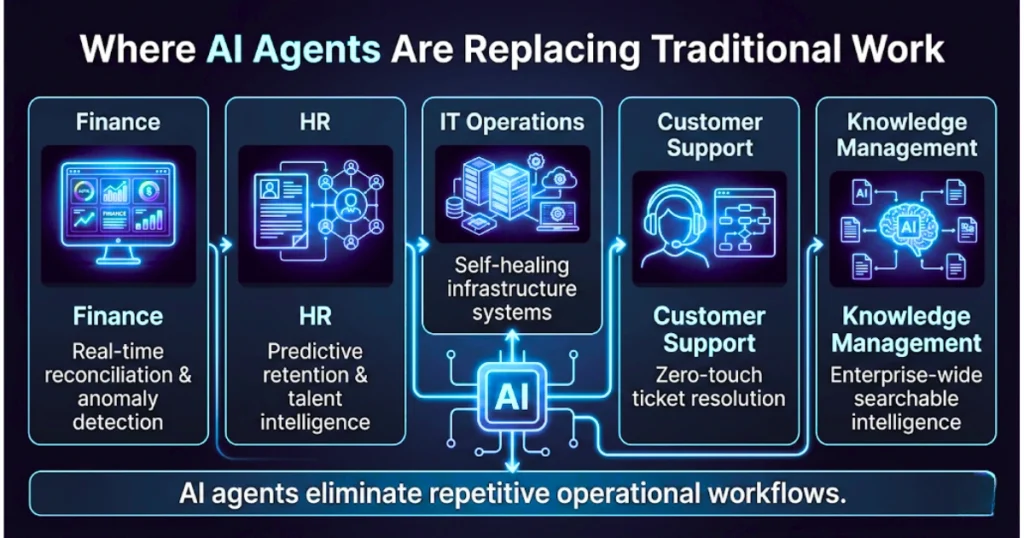
Where AI Employees Are Already Taking Over
This isn’t theoretical. It’s already happening across core business functions.
1. Finance: From Monthly Close to Continuous Intelligence
- Traditional: Manual reconciliation, delayed reporting, end-of-month chaos.
- Now: AI agents ingest and reconcile data in real-time, detect anomalies instantly, and maintain a continuous financial close.
- Decision-making moves from weeks → minutes
2. HR: From Resume Screening to Predictive Retention
AI agents now analyze employee behavior and engagement to predict attrition risk and map hidden skills across teams. Instead of reacting to resignations, companies:
- prevent them before they happen
3. IT Operations: Self-Healing Systems
Instead of waiting for tickets, AI detects performance issues, diagnoses root cause, and fixes the problem automatically. Most issues are resolved:
- before the employee even notices
4. Customer Support: From Response to Resolution
Chatbots answered questions. AI agents access order data, process refunds, update systems, and close tickets. End result:
- Zero-touch support workflows
5. Knowledge Management: The “Corporate Brain”
Companies sit on massive unused data: Emails, Slack threads, Docs, and Meeting transcripts. AI agents now index everything, understand context, and retrieve answers instantly. This turns scattered data into:
- real-time institutional intelligence
The Hidden Advantage: Unlocking “Dark Data”
Over 50% of enterprise data is unstructured and unused. Autonomous agents change that. They:
- Extract insights from conversations
- Identify trends
- Surface decisions from past discussions
What used to be buried is now: searchable, usable, actionable.
The Productivity Shift: From Effort to Output
Companies invested in technology for decades—but productivity didn’t scale equally. That’s the productivity paradox.
AI agents solve it by removing friction between Thinking, Execution, and Systems.
- Before AI Agents: Idea → manual execution → delays
- After AI Agents: Goal → system executes → human reviews
The new skill isn’t doing the work. It’s defining the outcome.
The Real Impact: Organizational Flattening
AI doesn’t just replace tasks. It reshapes org structure.
- Fewer coordination layers
- Less middle management overhead
- More autonomous contributors
Some companies are already planning to flatten hierarchies using AI systems. Why? Because AI handles reporting, monitoring, and coordination. Humans focus on strategy, creativity, and decision-making.
The Risks Nobody Can Ignore
Autonomous systems introduce new risks.
- Data Exposure: If AI systems process sensitive data through unsecured pipelines, you risk IP leakage and severe data breaches.
- Bias at Scale: AI can amplify flawed historical decisions faster than humans ever could.
- Over-Automation: Giving agents full control without guardrails can trigger incorrect actions and create cascading failures.
The Fix: Controlled Autonomy
The winning companies are not giving AI full freedom. They’re building reliable AI systems where:
- AI executes → humans approve
- AI suggests → humans decide
- AI escalates → humans intervene
This is called: Human-in-the-Loop (HITL)
The New Workforce Model
The future isn’t humans vs AI. It’s Human + AI Agent Systems. AI handles scale, speed, repetition. Humans handle judgment, ethics, strategy.
The Role Shift:
- Old roles: Analyst, Coordinator, Operator
- New roles: AI orchestrator, Workflow designer, Decision controller
How to Transition (Without Breaking Your Business)
- Identify bottlenecks: Look for repetitive workflows, multi-system tasks, and manual coordination.
- Add agents to execution layers: Don’t replace everything at once. Start with finance ops, support workflows, or internal reporting.
- Add guardrails: Implement approval systems, audit logs, and access control.
- Keep humans in critical paths: Especially for financial decisions, hiring, and customer impact.
- Scale gradually: Expand only after measurable ROI and stable workflows.
The Rise of the AI-Orchestrated Company
The companies winning in 2026 are not the ones using AI tools. They’re the ones building AI-operated systems where workflows run automatically, data flows seamlessly, and decisions happen faster.
Final Thought
AI employees aren’t replacing humans entirely. They’re replacing inefficient systems built around human limitations.
The real question is no longer: “Will AI take jobs?” It’s: “Which parts of your business are still waiting to be automated?”
Bottom Line
- Chatbots answered
- AI agents execute
- Businesses that adapt win
The shift is already happening. You can either: Compete with AI Or Learn to run systems powered by it.