

I burned through a genuinely embarrassing number of hours this year trying to keep up with AI on YouTube, half of it useful, half of it fifteen-minute videos that could’ve been a tweet.
What’s below is what actually survived my subscription list after that filtering, ranked by how much I actually learned versus how much time I lost watching someone react to a benchmark chart. If you only have time to add three, I’ve flagged which three I’d pick.
The Quick Comparison
| Channel | Best For | What Actually Stands Out | Watch Time Per Video |
| Andrej Karpathy | Understanding how models really work | Builds GPT and backprop from scratch, live, on screen | 1-3 hours |
| StatQuest | Getting unstuck on the math | Slow, deliberate, never assumes you already know the term | 10-20 minutes |
| Yannic Kilcher | Honest paper reviews | Says out loud when a paper’s claims don’t hold up | 30-60 minutes |
| Two Minute Papers | Fast research overview | Shows the actual output, not just the abstract | 5-8 minutes |
| Sentdex | Coding without shortcuts | Builds things without hiding behind a library | 15-40 minutes |
| AI Jason | Building agent workflows | Real automations, not toy chatbot demos | 15-25 minutes |
| AssemblyAI | Clean technical crash courses | Rare for a company channel: barely sells anything | 10-20 minutes |
| DeepLearning.AI | Structured, ground-up learning | Andrew Ng’s Coursera rigor, free on YouTube | 10-30 minutes |
| AI Explained | Weekly model and news roundups | Tests models directly instead of trusting the press release | 20-40 minutes |
| Matt Wolfe | Discovering new tools fast | Screen-shares the actual tool instead of just describing it | 10-15 minutes |
Andrej Karpathy
If I had to pick one channel to actually understand what’s happening inside a language model instead of just using one, this is it. Karpathy built GPT itself before he started teaching it, and it shows.
Every video feels less like a tutorial and more like sitting next to someone while they think out loud.
The catch is real: his “build from scratch” sessions run one to three hours, and you can’t skim them the way you can skim most YouTube content.
I’ve restarted his tokenizer video twice because I tried to half-watch it while doing something else and just lost the thread completely. Block out real time for this one.
StatQuest
Josh Starmer’s whole channel exists because most math explanations assume you already understand the thing they’re explaining. StatQuest doesn’t do that, and it moves slowly enough that I’ve actually recommended it to people who told me they “just don’t get” statistics.
The trade-off is pace: if you already have a stats background, some of the early videos in a series will feel like they’re stalling. Stick with it anyway, because the payoff videos on things like PCA and transformer attention are worth the slow build-up.
Yannic Kilcher
Kilcher is the one channel on this list I’d trust to tell me a hyped paper is actually mediocre. Most research-summary content is uncritically enthusiastic because enthusiasm gets more views, and Kilcher just isn’t.
He’ll point out a sloppy baseline comparison or an inflated claim on camera without much diplomacy about it.
That bluntness is exactly why I keep watching. It also means his videos run long and occasionally get into open-source community drama that isn’t strictly technical content, so skip ahead if that’s not what you’re there for.
Two Minute Papers
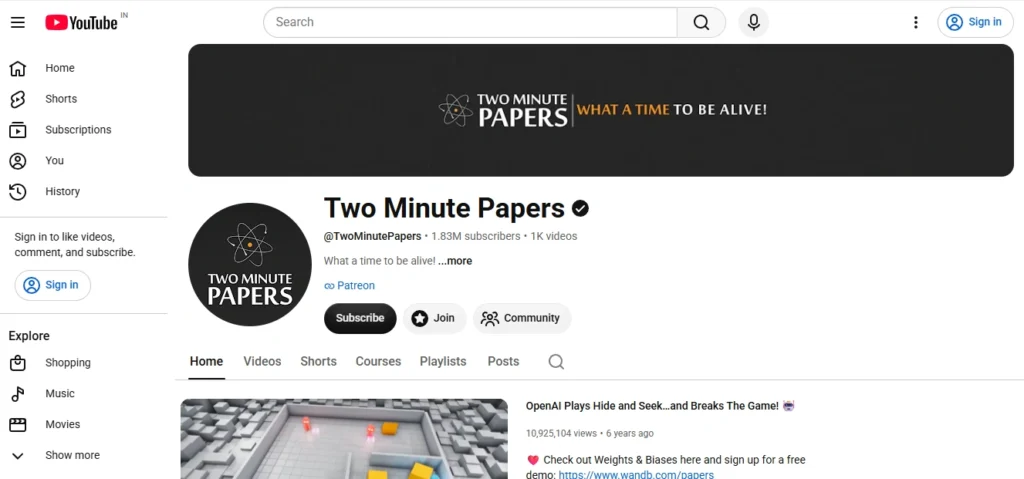
This is the one I put on when I have eight minutes and want to know what happened in AI research this week without committing to anything.
Károly Zsolnai-Fehér shows the actual visual output of new models, physics simulations, generative video, robotics, rather than just narrating a paper’s abstract, which makes it genuinely useful for spotting what’s worth digging into further.
It’s not deep, and it’s not meant to be. Think of it as a research trailer, not the movie.
Sentdex
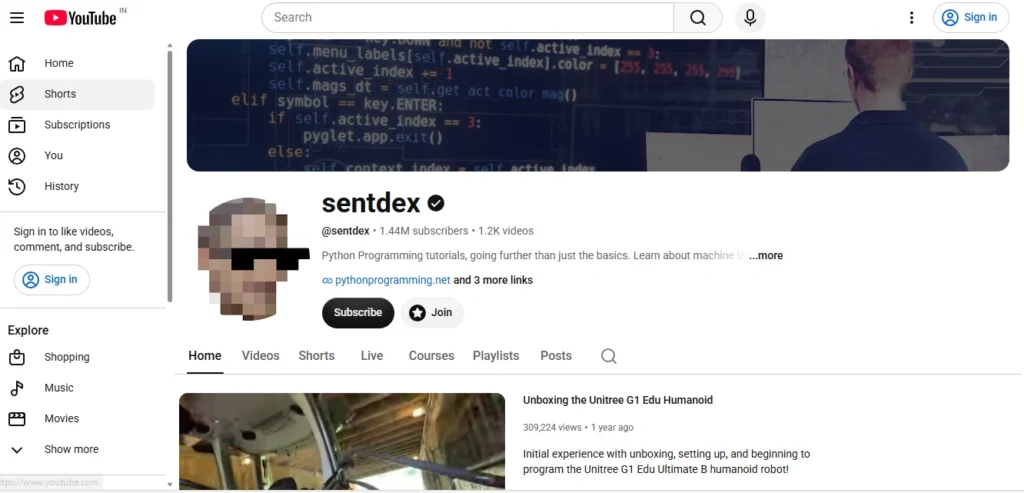
Harrison Kinsley’s channel has been around long enough to remember when “machine learning tutorial” meant importing a library and calling one function. Sentdex still builds things the harder way—from-scratch neural networks, custom reinforcement learning setups—which forces you to actually understand what’s happening instead of trusting a black box.
It’s slower to get to a working result than most tutorials, which is either the whole point or a dealbreaker depending on what you’re trying to do that afternoon.
AI Jason
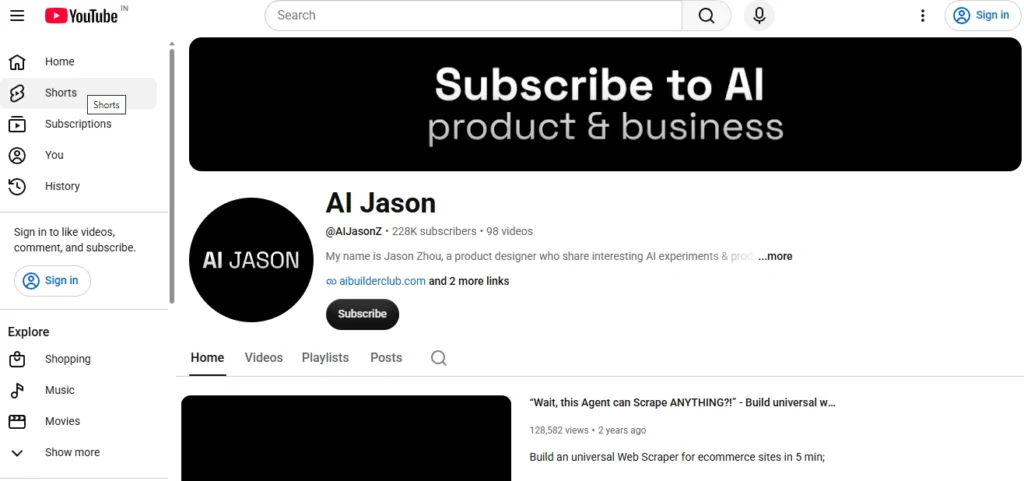
Most “build an AI agent” content on YouTube is a toy chatbot wearing a business suit.
AI Jason is one of the few channels that actually builds workflows resembling something a real company would use—multi-agent pipelines, RAG systems tied to real data sources, automations that do more than answer a question.
It moves fast and assumes you’re comfortable enough to follow along without every step spelled out, so it’s not the gentlest entry point if you’re brand new to building anything.
AssemblyAI
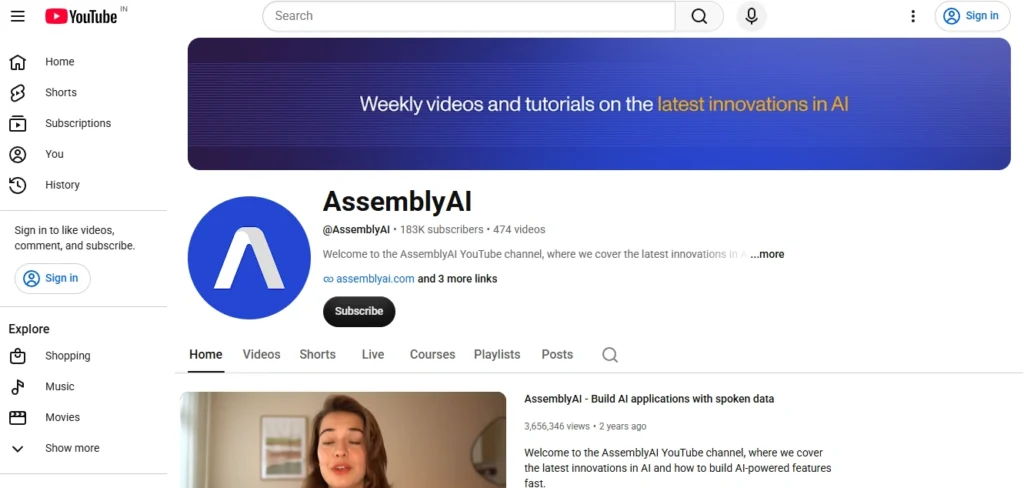
I went in expecting a thinly disguised product demo, since it’s a company channel, and came away recommending it anyway.
Their crash courses on vector databases and RAG pipelines are genuinely clean, well-produced, and light on the sales pitch, which is rarer than it should be for a channel with a product to sell.
The content skews toward their own area of strength, speech and audio models, so it’s not your one-stop shop, but what it does cover, it covers well.
DeepLearning.AI
Andrew Ng’s channel is the closest thing on this list to an actual course rather than a video. It’s structured, it builds on itself in order, and the “AI Heroes” interviews are a good way to hear how the people who actually built this field think about where it’s headed.
It’s also the least exciting channel here in the best possible sense—no hype, no drama, just a curriculum. If you want structure over stimulation, start here.
AI Explained
Every AI channel claims to cut through the hype. This one actually does, mostly by running new models through genuinely hard reasoning tests instead of repeating whatever the launch blog post claimed.
The weekly roundups are dense enough that I sometimes need to pause and rewatch a section, which is either a compliment or a warning depending on how much attention you have left in your week.
Matt Wolfe
This is the discovery layer, not the depth layer. Wolfe screen-shares new AI tools as they launch, which is genuinely the fastest way I’ve found to hear about something useful before it shows up in five other newsletters.
Don’t expect technical rigor here, expect a fast, honest first look at whether a new tool is worth your time, which is its own kind of useful.
Ten channels is more than anyone actually keeps up with weekly. If you’re starting from zero, Karpathy and StatQuest together will teach you more than any paid course I’ve seen. If you’re already building things, AI Jason and AI Explained will keep you moving faster than reading everything yourself ever could.
Source: KDnuggets, "10 YouTube Channels Keeping You Ahead in AI"