
According to KDnuggets, AI engineering sits at the intersection of software development, machine learning, and generative AI. In this role, you rarely train massive foundation models from scratch. Instead, the job is about making existing models useful wiring them into applications and automated workflows.
This involves handling model APIs, vector databases, retrieval-augmented generation (RAG), and model deployment. You might design agents that execute tools, automate business processes, or coordinate with one another.
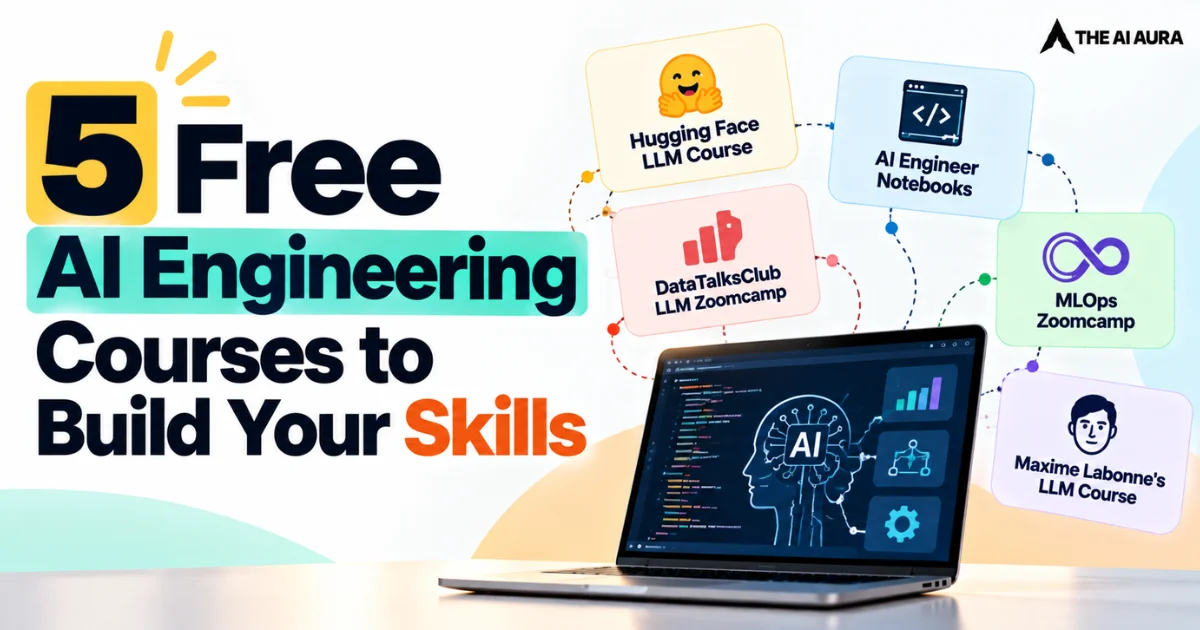
The barrier to entry is lower than it looks. You don’t need an expensive bootcamp to pick up these skills. Below is a progressive learning path made up of five free, open-source courses, ordered from foundational concepts to advanced optimization.
Quick Comparison
| Course Name | Difficulty | Core Focus | Best For |
| Hugging Face LLM Course | Beginner to Intermediate | Transformers, tokenization, datasets, fine-tuning | Building a baseline understanding of how LLMs operate. |
| AI Engineer Notebooks | Intermediate | RAG, agents, tool calling, raw API building | Developers who want framework-free, hands-on practice. |
| LLM Zoomcamp | Intermediate | Vector search, evaluation, monitoring, orchestration | Learning how to piece components into end-to-end applications. |
| MLOps Zoomcamp | Intermediate | Deployment, CI/CD, MLflow, pipelines | Engineers moving models from local experiments to production. |
| Maxime Labonne’s LLM Course | Intermediate to Advanced | Quantization, DPO, QLoRA, model merging | Deep-diving into optimizing and fine-tuning open-source models. |
1. Hugging Face LLM Course
If you are new to large language models, start here. This course breaks down how Transformers actually work before introducing the Hugging Face ecosystem, including Datasets, Tokenizers, and Accelerate.
You get hands-on practice fine-tuning pretrained models, curating datasets, and working with classical NLP tasks. It requires solid Python skills and serves as a necessary prerequisite before you start messing with complex agent workflows.
2. AI Engineer Notebooks
Once you understand the basics, this GitHub repository offers a highly practical, framework-free approach. Rather than relying on heavy abstractions, these notebooks teach you how to build agent loops, tool calling, and RAG pipelines using raw API calls.
Running primarily on the free Groq API with optional Colab GPU exercises for tasks like LoRA fine-tuning it forces you to understand exactly what is happening behind the scenes of higher-level frameworks.
3. DataTalksClub LLM Zoomcamp
Knowing how to make an API call is different from building a resilient application. This project-driven course focuses on building complete LLM systems.
You step through agentic RAG, vector search, and orchestration, while also covering critical production elements like evaluation and monitoring. By the end of it, you will see how retrieval, agents, and system monitoring fit together in a real-world application.
4. MLOps Zoomcamp
Building a model is only half the battle; the rest is keeping it running. Also from DataTalksClub, this course shifts focus entirely to operations. You learn experiment tracking with MLflow, workflow orchestration, CI/CD, and how to deploy and monitor systems reliably.
It assumes you already know your way around Python, Docker, and command-line tools. This is where you learn how to take an experimental pipeline and build scalable AI systems that don’t fail in production.
5. Maxime Labonne’s LLM Course
This is the deep end. Labonne’s course is built for those who want to tear apart open-source models and optimize them. The curriculum covers advanced fine-tuning (QLoRA, DPO), quantization (compressing models into formats like GGUF to make them run faster), and model merging.
Using tools like Unsloth and Axolotl, it is a highly technical track focused entirely on getting maximum performance out of open-source weights.
A logical way to tackle this is to start with Hugging Face for the theory, use the Notebooks and LLM Zoomcamp to build functional applications, rely on the MLOps Zoomcamp to learn how to host them safely, and finish with Labonne’s course to master advanced model optimization.
Even with AI coding assistants writing boilerplate, engineering fundamentals remain non-negotiable. You still need to understand system architecture to debug failures, monitor deployments, and fix things when they inevitably break.
AI accelerates the process, but the ability to take a concept all the way to a stable production environment is what makes you a competent engineer.