Exploring AI, One Insight at a Time

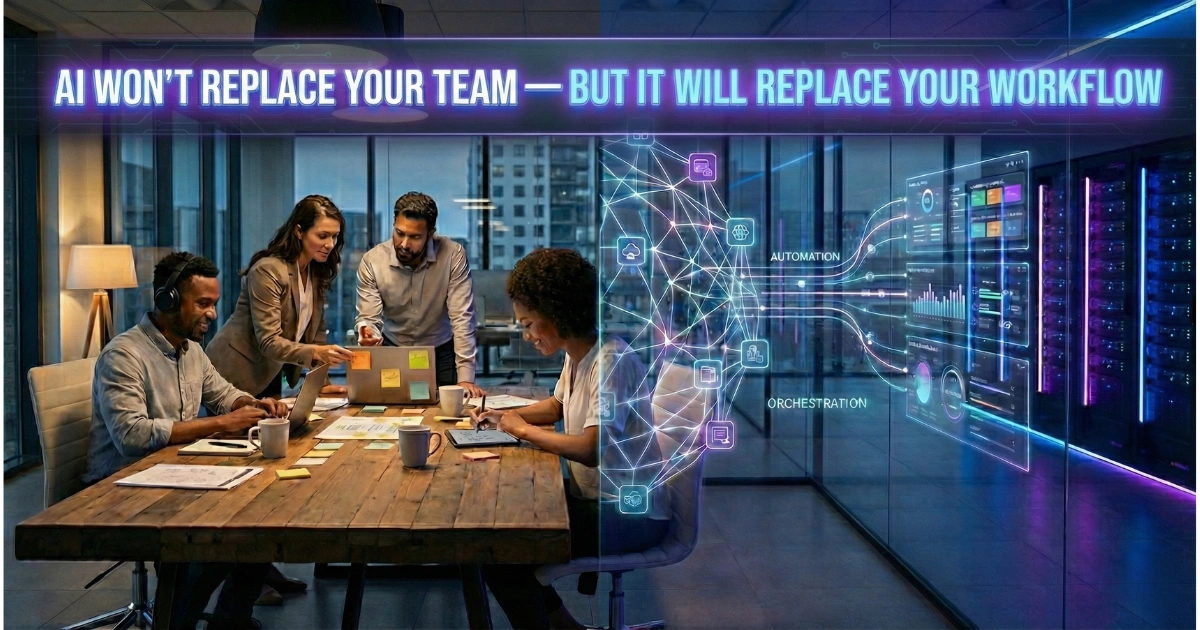
AI Won’t Replace Your Team — But It Will Replace Your Workflow: A 2026 Enterprise Analysis

Quick Answer:
The current enterprise AI shift isn’t about mass job replacement; it’s about structural workflow redesign. While large language models cannot replicate human strategy or relationship-building, multi-agent orchestration systems are dismantling legacy, linear tasks.
Companies adapting to intelligent, AI-routed workflows will inevitably outcompete those relying on static task automation.
Introduction: The Misguided Narrative of Mass Displacement
The discourse surrounding artificial intelligence in the corporate sphere has been dominated by a singular, persistent anxiety: the impending obsolescence of the human workforce.
Every few months, a new startup captures headlines by declaring it has engineered a system capable of replacing elite management consulting firms or automating entire departments out of existence.
This narrative incorrectly frames strategy, operational management, and creative execution as mere exercises in data optimization—functions an algorithm can supposedly execute better than a human.
This narrative collapses under rigorous technical scrutiny. Artificial intelligence is not a strategist, a relationship builder, or an ethical arbiter.
It is, however, an incredibly powerful orchestration tool. Understanding The Automation Ceiling: Where AI Actually Stops Adding Business Value is critical for leadership teams trying to separate marketing noise from operational reality.
The genuine disruption within modern enterprises does not lie in the elimination of jobs, but in the total reconstruction of business operations. A job is a complex bundle of responsibilities, domain expertise, and contextual judgment.
A workflow is a sequence of discrete tasks, routing logic, and data handoffs. AI is not replacing the team; it is replacing the brittle, highly manual workflows that teams have historically been forced to navigate.
How We Tested: Methodologies & Architecture
To separate structural reality from vendor hype, we bypassed standard consumer chat interfaces. Instead, we evaluated 15 distinct enterprise workflow architectures across local development environments and cloud-hosted deployments.
Our testing focused on:
- Multi-Agent Orchestration: Deploying frameworks to manage complex, multi-step business logic.
- API Economics: Tracking token consumption and latency under sustained, concurrent loads typical of a Series B startup scaling its operations.
- Contextual Stress Tests: Feeding messy, unstructured enterprise data (inconsistent PDFs, raw server logs) into routing pipelines to measure failure rates and error recovery.
We found that organizations measuring AI success purely by the raw capabilities of a base model are looking at the wrong metric. Success dictates evaluating the resilience of the surrounding architecture.
The Workflow Revolution: Deconstructing Business Operations
Historically, enterprise workflows accumulated organically. A simple client onboarding process often degrades into a convoluted sequence of spreadsheet updates, redundant approvals, and manual data entries.
For the past decade, organizations attempted to solve these inefficiencies using Robotic Process Automation (RPA). While RPA excels at structured, high-volume manual work, it is strictly deterministic. It breaks down entirely when confronted with unstructured data or contextual ambiguity.
The current shift moves from traditional task automation to AI-driven process orchestration, a transition we detail thoroughly in From Chatbots to Agents: Why 2026 is the Year AI Does the Work for You.
An intelligent workflow can interpret unstructured data—such as a uniquely formatted vendor invoice—recognize patterns and make context-dependent routing decisions.
Takeaway: The shift from RPA to Intelligent Automation marks the transition from systems that simply execute rules to systems that actively interpret context.
What is the Depth vs. Velocity Routing Framework?
We categorize AI workflow implementation through our Depth vs. Velocity Routing Framework:
- Velocity Routing (High Speed, Low Complexity): Utilizing smaller, highly targeted models to instantly route inbound data, classify support tickets, or extract entities.
The goal is millisecond latency and minimal API costs. (For a deeper dive into this architectural choice, see Specialized vs. Generalist AI: Which Model Wins the Generative War?). - Depth Routing (High Complexity, High Compute): Orchestrating heavier frontier models through iterative loops (flow engineering) for deep reasoning tasks like codebase refactoring or financial anomaly detection. The goal is accuracy over speed.
Core Comparison: Direct Prompting vs. Agentic Workflows
When implementing AI, the primary architectural decision is between relying on direct model calls and building agentic workflows. Here is how they compare across critical technical vectors:
How do they handle Reasoning?
- Direct Prompting: Struggles with complex, multi-step logic. Prone to hallucination when asked to hold multiple constraints simultaneously. (To understand the underlying mechanics of this flaw, read It’s Just Math, Stupid: Why AI “Hallucinations” Are a Feature, Not a Bug).
- Agentic Workflows: High reliability. By utilizing “flow engineering”—breaking tasks into smaller steps with built-in validation loops—reasoning accuracy significantly increases.
What is the impact on Coding?
- Direct Prompting: Enables “vibe coding” (copying and pasting single functions). Inefficient for large-scale systemic changes.
- Agentic Workflows: Enables Spec-Driven Development. A planner agent writes the architecture, a coder agent executes, and a critic agent tests the build against the initial constraints before advancing.
How is Context Window utilization managed?
- Direct Prompting: Relies on stuffing massive amounts of data into a 1M+ token window, which drastically increases costs and degrades recall accuracy for specific facts buried in the middle, a phenomenon explored in The Token Trap: Why “Unlimited Context” is a Lie.
- Agentic Workflows: Utilizes optimized Retrieval-Augmented Generation (RAG) pipelines, querying vector databases to pull only the strictly necessary context for a specific operation.
Which produces better Writing Quality?
- Direct Prompting: Often recognizable by predictable sentence structures and “AI tone.”
- Agentic Workflows: Superior quality. Outputs are routed through automated editorial agents configured with strict brand voice guidelines, driving The End of “Blank Page Syndrome”: How AI is rewriting Business Productivity by stripping out robotic symmetry and enforcing natural variation.
Pricing & API Economics
The “Tool-First” approach of giving every employee a basic chat subscription is shifting toward centralized API consumption.
A critical oversight in enterprise architecture is the assumption that larger models are universally better. Using a heavy reasoning model to do basic text classification is an economic failure.
Optimized workflow designs enable smaller, cost-effective models to handle 80% of the routine routing. The heavy, expensive models are reserved exclusively for the 20% of tasks requiring deep cognitive synthesis.
This hybrid approach—and avoiding costly architectural blunders outlined in Fine-Tuning vs. RAG: The $50,000 Mistake—reduces operational API expenses by up to 95% while maintaining output quality.
Leaders must look closely at The Hidden Cost of AI in Business: It’s Not What You Think to keep compute budgets from spiraling.
Real-World Use Cases
How are Developers using Agentic Workflows?
The industry is transitioning to “agentic engineering.” Developers define goals, establish technical constraints, and validate the final outputs of complex workflows rather than writing boilerplate syntax.
For technical leads navigating this transition, Building AI Agents That Actually Work: Design Patterns Developers Must Know is essential reading.
How is Marketing adopting AI Orchestration?
Marketers act as creative directors. An AI workflow can autonomously aggregate market data from an API, generate a creative brief, and produce localized copy variants.
As detailed in Beyond Static Images: The Future of AI in Creative Branding, the human oversees the emotional resonance and strategic alignment of the campaign rather than grinding out individual assets.
How are Startups leveraging AI?
Startups are adopting flat, AI-augmented “pod” structures. A single product manager handles rapid prototyping, basic QA, and user experience copy by orchestrating specialized AI tools, effectively operating with the output capacity of a much larger legacy team.
This operational leverage is key to From MVP to Moat: Turning Your AI Prototype into a Defensible Product.
FAQ Section
1. Why do so many generative AI enterprise pilots fail?
Most fail due to a “tool-first” fallacy—layering advanced AI over broken, redundant legacy processes without fixing the underlying workflow. We break down these systemic failures in The AI Adoption Illusion: Why Most Companies Are Doing It Wrong.
2. What is the risk of “Shadow AI”?
Shadow AI occurs when employees use unauthorized, public consumer AI tools for corporate work, exposing the enterprise to severe data privacy breaches. This is exacerbated by The “Black Box” Problem: Why We Can’t Audit AI, making governance nearly impossible without proper infrastructure.
3. What does a modern enterprise architecture look like? To move beyond pilot purgatory, organizations need a robust infrastructure layer. A comprehensive breakdown of this can be found in The AI Stack Explained: Models, Vector Databases, Agents & Infrastructure in 2026.
4. Will AI workflows eventually replace the need for human managers? No. As AI absorbs administrative execution, the demand for human cognitive oversight, ethical judgment, and strategic alignment actually increases.
Final Verdict: The Path Forward
For Developers: Shift your focus from syntax memorization to systems architecture and prompt engineering. Your value lies in how efficiently you can navigate From Prompt to Production: The Complete 2026 Guide to Building AI-Powered Applications.
For Startups: Capitalize on the flattening of the corporate hierarchy. Utilize AI workflows to maintain lean headcounts while scaling operational output to compete with entrenched enterprise players.
For Enterprise Leaders: Stop treating AI as a localized software feature. Conduct a thorough task inventory, sanitize your data pipelines, and rebuild your core operations around an AI-first routing framework to transition From Pilot Project to Profit Engine: Making AI Pay Off in the Real World.
Forward-Looking Insight: The 2026 AI Landscape
As we track the maturity curve throughout 2026, the defining pattern is clear: organizations will be human-led and agent-operated. We are entering an era of “superagency,” where intelligence is procured like a utility and deployed as a scalable digital workforce.
AI won’t replace your team. But a competitor operating with an AI-augmented team, executing within an intelligently redesigned workflow, absolutely will. The future operational advantage belongs to those who build the systems that allow humans and algorithms to compound their respective strengths.