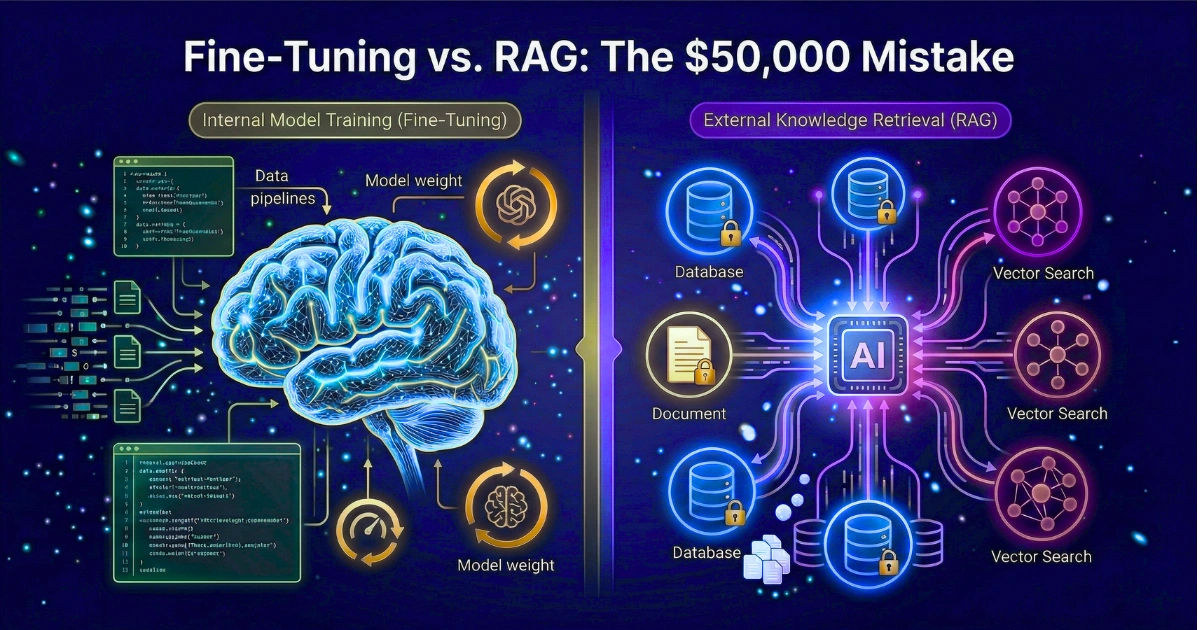
Fine-Tuning vs. RAG: The $50,000 Mistake

I am tired.

I have spent the last three years in San Francisco coffee shops, listening to pitch decks that all sound exactly the same. A founder sits down, eyes wide, and tells me, “We’re building a custom AI model for [Insert Boring Industry Here].”

They lean in. “We’re fine-tuning Llama 4 on our entire database. It’s going to know everything.”

I sip my coffee. I try not to sigh. Because I know I am looking at a dead company walking.

Here is the brutal truth: Most of you are about to set $50,000 on fire.

You are treating AI like a magic box. You think if you “train” it hard enough, it becomes a loyal employee. It doesn’t. It becomes a hallucinating liability that will lie to your customers with absolute confidence.

The industry is currently divided into two camps: The people who understand the difference between Fine-Tuning and RAG (Retrieval-Augmented Generation), and the people who are going to run out of cash by Q3.

Let’s save you the runway.

The “Lobotomy” vs. The Textbook

The biggest lie in SaaS is the word “Training.”

When a consultant tells you they will “train a model on your data,” you picture a classroom. You imagine the AI sitting at a desk, studying your company handbook, learning your refund policy.

That is not what happens.

Technically, Fine-Tuning is neurosurgery. It is a lobotomy.

Imagine you hire a brilliant genius named Al. Al has read every book on the internet. He is smart, but he knows nothing about your specific plumbing business. You have two ways to fix this.

Option A (Fine-Tuning):

You strap Al to a chair. You crack open his skull. You physically rewire his neurons so that every time he thinks of “pipes,” he thinks of your inventory list. You burn the information into his brain tissue.

  • The Problem: It takes months. It costs a fortune. And if you change your inventory next week? You have to open his skull again.

Option B (RAG):

You hand Al a binder.

  • The Solution: When a customer asks about pipes, Al opens the binder, finds the page, reads it, and answers.
  • The Win: If the inventory changes, you just print a new page. Al doesn’t need to “learn” anything. He just needs to know how to read.

Fine-Tuning changes who the model is.

RAG changes what the model knows.

If you confuse these two, you lose.

Candidate #1: Fine-Tuning (The Money Pit)

This is what VCs want to hear you say. “Proprietary Model” sounds like a moat. It sounds defensible. It sounds like you are building a Specialized vs. Generalist AI.

Usually, it is just a trap.

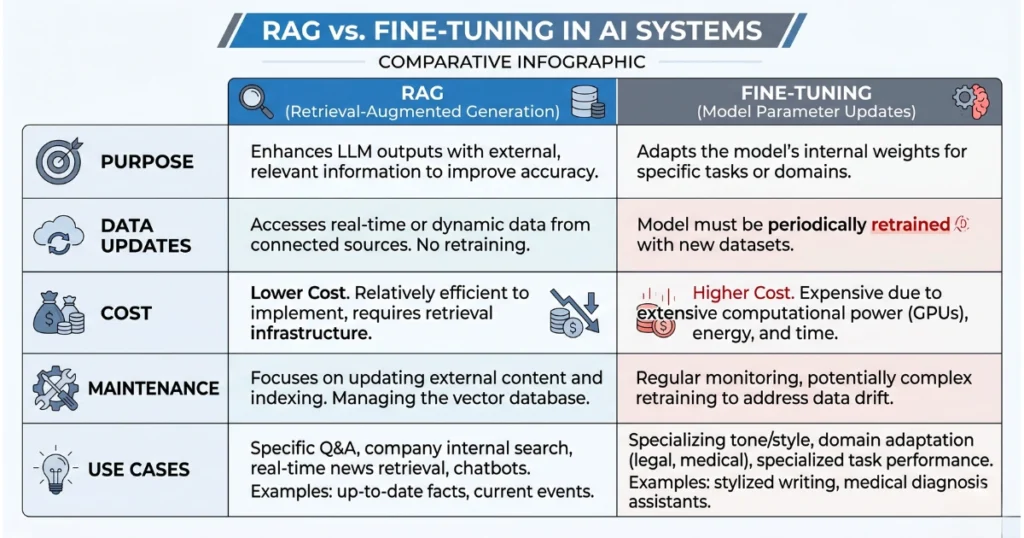
Fine-tuning is the process of taking a pre-trained model (like GPT-4o or Claude 3.5) and blasting it with a smaller, specific dataset to adjust its weights. It works, but rarely for the reasons you think.

The “Why It Matters” Hook

You use this when the behavior is wrong, not the knowledge. If your AI is rude, or talks like a robot, or won’t output JSON, you fine-tune it. You fix the personality.

Pros & Cons

ProsCons
Style Control: Can make an AI sound exactly like a pirate or a lawyer.Amnesia: It does not reliably remember facts. It remembers “probabilities” of facts.
Format Strictness: Forces the model to output clean code or specific data structures.Static Nightmare: The moment training finishes, the model is obsolete.
Latency: Faster than RAG because there is no search step.Cost: Requires GPUs to train and often expensive dedicated hosting.

The ROI Math

Let’s be real about the bill.

  • Data Cleaning: 200 engineer hours to format your messy JSON logs. ($20k)
  • Training Runs: You will mess up the first three times. Compute isn’t free. ($5k)
  • Maintenance: Every time your product updates, you re-train.
  • Total Year 1 Cost: Easily $50,000+.

The Verdict

Avoid if you just want the AI to answer questions about your documents. It will hallucinate.

Buy if you need the AI to speak a new language (like specialized medical code) or adopt a very specific, unchangeable persona.

Candidate #2: RAG (The Boring Winner)

RAG stands for Retrieval-Augmented Generation. It sounds like nerdy jargon. It’s actually just a search engine glued to a chatbot.

Instead of teaching the AI the answer, you build a database of “Cheat Sheets.” When a user asks a question, the system searches the cheat sheets, pastes the relevant info into the prompt, and says: “Hey AI, use these notes to answer the user.”

The “Why It Matters” Hook

It stops the lying. Because the answer is right there in the prompt, the AI doesn’t have to guess. It just summarizes. It is boring. It is reliable. It is what enterprise customers actually pay for.

Pros & Cons

ProsCons
Accuracy: Drastically reduces hallucinations.Complexity: You have to manage a Vector Database (like Pinecone or Weaviate).
Citations: It can tell you exactly which document it used.Context Limits: You can’t stuff a whole book into one prompt (yet).
Security: You can stop the AI from seeing “CEO Salary” docs.Latency: Adding a search step adds a few milliseconds of lag.

The ROI Math

  • Setup: Connect a Vector DB to your existing docs. (1 week of dev time).
  • Hosting: Pennies. You pay for storage and standard API calls.
  • Updates: Instant. Upload a new PDF, and the AI knows it immediately.
  • Total Year 1 Cost: Maybe $5,000.

The Verdict

Buy if you are building customer support bots, legal analysis tools, or internal knowledge bases.

Avoid if you need the model to learn a fundamentally new skill (like how to play Chess) that can’t be explained in a text document.

The “Free Tier” Check

You can test this right now without spending a dime.

  • For Fine-Tuning: You can’t really do it for free. You need GPUs. Google Colab has a free tier, but good luck fitting a decent model on it.
  • For RAG: You can build a RAG pipeline on your laptop in an afternoon. Use LangChain (free library), a local ChromaDB (free vector store), and a cheap API key. Total cost: $0.

The Final Reality

Here is the thing founders forget: Your data is messy.

If you fine-tune a model on messy data, you get a messy model. It is “Garbage In, Garbage Forever.” You can’t fix it without restarting.

If you use RAG on messy data, you get bad search results. But guess what? You can fix the search results today. You can tweak the algorithm. You can re-upload the PDF. You have control.

The startups that win in 2026 won’t be the ones with the “smartest” models. We all have access to the same models.

The winners will be the ones who move from chatbots to agents that can actually use context to get work done.

Stop trying to build a brain. Build a bookshelf.

The Bottom Line:

If you have $50,000, spend $5,000 on a RAG system and $45,000 on a marketing manager who can actually explain why your product matters.

You’re welcome.

Pradeepa Sakthivel
Pradeepa Sakthivel
Articles: 15

Leave a Reply

Your email address will not be published. Required fields are marked *