
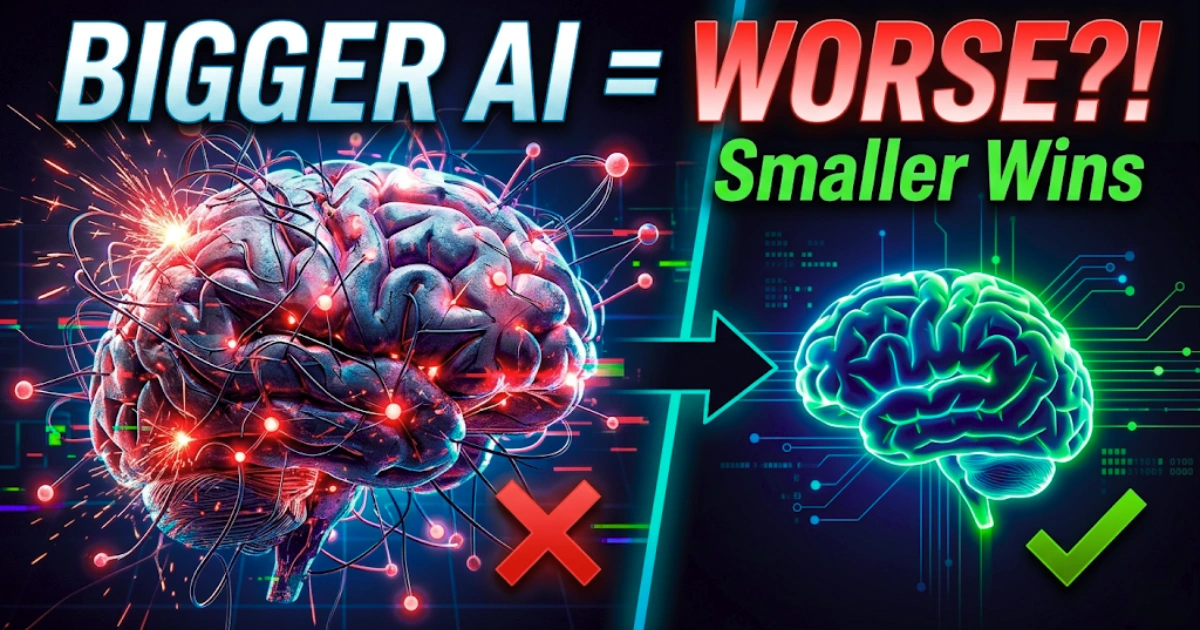

The Myth of “Bigger Is Better” in AI
There’s this habit in AI where people look at one number and decide everything from it. A new model comes out, the parameter count is huge, and that’s enough for people to assume it must be better. It sounds reasonable on the surface. More parameters, more intelligence.
But that idea doesn’t really survive once you start using these models for actual work. At some point, you notice something slightly off. The bigger models don’t always feel better. Sometimes they’re just… more. More words, more delay, more cost. Not necessarily more useful.
What “bigger” actually means
When people talk about size, they’re talking about parameters. The internal weights that guide how the model responds. More parameters means more capacity. That’s true.
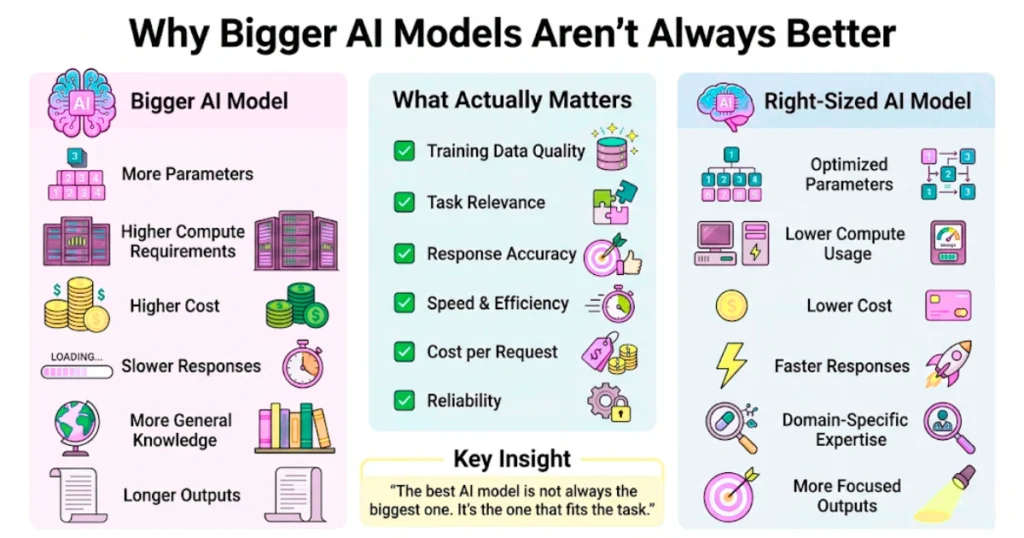
But capacity isn’t the same as getting better answers. After a certain point, increasing size feels less like improving the model and more like scaling the machinery behind it. You don’t always get a cleaner result—just a heavier system.
And once you hit that stage, other things quietly take over: the data quality, how relevant that data is, and whether the model is even suited for the task you’re giving it. That part tends to matter more than people expect.
Where things start to feel off
The first thing you notice is how quickly the gains slow down. Going from a small model to a decent one feels like a real upgrade. But going from that to something massive? The difference gets harder to spot. You can measure it, sure. But in day-to-day use, it often doesn’t feel dramatic.
Then there’s the data issue. A large model trained on average data doesn’t suddenly become sharp. It just becomes very good at reproducing patterns—some useful, some not. Sometimes it even feels more confident while being slightly wrong, which is arguably worse.
Smaller models trained on tighter, more relevant data don’t look as impressive, but they tend to behave more consistently.
They also tend to say more than needed
This is one of those things you don’t notice until you do. Large models don’t just answer questions. They expand them. Add context. Explain things you didn’t ask for. It’s not always bad. But it creates more room for small errors.
And in tasks where precision matters, that extra output becomes noise. Shorter answers, oddly enough, tend to be more accurate. You end up having to limit the model instead of letting it run freely.
The practical side shows up quickly
Speed is one of those things that sounds minor until you deal with it constantly. Larger models are slower. Even if it’s just a bit, it adds up—especially in anything interactive.
And then there’s cost. Every request is heavier.
So you end up asking a very simple question: is this actually worth it? A lot of the time, the answer is no. A smaller model that’s slightly less capable on paper but faster and cheaper tends to win in practice.
General vs actually useful
Big models try to handle everything. That’s the idea behind them. But that also means they’re not particularly sharp in one specific area.
If your task is focused—something repetitive, domain-specific, or structured—a smaller, tuned model often feels better to use. Not in a flashy way. Just… more reliable.
What you notice after a while
After working with these systems for some time, a pattern starts forming. The biggest model is rarely the one you end up sticking with. Smaller ones feel easier to control. More predictable.
And interestingly, tightening the output—keeping it shorter, more constrained—often improves results more than switching to a bigger model. That’s usually the point where the “bigger is better” idea starts to lose its grip.
A different way to look at it
At some point, the question changes. Instead of “how big is this model?”, it becomes “does this actually fit what I’m trying to do?”
That shift makes a bigger difference than it sounds. You start paying attention to things like speed, cost, and how the model behaves under real conditions—not just how it performs in ideal ones. And once you look at it that way, size becomes just one variable in the mix.
Where this leaves things
Large models have clearly pushed AI forward. That part isn’t up for debate. But they’re not a shortcut to better results. In a lot of real situations, something smaller, faster, and more focused ends up being the better choice. Not because it’s more powerful—but because it fits the job better.