

HR departments are buying snake oil.
Enterprise vendors are rebranding basic keyword scrapers as “Autonomous Talent Agents” and selling them to executives desperate to compress their time-to-hire metrics.
The narrative promises a frictionless pipeline where language models passively source, interview, and rank candidates while human recruiters sip coffee.
The reality is a fragile web of brittle API integrations and deterministic parsers masquerading as artificial intelligence. You hand a probabilistic text generator the keys to your Greenhouse instance, define a vague scoring rubric, and trust it to evaluate decades of human nuance.
You are automating your blind spots at machine speed.
Semantic Candidate Matching is a Broken Pipeline
Treating a language model as a recruiter assumes the model understands technical domain logic.
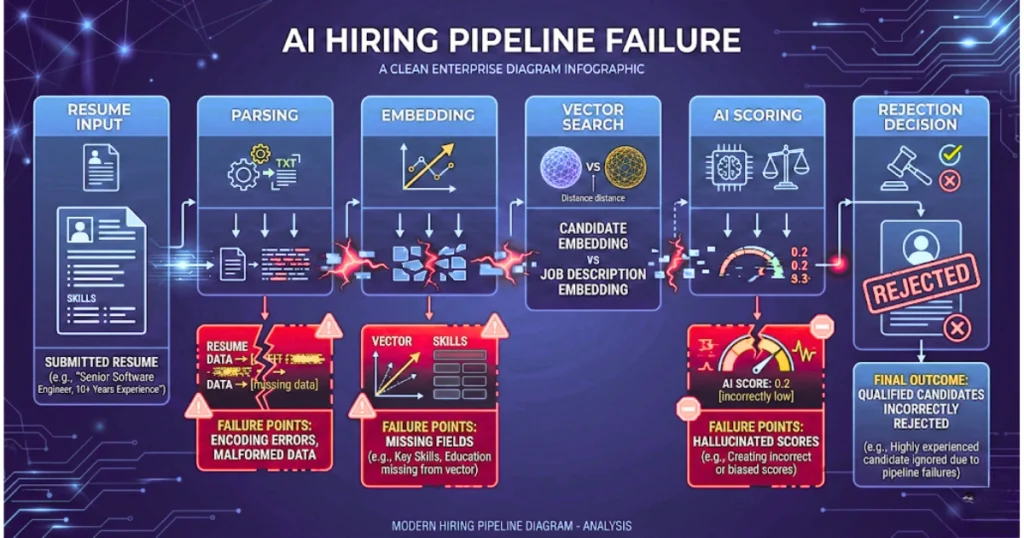
It does not. Semantic search simply maps candidate resumes into high-dimensional vector spaces and measures the mathematical distance against a job description. The vendor sells this as “contextual understanding” that looks beyond exact keyword matches.
The underlying architecture is entirely at the mercy of the ingestion schema.
We audited a Series B fintech deployment last month that integrated a custom evaluation agent into their Workday ATS. Candidates uploaded resumes encoded in UTF-16 instead of standard UTF-8.
The ingestion pipeline’s text extractor choked on the encoding, silently mapping the employment history sections into malformed JSON blocks.
The agent lacked an aggressive fallback protocol for null values. It hallucinated zero years of experience for every affected applicant and aggressively fired auto-reject webhooks for 340 highly qualified senior engineers.
The dashboard displayed a flawless 100% processing rate.
Scheduling Agents Suffer from Catastrophic State Collapse
Chatbots designed to handle interview logistics are fundamentally flawed state machines.
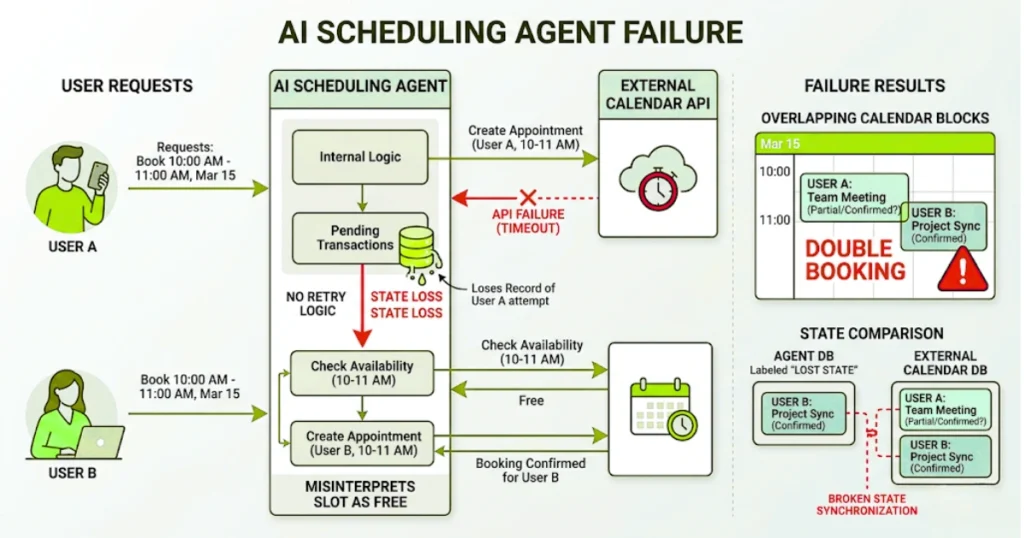
Vendors configure ReAct loops to negotiate interview slots between candidates and hiring managers. They assume calendar APIs are stable and timezone arithmetic is trivial for an LLM.
When a candidate requests a reschedule due to a conflict, the agent must mutate the calendar state, update the ATS, and notify the hiring panel simultaneously.
A single dropped packet destroys the execution graph.
If the Microsoft Graph API returns a temporary 503 timeout during the availability check, an under-constrained agent will not trigger a retry backoff. It will simply assume the lack of an error payload means the calendar is entirely clear.
The agent proceeds to book triple-overlapping technical interviews over the CTO’s only focus blocks.
Predictive Analytics is Just Automated Redlining
Training an agent to predict “culture fit” based on historical hiring data is architectural malpractice.
You are feeding a reward model years of biased human decisions and mathematically optimizing for them. The neural network inevitably latches onto spurious correlations that have absolutely nothing to do with technical competency.
It learns that candidates who use specific LaTeX formatting templates or attend certain universities generate higher similarity scores against your historical top performers.
The model codifies these hidden weights into its evaluation criteria, systematically purging diverse talent before a human ever views the pipeline.
Applying a secondary interpretability model to audit these decisions just stacks a second black box on top of the first.
Do not deploy autonomous agents with write-access to your rejection webhooks. Force the model to output its evaluation rationale into a quarantined staging table, require explicit human validation for every single disqualification, and fire any vendor who refuses to expose their vector retrieval strategy.