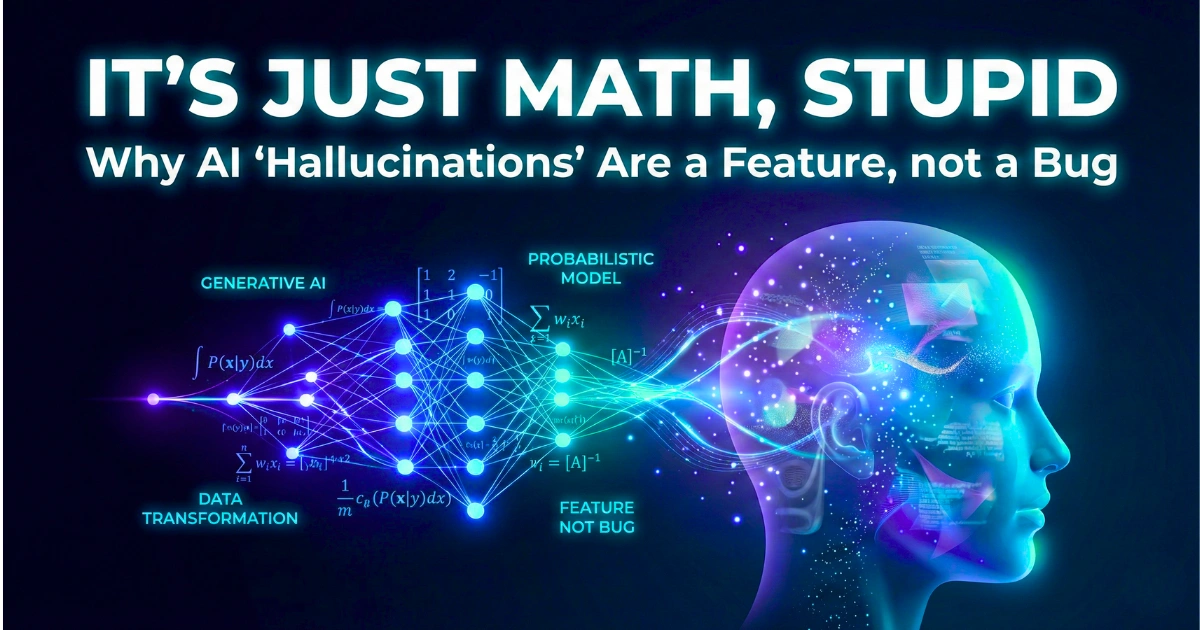
It’s Just Math, Stupid: Why AI “Hallucinations” Are a Feature, not a Bug

Executive Summary: The Technical Reality

  • Core Concept: AI Hallucination is not a system failure; it is the correct functioning of a probabilistic engine forcing a prediction on sparse data.
  • The Mechanism: LLMs do not retrieve facts; they traverse high-dimensional vector space to find statistically probable token sequences.
  • The Trade-off: Reducing hallucination to zero (Temperature 0) destroys a model’s ability to reason, generalize, or be creative.
  • The Solution: You cannot “train out” hallucinations. You must engineer around them using RAG (Retrieval-Augmented Generation) and deterministic verification layers.

Three years ago, a lawyer made headlines for citing non-existent court cases generated by ChatGPT. He was ridiculed. In 2026, we still see enterprise pilots implode because a CEO asks a model to summarize a financial report and it invents a revenue stream.

The immediate reaction is always the same: “The model is broken. Fix the hallucination.”

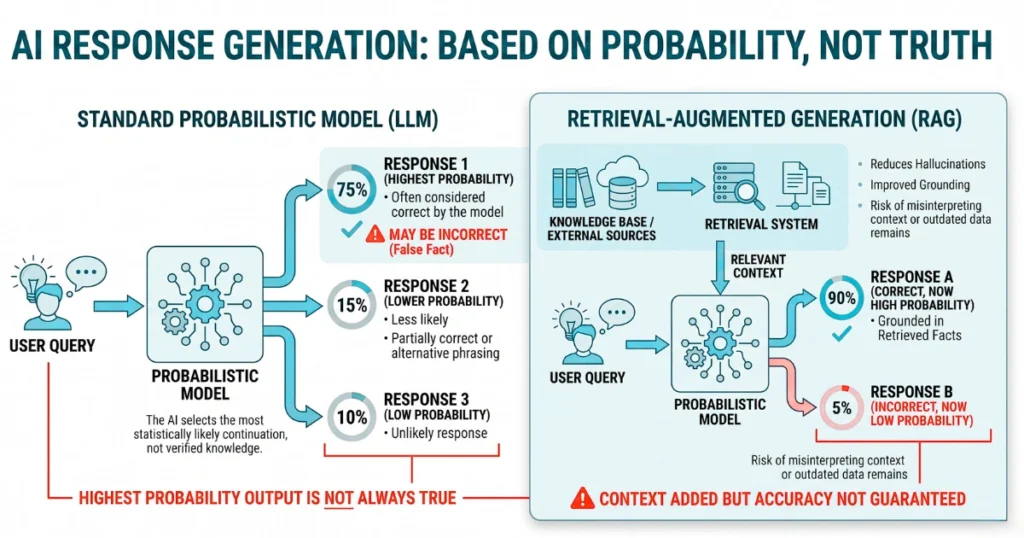
This is a category error. The model isn’t broken. When an LLM fabricates a court case or invents a fact, it is doing exactly what it was built to do: predicting the next statistically probable token based on patterns learned during training.

Hallucination isn’t a bug in the code. It is the fundamental mechanic of generative AI. If you eliminate the capacity to hallucinate, you eliminate the capacity to generate. You are left with a database.

What Is AI Hallucination?

Technically, an AI hallucination occurs when a Large Language Model (LLM) generates output that is syntactically correct and fluent but factually groundless or nonsensical. This happens because LLMs are probabilistic decision systems, not knowledge bases. They do not “know” facts; they calculate the statistical likelihood of word sequences based on training data.

The Mechanics: Vector Space and Temperature

To understand why models “lie,” we must look at the underlying architecture. LLMs do not store discrete facts. There is no row in a SQL database that says Paris = Capital of France.

How Vector Space Works

LLMs compress vast amounts of text into high-dimensional vector space. Words and concepts are converted into numbers called embeddings. In this geometric space, “Paris” is mathematically close to “France,” “Capital,” and “Eiffel Tower.”

When you prompt a model, it calculates a trajectory through this space. It looks for the path of least resistance—the sequence of tokens that minimizes statistical surprise.

Consider a prompt like: “Describe the legal precedent for AI copyright in the 18th century.”

There is no factual answer. However, the model has learned the structure of legal writing. It knows how case names sound. It knows the cadence of judicial opinions. So, it calculates a trajectory that satisfies the linguistic pattern, generating a confident, fictional court case. The math checks out, even if the reality doesn’t.

The Role of Temperature (Randomness)

If we want models to be strictly factual, we could set their temperature to zero. In AI engineering, temperature controls the randomness of the output token selection.

  • Temperature 0 (Deterministic): The model always picks the single most likely next token. It becomes rigid, repetitive, and incapable of nuance.
  • High Temperature (Probabilistic): We force the model to occasionally choose the second or third most likely word.

This variance allows a model to rephrase a sentence or solve a coding bug. It is also the mechanism that solves The End of “Blank Page Syndrome” by offering novel ideas. But that same variance causes hallucinations. You cannot have one without the other. Creativity is just “hallucination that is useful.”

The Generalization Paradox

The goal of machine learning is generalization—the ability to apply learned patterns to unseen data.

If a model could only output text that appeared exactly in its training data, it would be a compression algorithm, like a .zip file. It would be useless for anything other than rote memorization.

We require models to understand concepts like “sonnet” and “quantum physics” and combine them to write a poem about quarks. That poem does not exist in the training data. The model must “hallucinate” the combination.

This is where the demand for perfect factuality collapses. You are asking the model to be a creative engine for some tasks (coding, writing) but a strict encyclopedia for others. The model does not know the difference. It treats “write a fictional story” and “summarize this meeting” as the same mathematical task: predict the next token.

Real-World Use Cases: When Hallucination Is a Feature

In many technical domains, we explicitly pay for the model’s ability to hallucinate.

IndustryApplicationWhy Hallucination is Required
Drug DiscoveryProtein FoldingWe need the model to imagine valid molecular structures that do not exist in nature yet.
Software DevCode RefactoringThe model must synthesize a new solution for a specific legacy codebase, not copy an existing snippet.
Data ScienceSynthetic DataWe generate “fake” patient data to train algorithms without violating HIPAA. We are asking the model to hallucinate people.

In these cases, the “bug” is the primary feature. We leverage the model’s ability to navigate the vector space of possibilities, rather than the vector space of history.

Why Fine-Tuning Won’t “Fix” Hallucinations

A common question from founders is: “Can’t we just fine-tune the model to stop hallucinating?”

The short answer is no. This is perhaps the most expensive misunderstanding in the industry—what we call The $50,000 Mistake: Fine-Tuning vs. RAG.

Fine-tuning adjusts the weights to prefer certain patterns (e.g., medical jargon or JSON formatting). However, you cannot fine-tune a model to “know what it doesn’t know.”

Attempts to use RLHF (Reinforcement Learning from Human Feedback) to suppress hallucinations often lead to Refusal Behavior. The model becomes so penalized for being wrong that it refuses to answer basic questions. We saw this heavily in 2024—models lobotomized in the name of safety, rendering them useless.

Practical Engineering: Architecture Over Training

If you cannot train hallucination out of the model, you must architect around it. This evolution from simple prompting to complex systems is Why 2026 is the Year AI Agents Do the Work.

1. Retrieval-Augmented Generation (RAG)

This is the industry standard in 2026. Instead of relying on the model’s internal weights (memory), you inject relevant facts into the context window. You turn the “open-ended exam” into an “open-book exam.” The model uses its hallucination engine to construct sentences, but the source material is constrained to the data you provide.

2. Deterministic Verifiers

Do not trust the LLM to check its own work.

  • For SQL: Run the generated query in a sandbox environment.
  • For Math: Offload the calculation to a Python script.
  • For Facts: Use a Search API to verify if a URL or citation exists.

3. Separation of Concerns

Use a high-temperature model for brainstorming and drafting. Use a low-temperature model (or a completely different deterministic system) for editing and fact-checking. This often involves choosing the right tool for the job. In the debate of Specialized vs. Generalist AI, specialized models or agents often outperform massive generalist models in reducing error rates for specific tasks.

Frequently Asked Questions (FAQ)

Can AI hallucinations be completely eliminated?

No. Because LLMs are probabilistic, there is always a non-zero chance of generating an incorrect token. You can minimize hallucinations through RAG and grounding, but you cannot eliminate them at the model level without destroying the model’s utility.

Is hallucination a sign of a bad model?

Not necessarily. High hallucination rates often correlate with high creativity and reasoning capabilities. The most “imaginative” models—whether you are comparing Claude 3.5 Sonnet vs. ChatGPT-4o—are often the most prone to subtle fabrications because they are better at connecting disparate concepts.

Why do AI models cite fake court cases?

Models optimize for the pattern of a citation, not the fact of it. In the model’s training data, legal arguments are followed by citations. The model replicates this structure to complete the pattern, filling the variables (Case Name, Year) with statistically probable, but often fictional, data.

Conclusion: Stop Fighting the Math

We have spent years trying to force these models to be something they are not. We want them to be poets who are also actuaries.

It doesn’t work that way. The vector space is messy. The connection between words is probabilistic.

For founders and builders, the takeaway is clear: Stop trying to fix the model. If your use case requires 100% accuracy (like a nuclear reactor or a bank ledger), do not use an LLM. Use code. Use logic.

But if you need synthesis, translation, or ideation, accept the variance. The future of AI isn’t a model that never lies. It’s a system that understands when it’s dreaming and knows when to wake up and check the reference manual.

Until then, treat every output as a best guess. It’s just math.

Kavichselvan S
Kavichselvan S
Articles: 10

Leave a Reply

Your email address will not be published. Required fields are marked *