

India has long been the world’s back office. For years, global firms outsourced business processes, customer support, and basic coding tasks to hubs like Bengaluru, Hyderabad, and Pune. Today, the ground is rapidly shifting beneath the IT sector.
Recent data reveals a fascinating trend across tech hubs. Artificial intelligence is creating more jobs than it destroys.
A Nomura study tracking company announcements through late 2026 shows a clear pattern. Companies created roughly 131,000 AI-related jobs across Asia, while cutting just 61,000. India, alongside the Philippines and China, sits firmly in net-positive territory.
On paper, this sounds like an absolute victory against the narrative of an AI job apocalypse. But step onto any engineering college campus in India right now, and the anxiety is palpable.
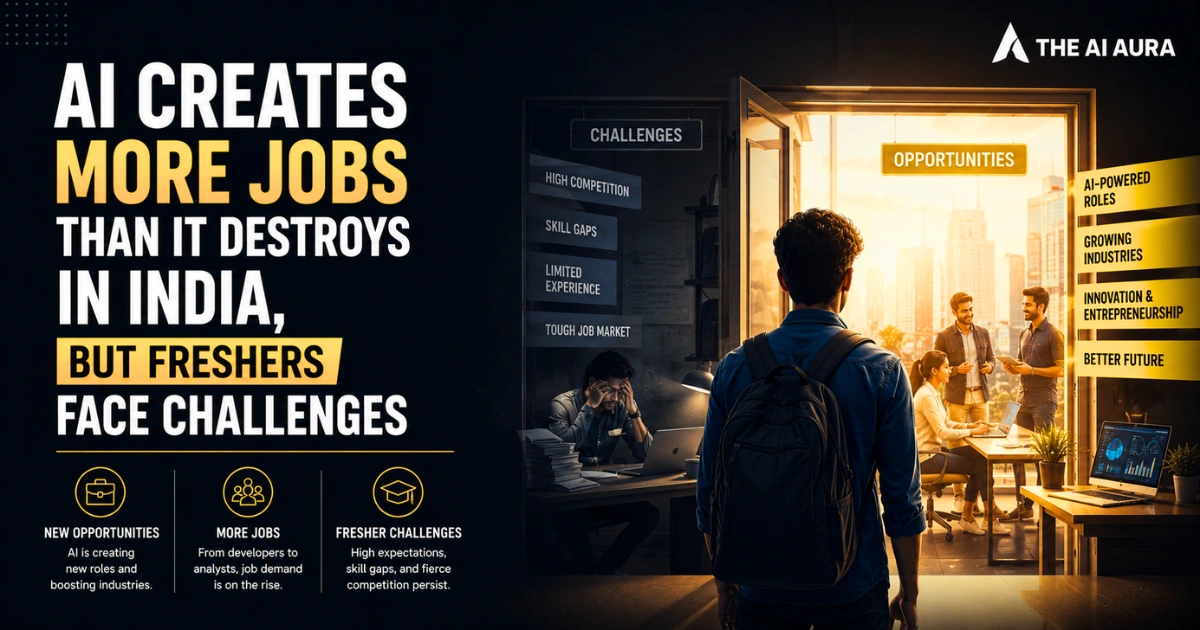
The jobs AI creates are not the same ones it wipes out. We are witnessing a massive structural shift in how companies hire as AI transforms the hiring process, and the heaviest toll is falling squarely on the shoulders of fresh graduates.
The Reality of ‘Silent Firing’ and the Entry-Level Squeeze
Consider the traditional Indian IT career ladder. For decades, companies recruited massive batches of freshers directly from college campuses. These graduates handled routine testing, basic coding, and manual data entry. Today, AI handles these exact tasks faster and cheaper.
Instead of announcing mass layoffs, companies now use “silent firing.” They rarely fire senior staff. Instead, they simply stop hiring newcomers. Data from Xpheno highlights this sharp decline. Net hiring in India’s IT sector dropped from 600,000 in FY22 to roughly 140,000 in FY26.
We are seeing a classic K-shaped job market. A survey by ICRIER found that 55% of IT firms scaled back entry-level hiring. Meanwhile, demand for experienced professionals remains high.
Companies readily pay top dollar for veterans who can drive business strategy with AI. However, entry-level candidates with only basic coding skills struggle to find jobs. In effect, AI is automating away the first rung of the corporate ladder.
Navigating the Shift From Routine to Value-Driven Roles
Where are the new opportunities emerging? Currently, the technology sector drives over 90% of AI-linked job creation. In India, demand is rising in data annotation, linguistics, and specialized AI services. Other industries are also opening new roles. For example, banks now hire AI risk analysts while trimming back-office staff.
The transition is clear. We are moving away from an economy that rewarded raw, scaled manpower for routine tasks to one that demands complex problem-solving, reinforcing the reality that AI won’t replace your team — but it will replace your workflow.
While physical, high-touch sectors like healthcare, manufacturing, and direct care remain largely shielded from automation, the baseline for entry into the knowledge economy has permanently moved higher.
This change brings a huge challenge for India’s workforce. The country built its tech reputation on basic technical skills. While macro data shows net job growth, micro reality brings immediate disruption.
A generic degree no longer guarantees an entry-level desk job. Graduates must build domain expertise and master modern AI tools. The bottom rung is still there, but you need better skills to reach it.
Source: The Economic Times, "AI Is Creating More Jobs Than It Destroys in India, but Freshers Face the Squeeze"