
We spend too much time obsessing over model weights. The enterprise tech cycle focuses heavily on parameter counts and massive compute investments. Many assume raw intelligence is the only path to better automation.
However, knowing why bigger AI models don’t always mean better AI clarifies what happens when you run a frozen model in a live setting: you must optimize the surrounding architecture.
Google Cloud AI Research addressed this engineering bottleneck by open-sourcing Harness2. This plug-and-play framework redefines agentic deployment in open-world environments. It demonstrates that agents can gain substantial capability without upgrading their underlying foundational model.
The Mechanics of Recursive Scaffolding
The framework operates on a practical premise: a model is only as effective as the environment built around it. To manage this, the researchers isolated eight highly specific editable components that dictate agent behavior.
These include the core system prompt, memory buffers, subagents, guardrails, tool guidance, skills, scripts, and plugin middleware. Every single piece is mounted as an independent file, creating a modular foundation for what happens next.
When an unseen task arrives without test cases or verifiers, the recursion engine triggers. The base harness attempts the task first. Simultaneously, an external editor suggests invariant and domain-specific code changes.
According to the technical overview published by Mark Tech Post, this Propose, Probe, Compose loop evaluates the competing trajectories against actual observed behavior rather than relying on ground-truth labels.
Only the edits backed by successful execution are retained. Once a task concludes, a secondary level of recursion initiates. A reflector logs the adapted harness and any actionable lessons into an experience library.
The next task will begin with a baseline harness but leverages that stored operational wisdom to navigate complex tool use and planning failures.
Performance Gains Without Parameter Updates
The most compelling aspect of Harness2 is the performance lift it achieves without updating model weights. Benchmark evaluations across suites like WorkBuddy-Bench, JobBench, and Harvey’s LAB revealed that weaker models gain the largest boost. A single refinement pass increased a GLM-5 setup by over 11 points, enabling it to surpass a baseline Gemini 3.5 Flash setup.
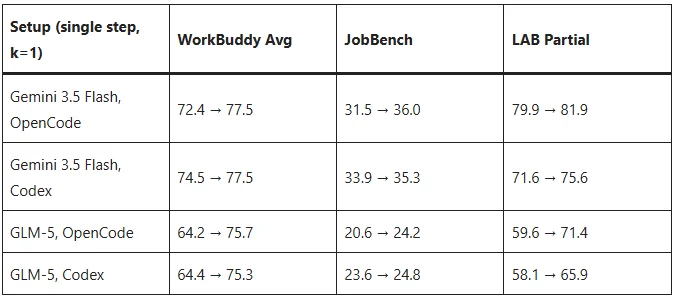
Img source: Mark tech post
Engineers can scale search budgets across parallel or sequential probes, essentially trading inference compute for accuracy. Running the setup locally requires a Linux environment with Python 3.12 or newer, along with the Google Cloud CLI for Vertex AI connections.
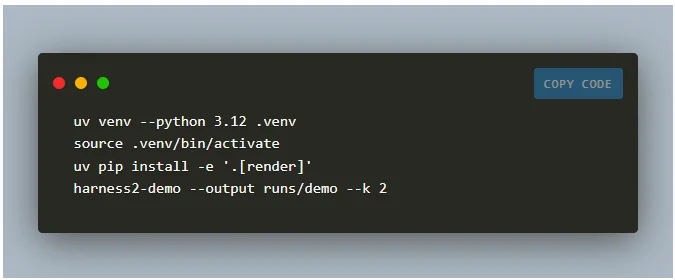
Img source: Mark tech post
It is a calculated pivot away from monolithic model training. The trajectory of modern software engineering clearly hinges on understanding how to build reliable AI agents in 2026: design patterns that work in production, where dynamic, context-aware scaffolding and iterative self-correction handle the heavy lifting.