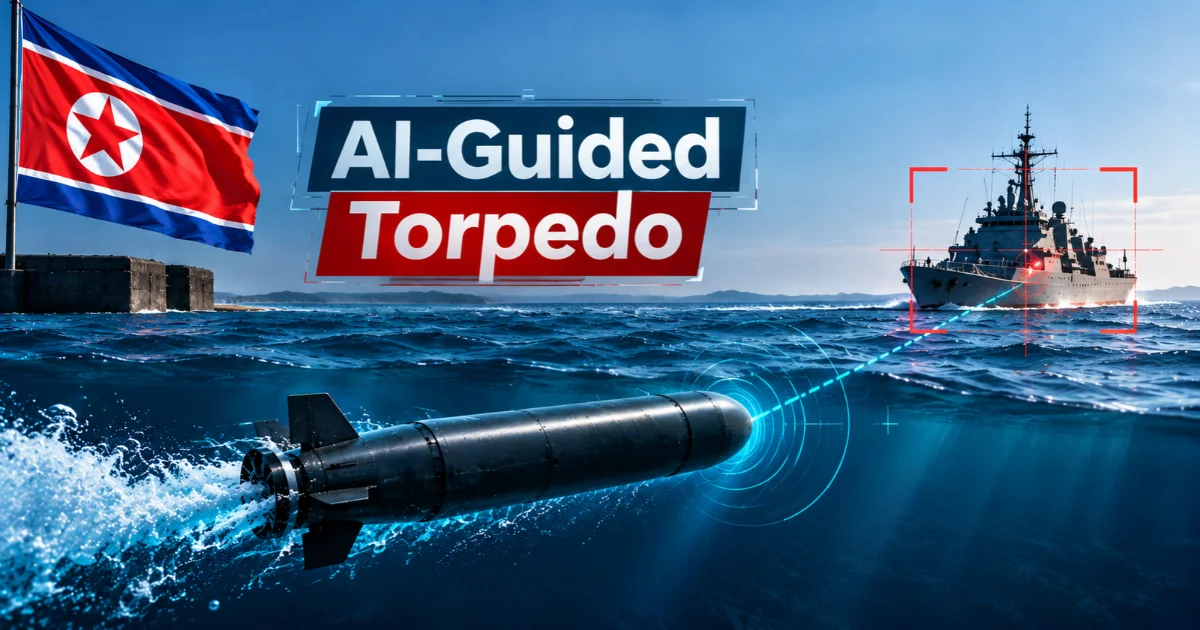

North Korea is rapidly modernizing its naval arsenal. Recently, the country tested the Zam-2.0, an advanced high-speed torpedo. Pyongyang wants to bypass allied air and missile defenses. Shifting tactical focus underwater presents a formidable new challenge for Seoul and Washington.
This test signals a deliberate pivot away from traditional ballistic displays. Instead, North Korea now targets stealth-oriented naval capabilities. This move fundamentally alters Pacific security dynamics.
The successful deployment of what state media claims is an autonomous, machine-guided weapon system reflects a broader shift across modern defense doctrines where developers study what are AI agents and how they work in high-stakes, unassisted operational environments.
By focusing on the subsurface domain, North Korea is exploiting an environment where allied sensor networks are naturally degraded, making early detection of an impending strike incredibly difficult.
Decoding the Zam-2.0 System
State media rarely shares detailed technical data. However, the weapon integrates artificial intelligence to boost target detection and terminal guidance. Modern submarine combat takes place in a noisy environment. Thermal layers, sea life, and acoustic countermeasures quickly confuse traditional sensors.
An AI torpedo processes complex sonar returns in real time. It easily separates actual hull signatures from deployed decoys. Because it tracks targets at high speeds, the torpedo adjusts course dynamically. This cuts down the reaction time for targeted vessels.
According to a comprehensive defense analysis detailing the geopolitical and technical fallout of this launch at Times of India, the Thursday test heavily focused on verifying these precise upgrades alongside advanced propulsion mechanics.
Improving propulsion not only translates to raw physical speed but also to acoustic stealth, potentially allowing the Zam-2.0 to mask its approach until it breaches the terminal intercept window.
For allied naval commanders operating in the region, a weapon that processes data and adapts during its engagement phase represents a severe tactical headache, as traditional evasion maneuvers may prove completely ineffective against machine-speed course corrections.
Escalating the Underwater Arms Race
The timing and nature of the Zam-2.0 test cannot be viewed in a vacuum. It directly followed North Korea’s underwater launch of two distinct types of strategic cruise missiles earlier in the same week, breaking a nearly three-year silence on submerged missile demonstrations.
This concentrated burst of naval testing underscores a rapidly intensifying arms race on the Korean Peninsula, where both North and South Korea are desperately racing to deploy systems capable of outmaneuvering traditional defense grids.
By publicly announcing the incorporation of artificial intelligence into its naval munitions, Pyongyang is engaging in a sophisticated form of psychological deterrence.
It is actively signaling to Washington and Seoul that its military-industrial complex is advancing beyond brute-force nuclear threats into the realm of smart, autonomous warfare mirroring trends where offensive and defensive operations intersect in AI and cybersecurity.
The broader strategic intent is unmistakable: to hold enemy carrier strike groups and allied submarine fleets at constant risk using relatively low-cost, high-impact autonomous vehicles. If the Zam-2.0 performs even remotely close to the capabilities broadcasted by state authorities, it forces a complete recalibration of allied naval maneuvers in the contested waters of the Pacific.
Defensive doctrines that have long relied on predictable, hard-coded enemy hardware must now account for smart munitions capable of independent hunting and tracking patterns, cementing the ocean floor as the next volatile frontier in this enduring geopolitical standoff.