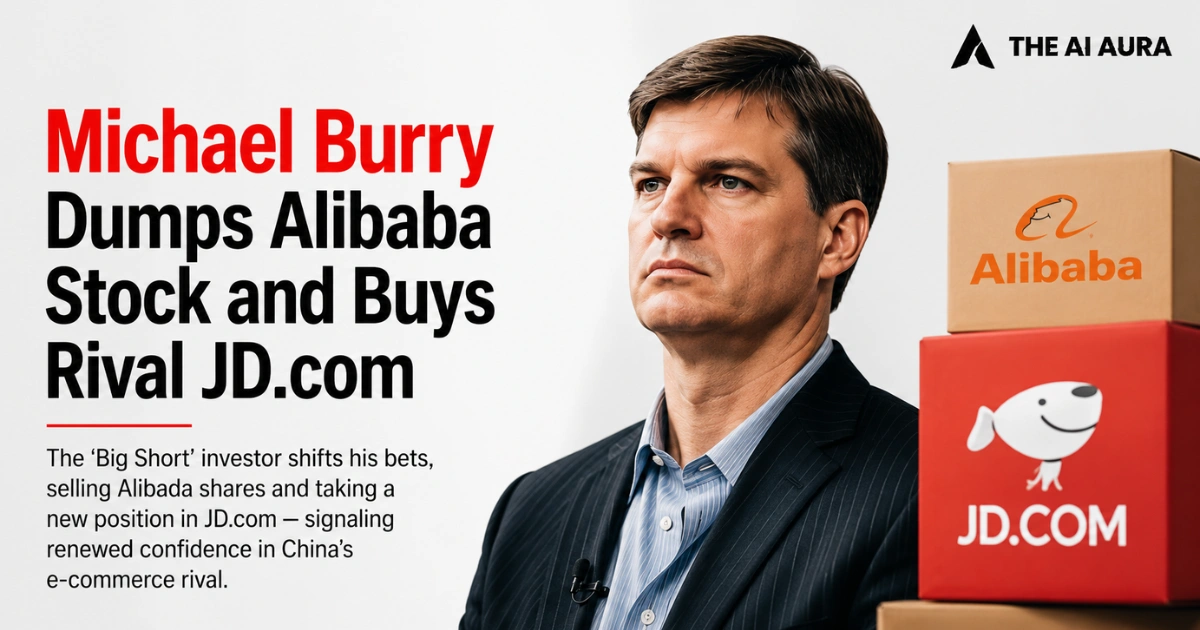

Michael Burry, the contrarian investor immortalized in The Big Short for successfully predicting the 2008 housing crash, has made his next aggressive market move.
According to a recent Substack post, the Scion Asset Management founder has completely liquidated his massive position in Chinese e-commerce giant Alibaba, reallocating that capital directly into its fierce domestic rival, JD.com.
For an investor who thrives on spotting macroeconomic fractures before the herd catches on, this isn’t merely a routine portfolio rebalancing. It is a stark warning about the massive, unchecked capital expenditures tied to the current artificial intelligence arms race.
Burry originally noted that he intended his exit from Alibaba to be a temporary, tactical shift. However, after reviewing the company’s aggressive financial maneuvers, he reversed course entirely, stating that Alibaba’s stock “would have to fall by half” before he would even consider re-entering the position.
The Alibaba Dilution and the AI Capital Trap
Alibaba’s underlying technology may be advancing, but its financial engineering has crossed a hard line for Burry.
The definitive breaking point arrived when Alibaba announced a massive HK$80 billion ($10.2 billion) capital raise, offloading 710 million new shares at an 8.4% discount to their previous close. The company explicitly stated that these proceeds would be funneled into expanding its artificial intelligence infrastructure.
While Burry conceded that Alibaba’s proprietary tech is “impressive” and that the firm is “making serious inroads” in the highly competitive low-cost large language model space, he refused to accept the cost to shareholders. In his own words, he “cannot bless share issuances.”
The recent quarterly numbers validate his deep skepticism. While Alibaba’s June quarter showed a respectable 9% bump in top-line revenue, net profits violently collapsed by 75%.
This massive hit to the bottom-line stems directly from a 75% spike in capital expenditure, pushing quarterly spending to a staggering $10 billion.
We are watching a global AI arms race where tech giants like Meta, Alphabet, Amazon, and Microsoft are burning through unprecedented cash piles to secure infrastructure dominance. Alibaba is desperate to keep pace, but the market is heavily penalizing this AI strategy.
Burdened by a slowing Chinese economy, regulatory crackdowns from Beijing, and brutal domestic competition, Alibaba shares are languishing more than 60% below their 2020 peak.
Diluting existing equity to fund highly speculative AI infrastructure was the exact trigger that pushed Burry out the door and into JD.com, a competitor he perceives as offering a much safer fundamental valuation.
Shorting the AI Infrastructure Boom: Oracle and Micron
Burry’s pivot away from Alibaba isn’t an isolated incident; it serves as the foundation for a broader, deeply bearish thesis on the current AI spending frenzy.
He is actively targeting companies he views as dangerously overexposed to the AI infrastructure bubble, taking aim at major technology players like Oracle and Micron.
Oracle represents the exact kind of financial overextension Burry targets. To support its cloud and AI ambitions, the software giant has locked itself into long-term leases and GPU capacity contracts worth hundreds of billions of obligations that completely dwarf its current revenue base.
Despite historically strong operating cash flows, the surging costs of AI infrastructure recently dragged Oracle into negative free cash flow territory.
Burry’s bet is highly calculated: if enterprise demand for AI applications falters even slightly, Oracle will be left suffocating under costly, unyielding obligations while profit margins erode.
Micron Technology faces a similar contrarian assault. Burry has expanded his short position against the memory chipmaker, viewing its recent market rally as a symptom of blind investor enthusiasm rather than structural strength.
Semiconductor manufacturing is famously cyclical, and Micron has historically suffered brutal downturns when supply eventually outpaces demand.
By shorting Micron, Burry is signaling that the current AI-fueled profitability is a fragile peak, leaving the stock highly vulnerable to an impending market correction.
Source: The Times of India, "One of America's Biggest Investors, 'Big Short' Michael Burry Has Dumped All His Alibaba Stock and Is Buying Its Home Country Rival"