
Getting a job at McKinsey & Company has always been tough. Acceptance rates historically hover between 0.5% and 1.5%. For decades, landing an offer meant acing the case study and impressing senior leaders.
Now, the firm is adding a technological twist for North American undergraduate applicants. If you want a business analyst role, your toughest interviewer might not be human.
McKinsey is piloting an AI avatar in its assessment process. Candidates must navigate an unpredictable 10-minute client discussion. The initiative aims to break through memorized scripts and reveal real-time problem-solving skills under pressure.
Decoding the Virtual Client Experience
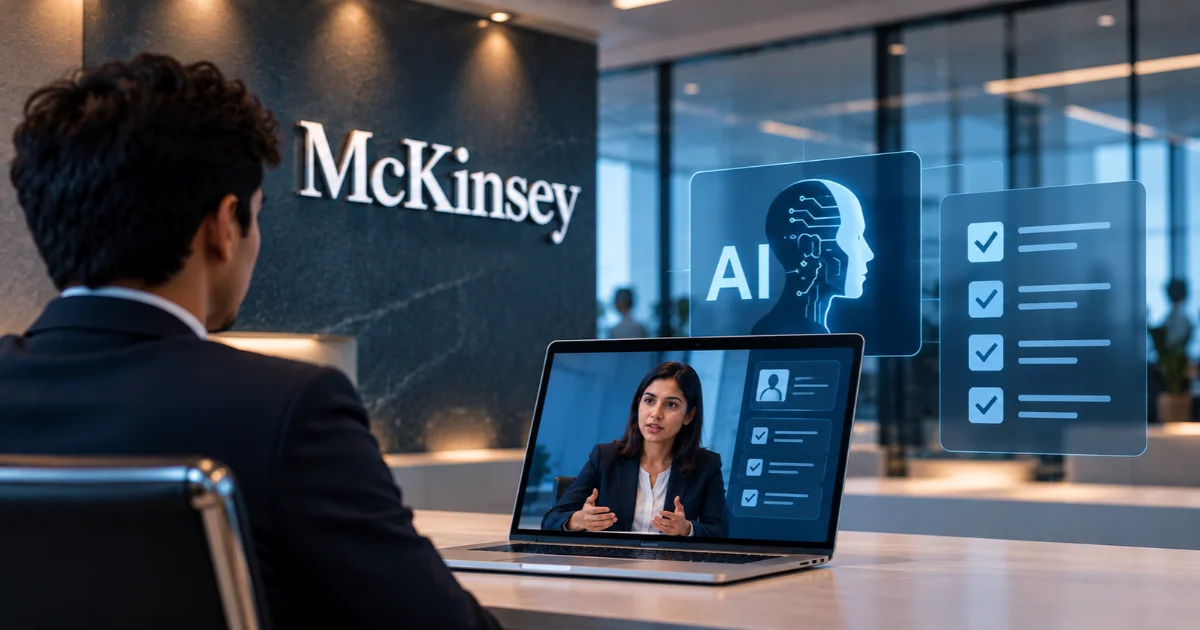
The mechanics of this new test are straightforward. Right after the standard case study, candidates sit before a laptop in the McKinsey office. Human partners quietly observe from the sidelines.
On the screen sits a generative AI avatar acting as a client. Saleem Zafar, a partner who helped build the tool, shares a typical scenario. A candidate might pitch where a city should build a new sports stadium. The AI steps in as the mayor, complete with distinct priorities and civic concerns.
According to a recent report detailing the process at Times of India, the primary goal is to evaluate how well candidates handle real-world conversational friction.
This virtual mayor might abruptly interrupt to inject fresh context or dig deeply into the underlying financial logic of your proposal, mimicking a professorial client who demands to understand the precise reasoning behind a recommendation. The tool is deliberately not programmed to be unhinged or to trap candidates with unfair gotcha questions.
Instead, it covers the vast majority of standard business interactions that consultants face daily. The human assessors sitting in the room are not looking for a textbook answer.
They are watching intensely to see if the applicant actively listens, absorbs the virtual client’s subtle cues, and pivots their strategy accordingly, rather than stubbornly bulldozing ahead with a pre-memorized pitch.
Moving Beyond the Rehearsed Script
This brings us to the core reason McKinsey is making such a radical procedural change to its famously rigid hiring pipeline. Over the years, the consulting interview preparation industry has become incredibly sophisticated.
Candidates routinely walk through the doors armed with overly polished, robotic responses that mask their genuine problem-solving instincts. Blair Ciesil, co-lead of global recruiting at the firm, has pointed out that this heavy rehearsal actually makes it frustratingly difficult for assessors to read a candidate’s authentic human qualities.
By introducing a dynamic, unscripted element that reacts in real time, the firm forces applicants to drop the corporate act and rely entirely on their raw interpersonal skills a prominent example of how AI is transforming the hiring process in 2026.
There is also a strong argument for leveling the playing field. In traditional role-play scenarios, human interviewers naturally vary in their temperament and mood. One partner might play a highly combative client, while another might be highly accommodating, inadvertently creating an uneven testing environment.
The AI avatar eliminates this inconsistency by presenting the exact same persona and difficulty level to every single applicant, ensuring that the pressure test remains completely uniform across the board.
Naturally, the integration of artificial intelligence in hiring carries significant historical baggage. Many industry watchers still remember Amazon abandoning an experimental recruiting algorithm in 2018 because it demonstrated a clear bias against female applicants.
McKinsey seems acutely aware of these algorithmic pitfalls, which is likely why the AI does not actually score the candidates or make any hiring decisions itself.
Instead, the initiative demonstrates how AI won’t replace your team — but it will replace your workflow, acting purely as a digital sparring partner while leaving final evaluations in human hands.
If this current crop of applicants proves the system is effective, landing a job at the world’s top consulting firm will increasingly depend on your ability to read a room that technically does not exist.