
It feels like everyone is scrambling for an AI strategy right now. You open LinkedIn and it’s just wall-to-wall competitors bragging about their efficiency wins. Then your CEO stops by asking where our ROI is, and suddenly there’s this massive pressure to ship something before the market leaves you behind.
So, you move fast. You grab an API, throw together a prototype, and it looks great.
But that’s exactly where the budget trap starts. The biggest misconception in software right now is assuming that getting the model to work is the expensive part. Most of the time, it isn’t.
The Sandbox Illusion
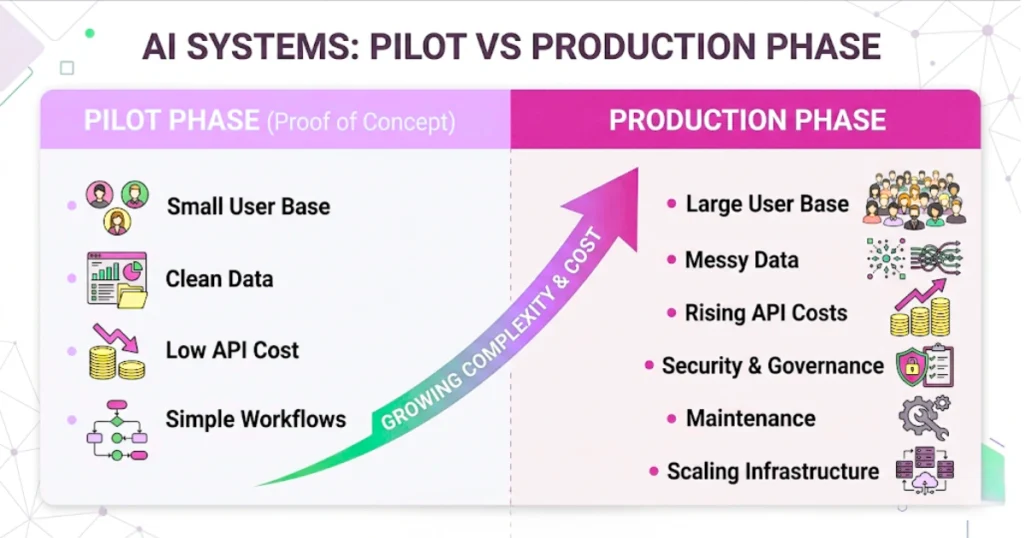
Think about the pilot phase. You’re running it in a controlled sandbox. You have a few early users, clean inputs, and everything behaves exactly how you designed it to. It’s incredibly easy to step back and think, “We nailed it.”
But production is a different beast entirely.
Real users don’t format things perfectly. They break things. The data gets messy, and the system that purred on your local machine suddenly starts choking at scale. That’s when the invisible costs start creeping in.
The Costs You Don’t See Coming
Wrestling with the data
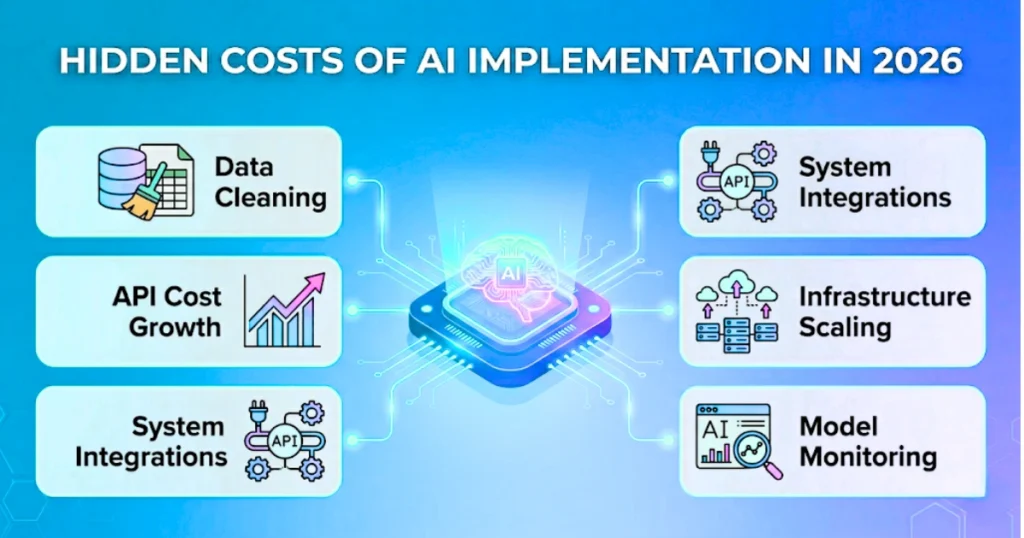
Nobody has perfectly clean data just waiting to be fed into an LLM. It’s usually scattered across CRMs, outdated databases, random spreadsheets, and half-finished docs.
Before your model can even do its job, someone has to scrub all of that. I’ve seen teams lose weeks—sometimes months—just wrestling with data quality before they even touch the AI logic. Data prep isn’t a stepping stone; it becomes a massive project of its own.
The slow creep of API bills
During early testing, your API bill is basically zero. But once you roll it out? Those costs don’t just jump; they creep.
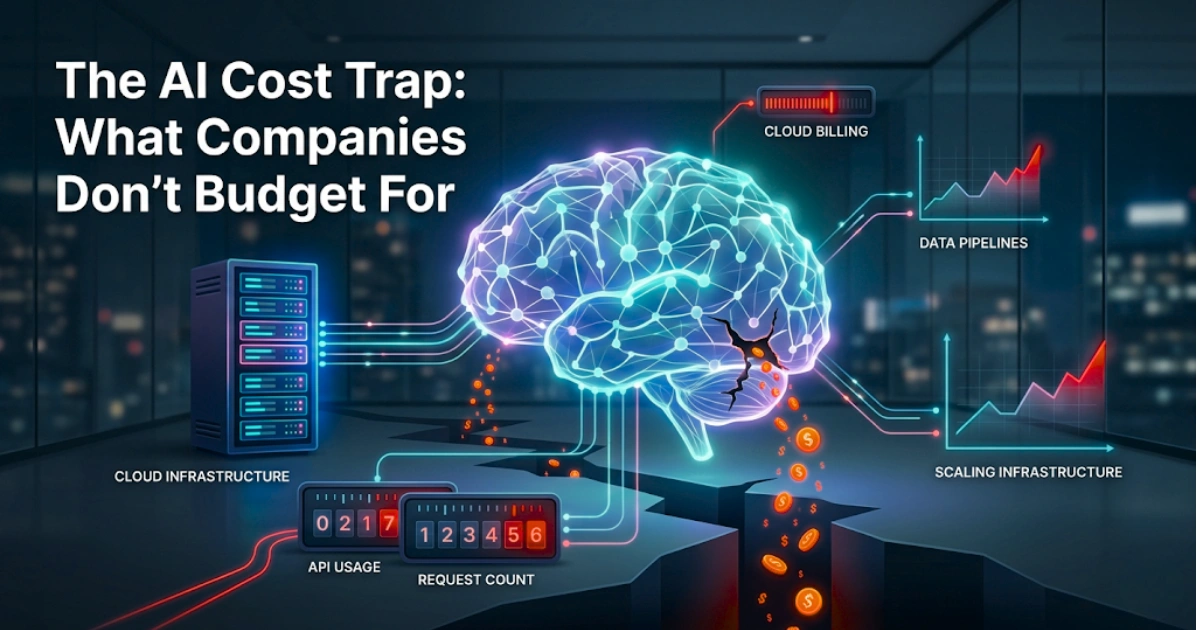
A few extra tokens here, a slightly longer prompt there. It seems fine until you multiply it by thousands of requests a day. As more teams start relying on the tool, compute and storage demands rise alongside it. Suddenly, you’re looking at an infrastructure bill that nobody forecasted.
Wiring it all together
You rarely just drop an AI into a vacuum. It has to actually talk to your existing tools.
You have to sit down with the backend team and figure out how to wire this thing into legacy systems without breaking them. And that work never really ends. APIs update. Internal workflows shift. Those integrations become a permanent maintenance tax.
Model drift is real
We also tend to forget that models aren’t static. What gave you amazing results in January might start acting weird by June because user behavior changed or the model itself was updated. You end up having to constantly monitor responses and tweak prompts just to keep the baseline quality intact.
The Point of No Return
Eventually, the pilot is deemed a success, and the natural next step is expansion. Give it to more users. Attach it to more workflows.
This is usually when the reality sets in. Security, compliance, and governance aren’t just “future problems” anymore—they are immediate operational blockers.
What started as a fun, contained experiment is now a core system that requires continuous, dedicated ownership. And backing out isn’t an option because too much time and money has already been invested.
Budgeting for Reality
We usually start by asking, “How much does this API cost?” But the real question we should be asking is, “What is this going to cost us to keep alive six months from now?”
If you’re moving an AI project into production, you need answers to a few basic questions:
- Who is actually going to clean the data?
- What happens to our margins when usage 10xs?
- Who is maintaining the backend integrations?
- Who is monitoring the prompt performance when it starts hallucinating?
If you can’t answer those questions, your budget is basically a guess. AI systems aren’t one-time software purchases; they are living products. The companies that account for the maintenance early are the ones finding real value. The ones that don’t just end up with a very expensive tech demo.