
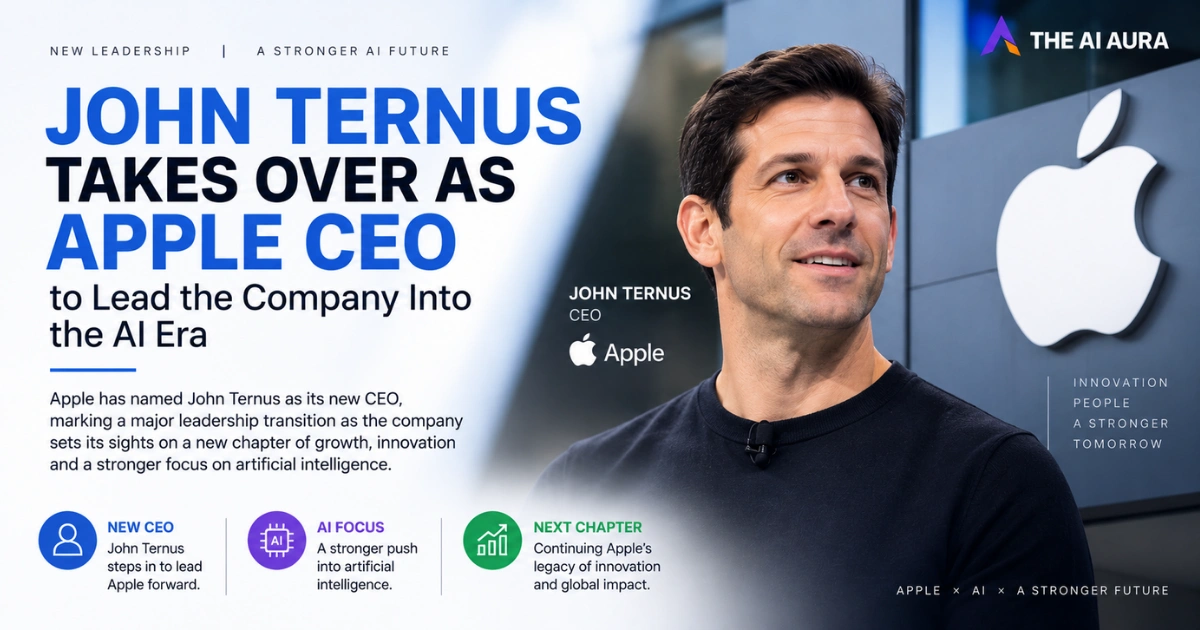

Tim Cook defined his tenure through supply chain precision and global scale. However, John Ternus faces a fundamentally different mandate as CEO. He must transform a hardware giant into a leader in generative AI.
Ternus previously led Hardware Engineering. Because he is not a software native, his appointment is both unorthodox and strategic.
Today, the primary bottleneck in consumer AI is not just training large models. Instead, companies must deploy models efficiently at the edge. Ternus understands this reality well.
Therefore, he focuses heavily on custom silicon, thermal control, and unified memory. Consequently, his elevation signals a shift toward running AI directly on Apple devices.
Re-architecting Apple’s Hardware for Generative AI
Under Ternus, Apple prioritizes devices that run continuous agentic workflows natively. In addition, the tech world is moving past cloud-dependent chatbots. Users now expect devices to execute complex tasks autonomously.
Ternus previously led the successful Apple Silicon transition. Thus, he knows how to match physical hardware with demanding software.
To scale Apple Intelligence globally, Ternus uses a hybrid inference model. Local processing requires high memory bandwidth and powerful neural engines.
Therefore, Apple redesigns its chips to run quantized models directly on devices. As a result, this method eliminates latency bottlenecks common in cloud platforms.
Ternus is effectively turning everyday consumer hardware into edge nodes capable of localized retrieval-augmented generation (RAG).
When an operating system needs to synthesize data from a user’s calendar, localized documents, and messages to generate a response, the data retrieval and model generation happen seamlessly on the local silicon.
This hardware-first approach to AI execution bypasses traditional server constraints, resulting in a faster, highly personalized user experience.
Bridging the Gap Between Consumer Privacy and AI Scale
The most significant operational challenge Ternus faces is scaling this infrastructure without compromising the strict privacy boundaries Apple has built its brand identity upon.
The “AI black box problem” is heavily scrutinized by global regulators, and Apple’s strategy to mitigate this risk revolves around its Private Cloud Compute (PCC) framework.
When an on-device model lacks the parameters for a complex query, the task is dynamically routed to Apple’s custom-built server infrastructure.
Ternus’s deep hardware background is the linchpin for this strategy. He is overseeing the deployment of proprietary Apple Silicon within these data centers, creating a unified, seamless compute architecture that stretches from the smartphone in your pocket to the server processing the heavy workloads.
This approach also solves a critical business utility issue: long-term cost management. Instead of paying exorbitant API and compute fees to third-party cloud hyperscalers, Apple controls the entire compute stack end-to-end.
Furthermore, Ternus is enforcing strict cryptographic verification protocols for these cloud hand-offs, ensuring that user data processed on Apple servers cannot be retained or accessed by anyone including Apple itself.
By treating cloud infrastructure as a direct hardware extension of the consumer device, Ternus is positioning the company to deliver secure, high-ROI artificial intelligence experiences at a scale that competitors will struggle to replicate.
Source: The Hindu, "John Ternus to Lead Apple Into the Age of AI"