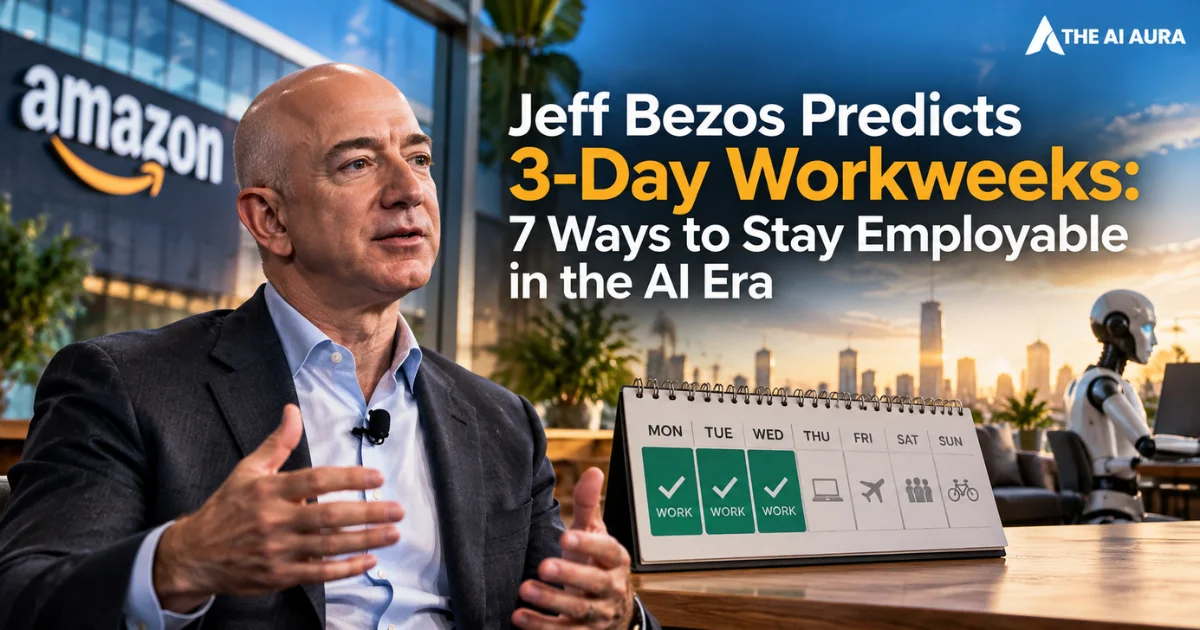

Imagine waking up on a Monday morning knowing your workweek will wrap up by Wednesday evening. It sounds like a dream. Yet, Amazon founder Jeff Bezos recently predicted this exact scenario.
He foresees a near future where AI dramatically boosts productivity. This surge could make the traditional five-day grind obsolete. In this reality, higher efficiency could even restore single-income households. People would finally get time back for family, personal projects, and rest.
This shift upends old views of labor, capitalism, and value. For decades, survival meant trading most waking hours for a paycheck. Now, smart algorithms can handle data processing, routine writing, and scheduling. Human workers could theoretically step back.
However, this transition will not happen smoothly on its own. Companies will not simply pay standard wages for less time without cause. If machines work faster and cheaper, leadership will cut costs first. To enjoy a shorter workweek without facing replacement, you must adjust how you work today.
The Reality of the Shorter Workweek
Before we start planning our four-day weekends, we have to navigate the immediate market disruption happening right now. Artificial intelligence is already hollowing out routine administrative and analytical roles, showing how AI employees are replacing traditional roles across key industries.
According to a recent Times of India report detailing Bezos’s predictions, the World Economic Forum estimates that nearly forty percent of all workers will need to fundamentally overhaul their skill sets within the next five years.
The shortened workweek will only become a reality for those who can aggressively prove their economic worth in a machine-dominated landscape.
Surviving this bottleneck requires a proactive mindset rather than a defensive one. We can no longer rely on a stagnant university degree or a decade of doing the exact same tasks to secure our future.
The market is demanding a hybrid professional someone who understands the underlying technology but operates conceptually above it. Employers are currently scrambling to find individuals who possess sharp analytical thinking and genuine adaptability.
They do not want passive button-pushers; they want strategists who can look at the output of a generative model, spot the inherent flaws, and apply a layer of nuanced judgment that no algorithm can replicate.
Rethinking Your Value in the Workforce
Staying employable moving forward means mastering a blend of technical fluency and irreplaceable human traits. The most urgent step is to recognize that AI won’t replace your team, but it will replace your workflow.
Integrating these systems into your daily routine is non-negotiable. By offloading routine administrative tasks to software, you free up the cognitive bandwidth needed to rigorously question validity, interrogate underlying data, and weigh the real-world consequences of machine output.
Beyond technical collaboration, the premium on deeply human skills has never been higher. Algorithms cannot read a room, mediate a heated boardroom conflict, or provide empathetic leadership during a crisis. Cultivating these interpersonal abilities alongside a relentless commitment to lifelong learning creates a protective moat around your career.
You must remain fluid, refusing to anchor your professional identity to a single job title that might be automated away tomorrow. Instead, build a dynamic portfolio of measurable results that proves exactly how you drive real value. Finally, lean heavily into your professional network.
Genuine industry connections and community engagement will surface the hidden opportunities that machines simply cannot predict, ensuring you remain a vital part of the economy long before the three-day workweek arrives.