
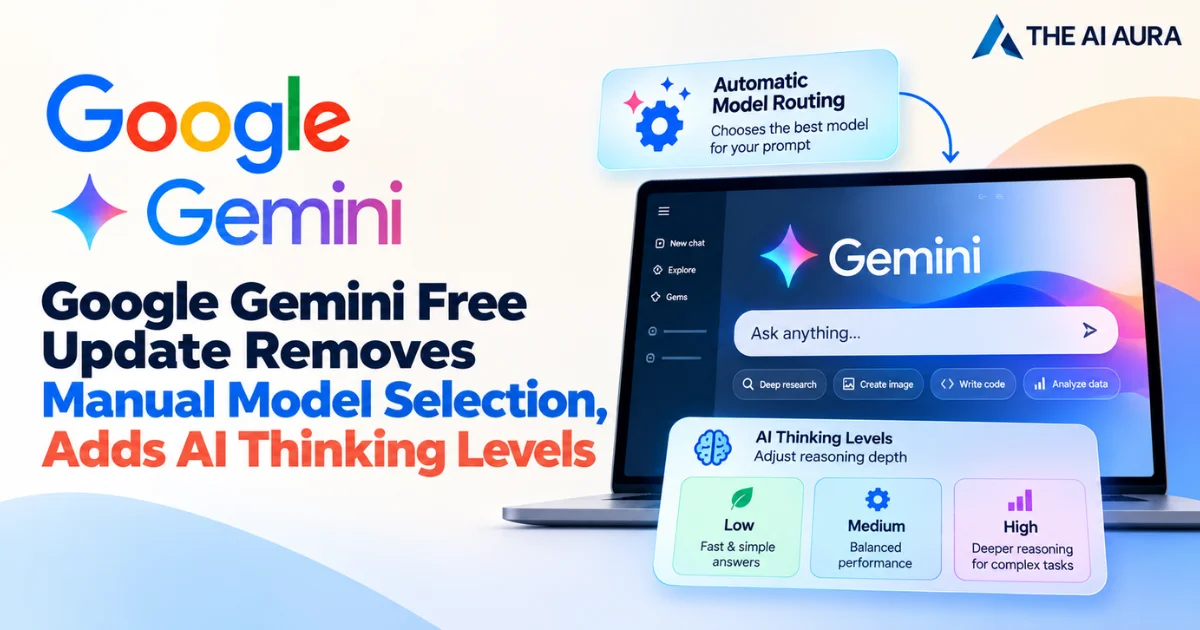

Google is fundamentally changing how everyday users interact with its flagship generative platform, trading granular model selection for an intelligent routing system.
For a long time, power users enjoyed the flexibility of manually switching between lightweight and heavyweight language models depending on their specific workload. That era is coming to a close for the free tier.
The latest update shifts the paradigm from choosing the underlying engine to defining the cognitive effort you need for the task at hand. It is a subtle but significant pivot in consumer AI design, pushing the complexity of model orchestration entirely into the background so you just get the right answer without fiddling with technical dropdown menus.
The Mechanics of Intelligent Prompt Routing
Instead of asking you to guess which exact model fits your query, the platform now handles that friction automatically behind the scenes. When you submit a prompt, the routing architecture instantly evaluates its complexity, context requirements, and computational weight.
Understanding what AI actually does when you type a prompt help clarify why these matters: the vast majority of everyday queries are instantly directed to Flash-Lite, which operates as the fastest and most highly optimized model in the lineup.
This aggressive routing ensures incredibly rapid response times for simple tasks while simultaneously managing server-side compute costs.
However, if you throw a heavy analytical task or a complex coding problem at the interface, the system detects the need for deeper contextual understanding and elevates the request to the standard Flash or the more robust Pro model.
According to a recent report by Mezha detailing the October rollout, the only option visible in the model menu for free users is now “Auto” with no alternative selection available. You actually still retain the ability to disable this automatic routing, but the penalty for doing so is steep.
Turning off the auto-selector locks your prompts exclusively to the Flash-Lite version, effectively walling you off from the heavier reasoning engines entirely. This architecture strongly encourages users to trust the automated routing as the only viable path to leverage the full capability of the ecosystem without upgrading to a paid subscription.
Redefining Control with Cognitive Tiers
While manual model names are fading from the free interface, Google is handing back control through a completely different mechanism with its new depth-of-reasoning settings.
This new framework entirely replaces the older Extended capability, giving users a way to dictate processing effort rather than hardware allocation. You can now dictate how hard the AI should work on your prompt by shifting between three distinct cognitive gears.
The low setting acts as a rapid-fire mode for situations where you just need a straightforward, factual answer with absolute minimal latency.
Stepping up to the medium tier delivers a highly balanced response that weighs processing speed against analytical depth, making it the ideal baseline for standard daily research. When you need the system to thoroughly evaluate a complex problem, engaging the high tier forces the engine to expend maximum resources, process the logic thoroughly, and deliver a heavily scrutinized output.
This structural shift makes perfect sense from a user experience perspective, especially as industry benchmarks show why bigger AI models don’t always mean better AI.
Most people do not actually care whether their prompt hits a specific parameter count; they simply care about whether the AI is thinking deeply about their specific question. By abstracting the technical model designations and replacing them with practical reasoning levels, Google is aligning the user interface directly with human intent.



