
Speech-to-speech AI has spent the last year trapped in an awkward transitional phase. We all know the frustrating feeling of talking to a digital bot that unnatural half-second pause, the complete inability to handle a simple human interruption, and the robotic failure to grasp conversational nuance.
Building an assistant that actually listens rather than just waits for its turn to speak is a massive engineering hurdle. xAI is looking to shatter that ceiling entirely.
The company just rolled out Grok Voice 3.0, positioning it not merely as a standard iterative update, but as a fundamental shift in how voice assistants process real-time logic.
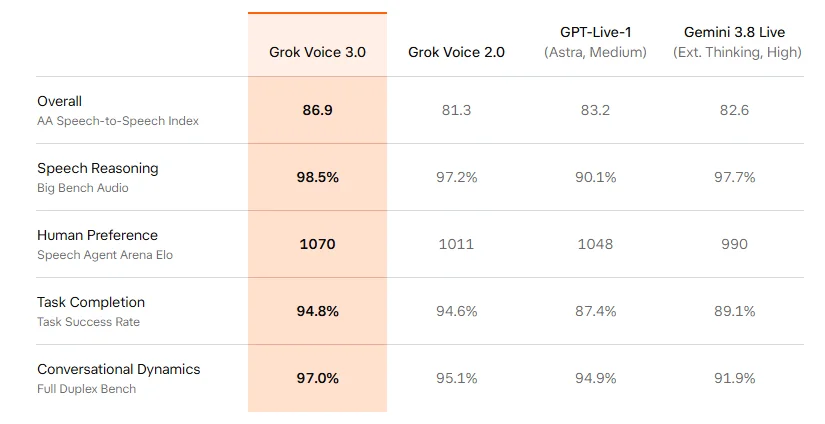
It currently stands as the most intelligent speech-to-speech model available on the market, claiming a highly coveted number one spot on the Artificial Analysis index and pushing the absolute boundaries of what enterprise support systems can accomplish without a human in the loop.
Breaking the Latency and Cost Barriers
The underlying narrative of this release isn’t just about raw intelligence, although the core metrics are undeniably impressive. What makes Grok Voice 3.0 structurally different is its deep capacity to handle the messy, overlapping reality of human communication.
On the Full Duplex Bench, which directly evaluates how well a model deals with dynamic turn-taking, awkward pauses, and sudden speech interruptions, the model hit a staggering 97 percent success rate. You can actually talk over the AI, and it recalibrates its response much like a real person would.
Img source: XAI
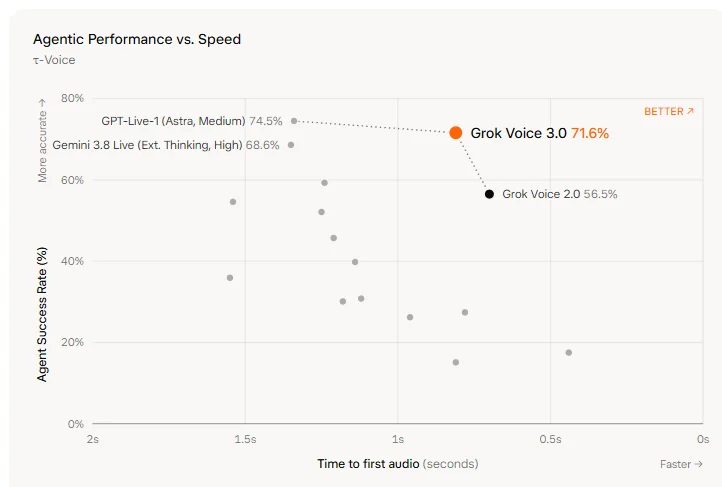
According to a comprehensive breakdown of the recent launch announcements, xAI managed to achieve a τ-Voice score of 71.6 percent proving its resilience against diverse accents and severe background noise.
It matches heavyweights like OpenAI’s GPT-Live-1 but accomplishes the feat with 40 percent lower latency. For developers learning how to reduce AI latency in production environments, bringing response times comfortably under the critical one-second mark is a gamechanger.
Img source: XAI
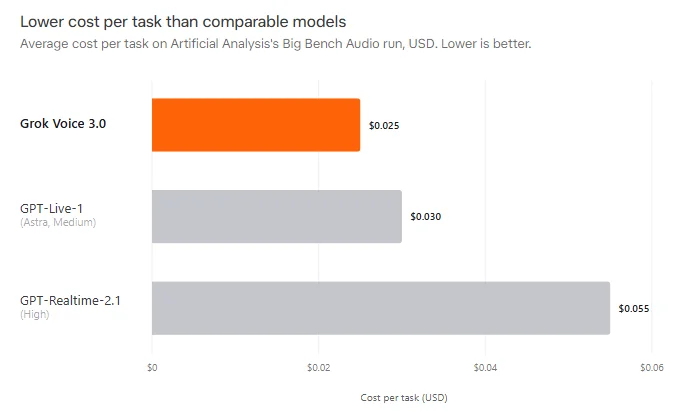
Speed in this sector usually demands a severe premium, yet xAI is aggressively undercutting the wider market. Running complex tasks costs roughly $0.025 per action, sitting significantly below competing frontier models.
For working developers, the Voice Agent API remains locked at just $0.08 per minute, ensuring teams upgrading from the previous architecture absorb absolutely zero price shock.
Img source: XAI
Enterprise Deployment at Serious Scale
Benchmarking in an isolated testing environment is one thing, but xAI leverages a distinct structural advantage: utilizing the broader corporate ecosystem as a massive, real-world testing laboratory. This architectural model isn’t just theoretical documentation.
It currently powers millions of daily, high-stakes interactions directly inside Tesla vehicles. Drivers utilize the integrated system entirely hands-free to parse complex emails, instantly adjust calendar schedules, or even route external purchases on their morning commute.
The sheer enterprise value becomes even more apparent when looking closely at SpaceX’s Starlink operations. Those internal call centers currently route an estimated 20,000 daily customer interactions straight through Grok Voice.
The AI isn’t just transcribing; it is independently verifying customer identities, actively troubleshooting sophisticated satellite hardware, and issuing necessary account credits on the fly.
This shift highlights how autonomous agents are replacing traditional roles in 2026, with roughly 70 percent of these complex interactions fully resolved without ever escalating to a human representative.
Perhaps the most surprising metric is the model’s sheer sales acumen, with one in four automated sales conversations successfully converting to a purchase before the phone line disconnects.
When you combine this aggressive real-world deployment with its top-tier accuracy scores on ServiceNow’s rigorous EVA-Bench, the industry picture becomes remarkably clear. xAI is deploying hardened, front-line infrastructure designed specifically to absorb the unpredictable chaos of everyday customer service.