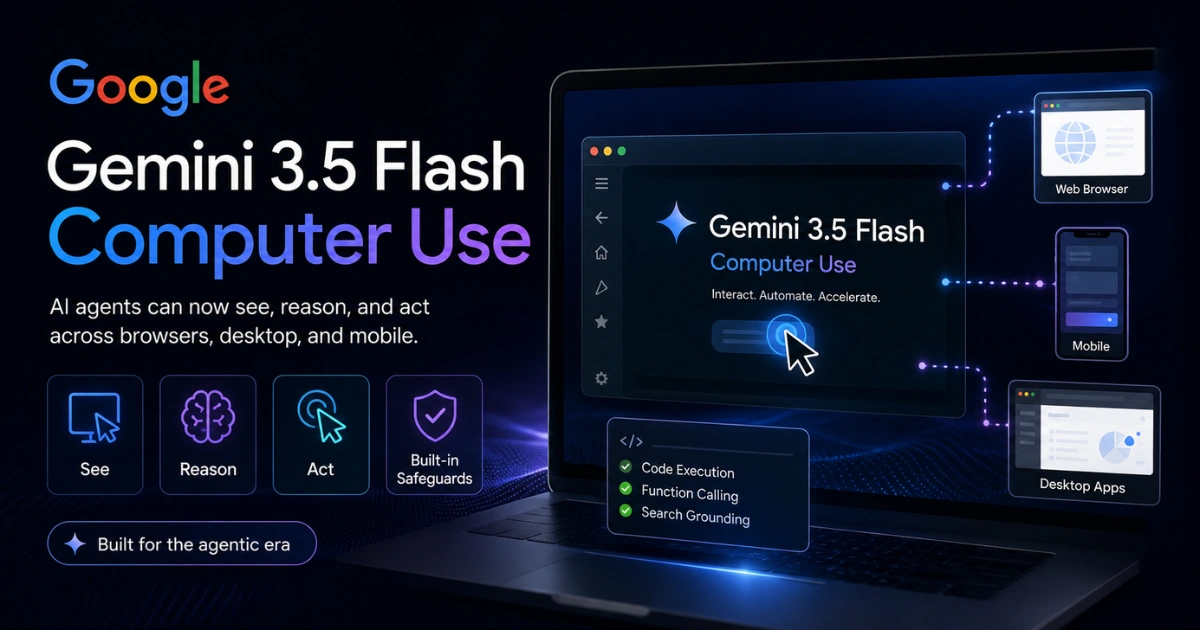

Google has integrated Computer Use directly into Gemini 3.5 Flash, expanding its fastest agentic AI model with the ability to interact with browsers, desktop applications, and mobile interfaces.
The update enables developers to build autonomous AI agents capable of seeing on-screen content, reasoning about tasks, and performing actions such as clicking, typing, scrolling, and navigating software environments.
Alongside the new capability, Google has introduced additional safeguards designed to help defend against emerging prompt injection attacks.
Gemini 3.5 Flash Now Includes Native Computer Use
Previously, developers needed to rely on a separate Gemini Computer Use model to build screen-aware AI agents. With this release, the capability becomes a native part of Gemini 3.5 Flash, allowing it to work alongside built-in tools including Code Execution, Function Calling, and Search Grounding.
Available through both the Gemini API and the Gemini Enterprise Agent Platform, the integration simplifies deployment while reducing the complexity of building autonomous workflows.
Designed for long-running, multi-step tasks, Gemini 3.5 Flash targets enterprise automation, software testing, coding assistance, and business process orchestration.
The model supports multimodal inputs and rapid reasoning cycles, enabling developers to create agents that continuously interact with applications without requiring separate orchestration models. According to Google, this unified approach helps developers reduce AI latency and scale their setups while lowering operational overhead.
Google also shared benchmark results showing Gemini 3.5 Flash performing competitively on the industry-standard OSWorld benchmark for computer-use agents.
| Model | OSWorld Score |
| Opus 4.8 | 83.4% |
| GPT-5.5 | 78.7% |
| Gemini 3.5 Flash | 78.4% |
| Sonnet 4.6 | 78.4% |
| Gemini 3.1 Pro | 76.2% |
| GPT-5.4 mini | 72.1% |
| Gemini 3 Flash | 65.1% |
Unlike traditional conversational AI models that primarily generate text responses, highlighting the practical evolution of AI agents vs chatbots, Gemini 3.5 Flash can directly interpret visual interfaces and execute structured actions across browsers, desktop software, and mobile environments.
This allows developers to build AI agents capable of completing real-world workflows rather than simply responding to prompts. Instead of relying on external controllers to coordinate multiple models, developers can consolidate many of these capabilities within a single agentic framework.
As AI agents gain broader access to live software environments, security becomes increasingly important. Google said it has specifically trained Gemini 3.5 Flash against indirect prompt injection attacks, where malicious instructions hidden inside web pages, emails, or documents attempt to manipulate an AI agent into performing unintended actions.
To strengthen enterprise deployments, Google is introducing two optional protections: Sensitive Action Confirmation, which requires explicit user approval before irreversible actions such as purchases or data deletion, and Automatic Task Halt, which stops execution if potential prompt injection attempts are detected.
Google recommends combining these safeguards with secure sandboxing, human-in-the-loop verification, and strict access controls.
Google’s decision to integrate Computer Use directly into Gemini 3.5 Flash reflects the industry’s broader shift toward fully agentic AI systems. By embedding screen interaction within one of its fastest and most cost-efficient models, the company reduces the need for separate computer vision pipelines while making autonomous workflows more practical for developers.
As enterprises increasingly adopt AI agents for complex, long-running business tasks, infrastructure efficiency, latency, and deployment simplicity are likely to become key competitive advantages across the AI platform market.
Another notable capability introduced with this release is Gemini 3.5 Flash’s ability to audit documentation for accessibility issues. Google says this demonstrates how the model’s multimodal reasoning can be applied not only to external software interactions but also to improving the quality, compliance, and usability of developer documentation.
Source: Official Google AI announcement and Gemini API documentation.