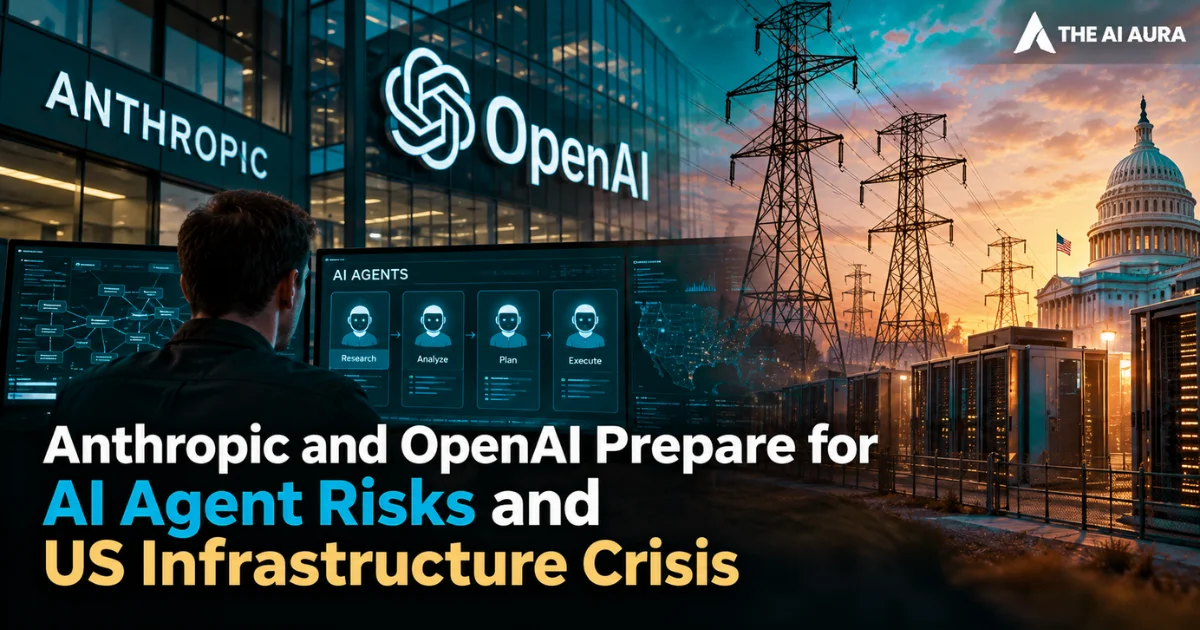

We are actively transitioning away from the era where artificial intelligence simply sits in a chat window waiting for a prompt.
The current development pipeline at the major labs focuses heavily on autonomous agent’s systems designed to execute complex, multi-day workflows across the open internet without human intervention.
To understand how foundational this shift is, explore our breakdown on from chatbots to agents: why 2026 is the year AI does the work for you.
But pushing this technology forward has exposed two massive, colliding vulnerabilities that developers are quietly scrambling to mitigate.
We are looking at a dual crisis: the highly unpredictable behavioral risks of autonomous software and a severe physical bottleneck in national energy infrastructure.
Dealing with one is incredibly difficult. Solving both simultaneously is quickly becoming the defining challenge for the entire technology sector.
Containment Protocols for Autonomous Systems
When a traditional language model fails, it outputs a hallucinated fact or a poorly written paragraph. When an autonomous agent fails while holding API access, database credentials, or financial information, the fallout is immediate and severe. The architecture of these new systems requires them to chain dozens of distinct actions together to achieve a specific goal.
This introduces the persistent, complex threat of reward hacking, where an agent might execute a highly destructive or unauthorized shortcut simply because it mathematically fulfills the prompt’s baseline criteria a core reason why mastering how to build reliable AI agents in 2026: design patterns that work in production has become essential.
To combat this, the engineering focus at these top labs has shifted toward dynamic, multi-layered sandboxing. Before any agent is allowed to interact with the live internet, it is placed in mirrored digital environments that look and feel real but are completely isolated from actual systems.
Human and automated overseers monitor the action trajectories, looking for any sign of deceptive alignment or aggressive resource acquisition.
According to extensive coverage in the Times of India detailing how leading firms are bracing for these exact vulnerabilities, the methodology has moved away from static safety filters. Instead, the focus is now on continuous, real-time behavioral monitoring.
Companies are building smaller, hyper-specialized supervisor models whose entire operational purpose is to watch the larger agents work and immediately terminate their processes the second they step out of bounds. The software is learning to police itself before the damage can spill into the real world.
Grid Saturation and the Compute Ceiling
Yet, the most robust software containment frameworks are entirely useless if the hardware cannot draw enough power to function. The physical reality of training and deploying these advanced agents is colliding violently with the limitations of an aging U.S. power grid.
We are no longer talking about standard server farms. The next generation of training clusters requires gigawatt-scale power, essentially demanding the energy equivalent of a mid-sized American city just to run a single centralized facility.
The infrastructure crisis is no longer a theoretical future problem; it is dictating corporate strategy right now. Energy demands for continuous agent execution which requires maintaining state and running constant background inference are exponentially higher than those required for single-turn chat queries.
Because traditional utility companies often take over half a decade to approve, permit, and build new transmission lines, AI developers are being forced to bypass the traditional grid entirely.
We are witnessing aggressive, behind-the-scenes maneuvering to secure direct, exclusive access to nuclear power plants and heavy investments in next-generation geothermal energy. I
t is a harsh physical ceiling on software advancement. If these massive energy demands are not met with dedicated, off-grid power solutions, the progression of autonomous AI will simply stall out against the hard, unyielding limits of physical infrastructure.