
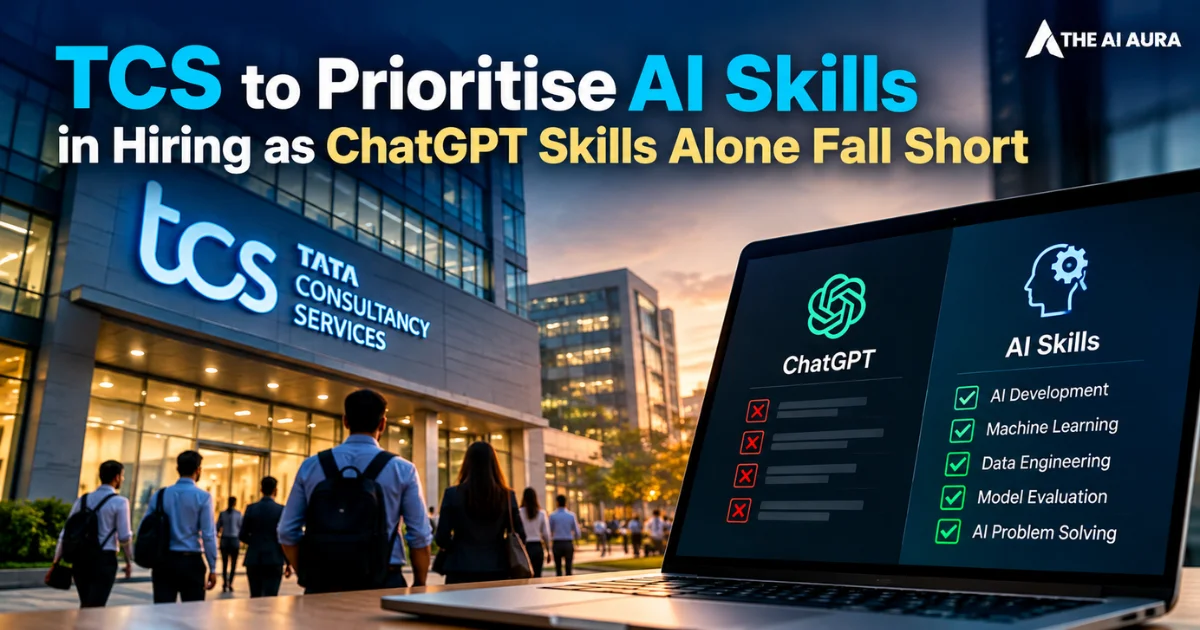

The global IT services landscape is currently undergoing a rather brutal recalibration. Knowing how to write a clever prompt for a large language model is rapidly transitioning from a highly sought-after technical premium to a simple baseline expectation. Tata Consultancy Services has made this shifting reality glaringly obvious in its recent recruitment cycles.
Out of the 4,500 employees the tech giant onboarded during the July to September quarter, a massive 80 percent arrived already equipped with advanced digital and new-age tech skills.
More importantly, roughly a quarter of these new hires possessed deeply specialized artificial intelligence capabilities. This is not just a slight adjustment in human resources strategy. It represents a fundamental rewrite of what actually makes a software engineer employable in today’s fiercely competitive market.
The Capability Gap Beyond Basic AI Tools
There is a surprisingly massive disconnect between an organization appearing ready for an automated future and actually having the infrastructure to build it. Slapping a generative model interface onto a corporate dashboard might look incredibly impressive to board members, but it rarely translates into immediate operational maturity.
According to a recent report published by NDTV detailing TCS’s hiring shift towards specialised artificial intelligence skills, more than nine in ten Indian tech employees are already utilizing these tools in their daily workflows.
Yet, spiking usage metrics simply do not equate to actual enterprise competence a dynamic explored in The AI Adoption Illusion: Why Most Companies Are Doing It Wrong.
Workers across the sector might be constantly interacting with tools like ChatGPT, but without rigorous coding standards, strict security checks, and clear alignment with core business processes, their output remains entirely experimental.
True engineering capability requires corporate leadership to clearly define exactly what needs to be built and to what precise standard. Merely asking a workforce to learn artificial intelligence on their own time is a recipe for disjointed, unscalable shadow IT.
The real challenge lies in bridging the gap between isolated experimentation and deploying reliable, measurable results that actually impact the bottom line.
Domain Knowledge Trumps Raw Technical Novelty
This aggressive corporate pivot toward highly specialized engineering talent inevitably sparks a debate about who really holds the leverage in the modern job market. It is incredibly easy to assume that fresh university graduates, who are practically native to these emerging generative platforms, would easily displace veteran workers.
However, raw familiarity with a neat tool is entirely useless if you do not fundamentally understand the business problem you are trying to solve.
TCS leadership has openly noted that mid-level engineers who demonstrate a genuine willingness to adapt actually hold the ultimate trump card right now. These veterans possess deep industry domain expertise and intimately understand the fragile complexities of enterprise-scale technology landscapes.
A junior developer might know the very latest model context protocol, but the seasoned engineer knows how to build scalable AI systems that don’t fail in production across legacy enterprise environments.
This critical intersection of domain knowledge and specialized technical application is exactly what drives profitability for major firms. With AI-related projects steadily increasing their share of overall revenue, the corporate focus is entirely on scaling these specialized engagements to push profit margins aggressively upward.
The era of getting hired just because you know how to vaguely chat with an algorithmic bot is effectively over, replaced by a demand for architects who can actually weave those models into the fabric of enterprise operations.



