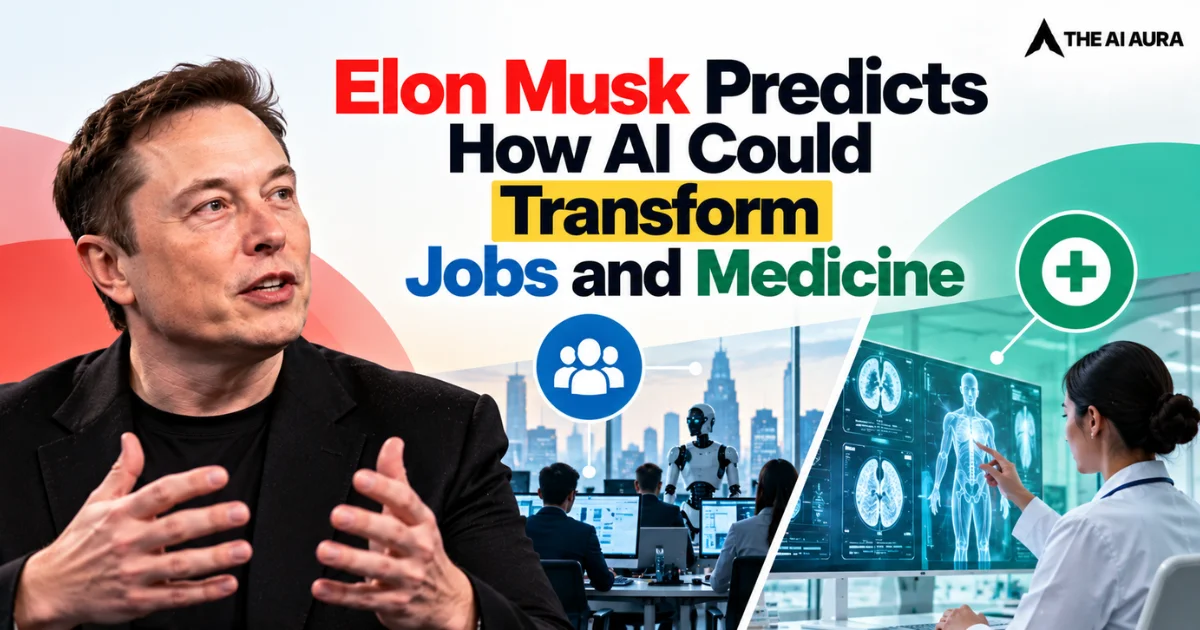

Tech leaders recently gathered at the White House alongside Donald Trump. During the event, Trump proposed rebranding artificial intelligence as “super intelligence.” However, Elon Musk focused on a much bigger vision. He outlined a radical thesis on the future of cognitive systems.
Instead of highlighting quick corporate gains, Musk predicted an era of absolute material abundance. He believes AI will drive the biggest breakthroughs in the labor market and healthcare delivery.
The Historical Shift from Manual Calculation to Universal High Income
Public anxiety around artificial intelligence is almost exclusively centered on workforce disruption, particularly as corporate restructuring and tech layoffs make headlines worldwide.
Frequent headlines about tech layoffs only amplify these fears. Yet Musk placed our current moment into a broader historical context. Decades ago, offices employed human “computers” to calculate ledger balances by hand.
Microprocessors quickly replaced those manual roles. However, workers did not disappear. Instead, software unlocked higher economic output and pushed workers into high-leverage roles.
According to a report on the executive event by Gulte , Musk argued that we are entering a comparable, albeit much faster, transition where automation will eliminate corporate friction and dramatically lower the cost of goods and services.
Under his model, the end game of cognitive automation is not merely survival through universal basic income, but what he defines as “universal high income.” When the marginal cost of producing software, physical goods, and operational labor collapses, societal purchasing power expands exponentially.
The corporate workload becomes lighter, productivity scales without linear headcount growth, and the nature of employment decouples from pure economic survival.
Democratizing Elite Healthcare Through Robotics and Superintelligence
Beyond corporate productivity, Musk emphasized that the most profound human impact of advanced intelligence will unfold across clinical medicine. The global healthcare infrastructure currently suffers from severe supply constraints: world-class specialists, diagnostic tools, and surgical experts are scarce and expensive.
Even the wealthiest individuals frequently face limitations in medical efficacy due to human error, diagnostic delays, and regional shortages of specialized talent.
Musk’s vision centers on the inevitable convergence of multi-modal machine intelligence and precision humanoid robotics. When diagnostic models ingest petabytes of global clinical literature, patient genomics, and imaging data in real time, their diagnostic accuracy begins to surpass the capabilities of any single physician.
Pairing that cognitive baseline with autonomous physical robotics means surgical procedures, routine diagnostics, and specialized therapies can be distributed universally.
As Musk noted, this allows everyday citizens worldwide to eventually receive a standard of personalized care superior to what any head of state or billionaire can access today.
By turning medical expertise into digital infrastructure, advanced intelligence shifts healthcare from a scarce service into an abundant, globally accessible utility.