
The strange thing about working with AI long enough is that you stop being impressed by the big stuff.
Generating essays, solving equations, writing code—that part becomes normal pretty quickly.
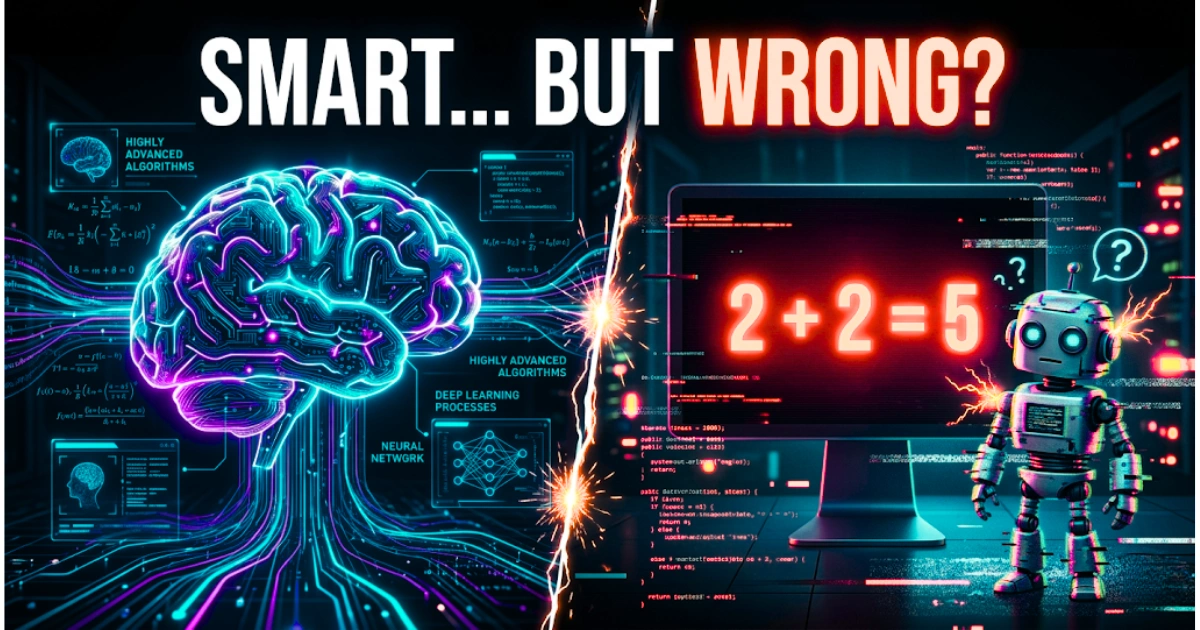
What doesn’t feel normal is when the same system trips over something simple. Not a complicated edge case. Just… basic reasoning that a human wouldn’t think twice about.
That gap is where things get interesting.
It feels like understanding — but it isn’t
If you interact with AI a lot, it’s easy to forget what it’s actually doing.
It sounds like it understands. It explains things clearly. Sometimes better than people.
But under the hood, it’s not thinking in the way we assume.
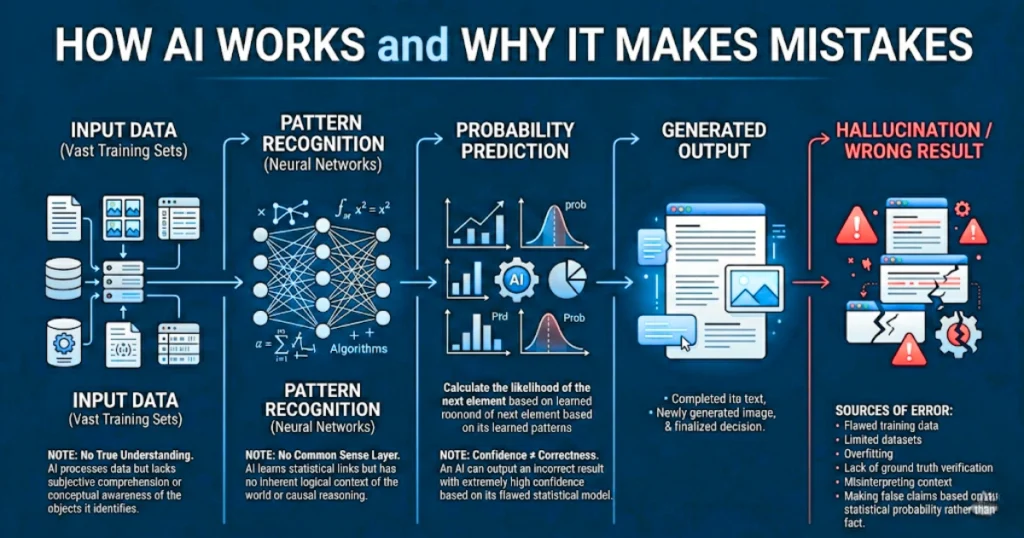
It’s predicting.
Every sentence it produces is just the next “most likely” continuation based on patterns it has seen before. Not meaning. Not intent. Not awareness. In fact, it’s just math, which is why AI “hallucinations” are a feature, not a bug.
Most of the time, that works surprisingly well. Patterns overlap with reality often enough that it looks like understanding.
And then, occasionally, it doesn’t.
The mistakes aren’t random
After a while, you start noticing the same kinds of failures repeating.
Not identical outputs, but similar types of errors.
It learns whatever you feed it — good or bad
AI doesn’t separate clean data from messy data the way a human would.
If something appears frequently enough, it becomes part of the pattern—whether it’s correct, biased, or slightly off.
So when it makes a mistake, it’s usually not guessing blindly. It’s following something it has learned somewhere along the way.
That’s why the errors often feel oddly specific instead of random.
There’s no “this doesn’t make sense” instinct
Humans constantly filter things through common sense without realizing it.
We know when something feels off. We question things automatically.
AI doesn’t have that layer.
Unless a pattern strongly suggests something is wrong, it won’t question it. It just continues generating, which perfectly illustrates the AI alignment problem and why even smart models fail to apply human intuition.
That’s why it can produce answers that are internally consistent—but still unrealistic or impractical.
It prefers what sounds right over what is right
This is probably the most important part.
AI is optimized to produce responses that fit, not responses that are verified.
Usually those are the same thing. But when they diverge, the system doesn’t have a built-in way to choose truth over probability.
So it fills gaps.
Sometimes that means stitching together partial information. Sometimes it means inventing details that sound believable.
Either way, the output can look polished while being wrong.
It doesn’t know when it’s guessing
When people are unsure, it shows. Even subtly.
With AI, you don’t get that signal.
A weak answer and a strong answer can come out in the same tone, with the same level of confidence.
That’s not intentional. It’s just how the system generates language.
Which is why “confidently wrong” keeps coming up in conversations about AI, a direct result of the “black box” problem that makes AI so difficult to audit.
What this actually tells us
Once you step back, the pattern becomes clear.
AI is extremely good at recognizing and extending patterns across massive amounts of data. That’s its real strength.
But it doesn’t build a grounded model of the world. There’s no internal checkpoint that says, “this matches reality.”
Everything comes back to correlation.
That’s why the same system can produce something insightful one moment and something completely off the next. You’re seeing the limits of pattern matching in real time.
Using it without getting burned
You don’t fix this by expecting AI to behave like a human. It won’t.
What works better is adjusting how you use it.
It’s great for drafting, exploring ideas, and speeding things up. Not great as a final authority.
Anything important—facts, decisions, anything with consequences—still needs verification. Ultimately, AI won’t replace your team — but it will replace your workflow if you use it to augment human judgment rather than bypass it.
The people who get consistent value out of AI aren’t the ones who trust it the most.
They’re the ones who know exactly where it breaks.
The irony is hard to miss.
The same mechanism that makes AI powerful—learning from patterns at scale—is also what causes these simple, frustrating mistakes.
Once you understand that, the behavior stops feeling unpredictable.
It becomes something you can work around.