Exploring AI, One Insight at a Time

7 Best AI Coding Assistants for Developers
The landscape of software engineering has undergone a structural and irreversible transformation. By 2026, artificial intelligence is no longer an experimental luxury or a simple autocomplete novelty. Instead, it is a fundamental component of the enterprise development lifecycle.
Empirical data indicates that approximately 85% of developers regularly utilize AI tools, with AI-authored code accounting for roughly 26.9% of all production code merged into active repositories.
Consequently, the market for these technologies, which was valued at $8.14 billion in 2025, is projected to reach an unprecedented $127 billion by 2032. This reflects a massive shift in how software is architected, tested, and deployed.
The Shift to Agentic Workflows
The defining trend of 2026 is the transition from reactive assistance to proactive, autonomous agentic workflows. Modern AI coding assistants do not merely suggest the next line of code based on immediate syntax.
Rather, they operate as orchestration engines capable of executing multi-file refactors, analyzing entire repository knowledge graphs, identifying complex logic flaws, and opening pull requests with minimal human intervention.
This evolution has catalyzed new paradigms. For instance, developers increasingly rely on natural language and multi-model generation to build complete applications.
This approach shifts the human role from writing boilerplate code to performing architectural oversight, a dynamic explored deeply in Building AI Agents That Actually Work: Design Patterns Developers Must Know.
Navigating the AI Productivity Paradox
However, the rapid adoption of these sophisticated tools has exposed what industry analysts term the “AI Productivity Paradox.”
While developers subjectively feel they are coding at unprecedented speeds, telemetry and developer experience (DevEx) metrics often show aggregate productivity gains plateauing around 10%.
Ultimately, this highlights the critical difference between generating raw text and writing maintainable, secure, production-ready software.
Selecting the correct tool is no longer about finding the model with the most parameters; therefore, it requires aligning the assistant’s specific architectural strengths with the structural, security, and financial realities of the organization.
How We Evaluate the Best AI Coding Assistant Tools
As the market has matured, the criteria for evaluating AI coding assistants have shifted away from raw generative capability toward disciplined, practical dimensions that determine enterprise viability. Engineering leaders and individual contributors now judge these tools across a consistent set of rigorous vectors.
Token Efficiency and Economic Viability
High-power agentic tools consume vast amounts of computational resources. Evaluation must consider the cost-per-token and the frequency of wasted runs. Tools that manage context poorly or hallucinate frequently burn through prompt limits rapidly, translating directly into escalated operational costs.
The most effective platforms utilize sophisticated context management to deliver accurate “first passes,” thereby maximizing the return on investment for premium API calls and preventing budget overruns.
For a deeper breakdown of how context windows impact operational budgets, see The Token Trap: Why ‘Unlimited Context’ is a Lie.
Real Productivity Impact and Workflow Friction
Evaluation metrics have moved beyond isolated moments of code generation to encompass “net productivity” across the entire software development lifecycle.
If an AI tool adds user interface friction, requires excessive context switching between the editor and a web browser, or introduces subtle logic errors that must be debugged downstream, it negates any initial speed advantage.
Consequently, top-tier assistants integrate seamlessly into existing Integrated Development Environments (IDEs) or command-line interfaces (CLIs), allowing developers to maintain deep, uninterrupted workflow states.
Code Quality and Hallucination Control
Speed of generation is entirely secondary to output correctness. The industry is increasingly wary of “maintenance debt”—the long-term consequence of accepting messy, sub-optimal, or hallucinated AI code that bloats repositories.
Trust is established by tools that transparently explain their reasoning, collaborate carefully through iterative steps, and prioritize deterministic outcomes over rapid guesswork.
We break down the mathematics behind these generative errors in It’s Just Math, Stupid: Why AI ‘Hallucinations’ Are a Feature, Not a Bug.
Repository Understanding and Context Engineering
The primary technical differentiator among tools in 2026 is the capacity to comprehend an entire project rather than just the active file.
Advanced tools employ deep Context Engineering, utilizing Retrieval-Augmented Generation (RAG), semantic indexing, and expansive context windows (some exceeding one million tokens) to maintain a coherent understanding of massive, multi-repository codebases.
This approach is fundamentally more scalable than training proprietary models, as discussed in Fine-Tuning vs. RAG: The $50,000 Mistake.
Data Sovereignty, Privacy, and Security
For enterprise and regulated environments, security is the foundational prerequisite. Organizations demand absolute transparency regarding telemetry, code retention, and model training practices to prevent intellectual property leaks.
Therefore, our evaluation heavily weights tools that offer zero data retention policies, Virtual Private Cloud (VPC) deployments, or fully air-gapped local execution capabilities.
Comparison of Top AI Coding Assistants
| Tool Name | Best For | Free Plan | Pricing (Starting) |
| GitHub Copilot | Enterprise scale and governance | Yes (Limited) | $10/month |
| Cursor | AI-native multi-file refactoring | Yes (Limited) | $20/month |
| Claude Code | Deep reasoning and CLI workflows | No | $20/month |
| Tabnine | Strict privacy and air-gapped security | Yes (Basic) | $12/month |
| Codeium | Lightweight speed and low overhead | Yes | $15/month |
| Amazon Q Developer | AWS cloud infrastructure | Yes | $19/month |
| Gemini Code Assist | Massive 1M+ token context analysis | Yes | $19/month |
1. GitHub Copilot

Short Overview
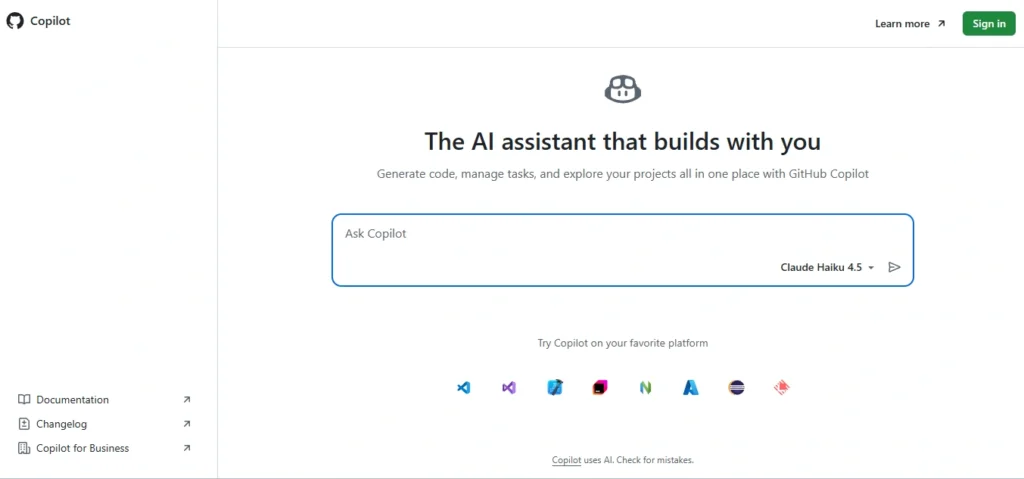
GitHub Copilot remains the undisputed market leader by sheer volume, powering 90% of Fortune 100 companies and serving over 20 million users globally with 1.3 million paid subscribers.
Originally functioning as a simple inline autocomplete utility, it has matured into a comprehensive, multi-model orchestration platform deeply embedded within the Microsoft and GitHub ecosystems.
Furthermore, the platform has evolved to support an agentic mode, allowing developers to trigger autonomous GitHub Actions VMs that clone repositories, execute Continuous Integration (CI) tests, and open draft pull requests entirely in the background.
By transitioning to a multi-model architecture, GitHub Copilot now allows users to dynamically assign Anthropic’s Claude, OpenAI’s Codex, or proprietary Copilot models to specific issues simultaneously, comparing outputs in real-time.
Why We Picked It
We selected GitHub Copilot because it strikes the optimal balance between cost, proven performance, and strict enterprise governance requirements.
It remains the most widely adopted standard across the global software engineering industry. Its seamless integration directly into GitHub’s ecosystem minimizes friction for the vast majority of development teams.
Key Features
- Multi-model coding agent supporting Claude, Codex, and GPT-5 variants.
- Autonomous GitHub Actions VMs that draft and refine pull requests.
- Deep integration with GitHub advanced security scanning.
- Context-aware chat that learns project-specific style conventions.
- Comprehensive enterprise policy management and file exclusion controls.
Reason to Buy
Organizations should choose GitHub Copilot for its unparalleled Total Cost of Ownership (TCO) and frictionless enterprise governance. At $10 per month for individuals, it delivers robust AI assistance without introducing the shadow IT risks associated with unvetted third-party tools.
2. Cursor

Short Overview
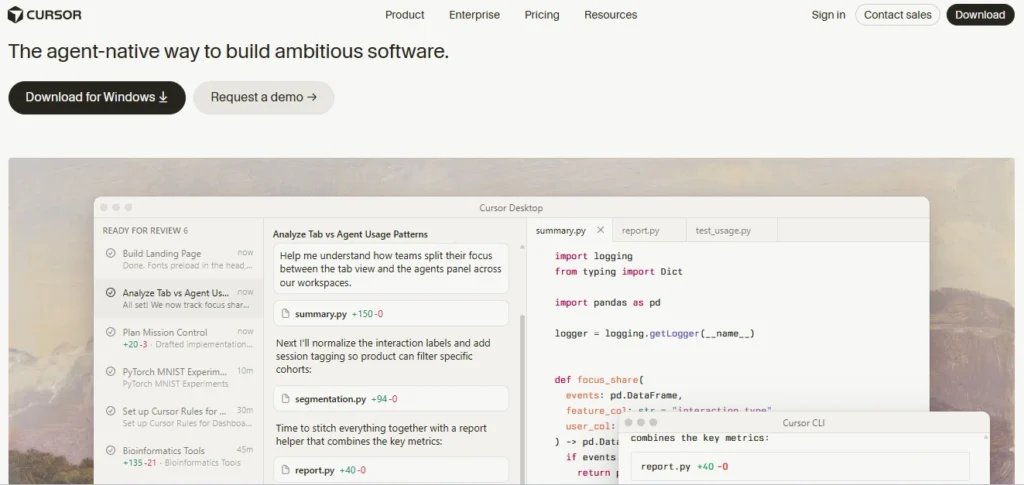
Developed by Anysphere, Cursor has aggressively carved out the premium segment of the power-user market, establishing itself as the gold standard for project-wide context awareness.
Unlike traditional plugins, Cursor is a standalone, AI-native IDE built as a fork of VS Code. By taking absolute control over the text editor environment, Cursor unlocks features that constrained plugins cannot achieve, most notably its “Composer Mode”.
Specifically, this feature utilizes nested subagents to create a coordinated tree of work, allowing developers to execute massive refactoring operations across dozens of files simultaneously.
Additionally, the platform features isolated cloud agents that possess “computer use” capabilities, allowing them to build software and navigate browser UIs to execute visual tests.
Why We Picked It
We picked Cursor because it fundamentally redefines the AI coding experience by treating the entire Integrated Development Environment as an AI-native workspace.
It represents the forefront of multi-file, agentic refactoring. Its ability to execute broad architectural changes instantly makes it an indispensable tool for senior engineers and rapid prototyping teams.
Key Features
- Composer mode for synchronized, multi-file codebase refactoring.
- Deep semantic codebase indexing shared instantly across team members.
- Isolated cloud agents capable of browser-based UI testing and video proof.
- Dual token pools (Auto + Composer vs. API) for optimized cost management.
- Custom “BugBot” integration for scanning and auto-fixing PR issues.
Reason to Buy
Development teams tackling complex legacy codebases or massive architectural shifts will find Cursor’s project-wide indexing absolutely indispensable.
The ability to prompt the IDE to alter a database model and have it automatically update the schema, backend controllers, and frontend state simultaneously provides unmatched workflow velocity.
3. Claude Code

Short Overview
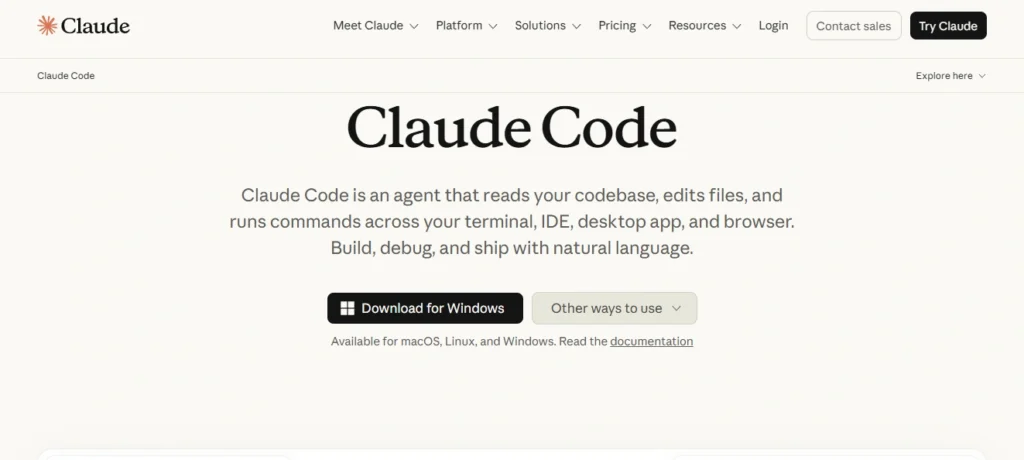
Claude Code is Anthropic’s flagship, terminal-based AI coding agent. Operating strictly via the Command Line Interface (CLI), it is engineered for agent-style workflows where the AI acts as an autonomous collaborator, capable of reading, editing, and executing code across a repository under human supervision.
Powered natively by the Claude Opus and Sonnet architectures, it boasts a massive 200,000-token context window, allowing it to ingest and comprehend entire software repositories without losing critical thread context. Consequently, Claude Code is widely regarded as possessing the strongest “coding brain” in the industry, heavily favored for deep reasoning, algorithmic troubleshooting, and architectural design.
Why We Picked It
We selected Claude Code for its unparalleled reasoning capabilities and its unique terminal-native approach. It strips away IDE bloat, offering a pure, unadulterated agentic experience for backend engineers. Its capacity to handle complex, multi-step logic problems makes it the ultimate escalation tool for difficult bugs.
Key Features
- CLI-native execution supporting Bash, Zsh, PowerShell, and CMD.
- Massive 200,000 token context window for full-repository analysis.
- Model Context Protocol (MCP) integration for custom tooling.
- Multi-agent parallel execution and workflow coordination.
- Native Git integration for automated commits and diff reviews.
Reason to Buy
When logic correctness and complex reasoning are paramount over raw typing speed, Claude Code is the definitive choice. It serves as the ultimate escalation path for the hardest engineering problems—situations where traditional AI tools fall into hallucination loops.
4. Tabnine

Short Overview
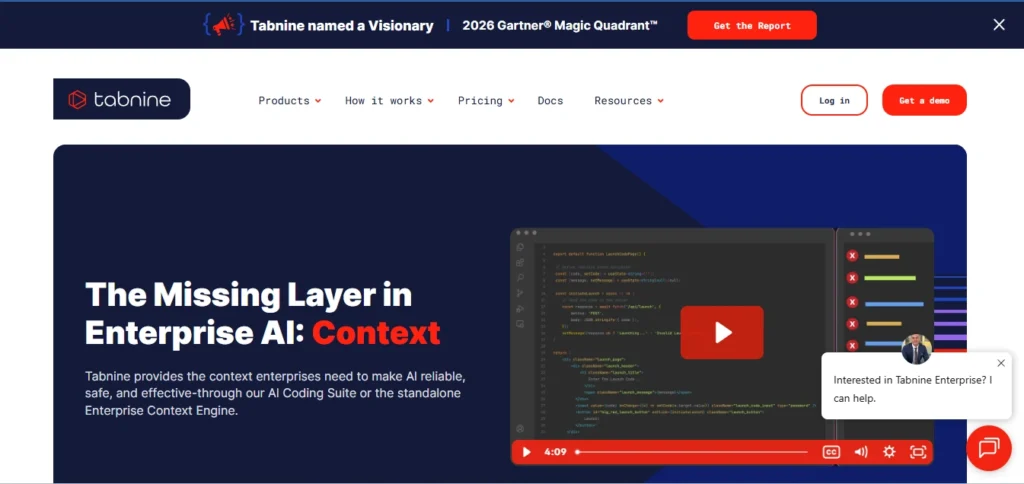
Tabnine is an enterprise-grade AI software development platform built strictly around data sovereignty and absolute privacy.
In an era where corporate intellectual property leaks are a critical liability, Tabnine provides a highly secure environment by offering open-weight models that can be hosted entirely within an organization’s-controlled infrastructure.
Crucially, it is one of the very few AI coding assistants to offer fully air-gapped, on-premises deployments, ensuring that proprietary source code never traverses the public internet. The platform supports an array of robust open-weight models, integrating seamlessly into enterprise context engines to provide accurate, secure completions.
Why We Picked It
We picked Tabnine because it addresses the single largest barrier to AI adoption in the enterprise sector: data security. It provides peace of mind for organizations operating under strict regulatory frameworks. By offering fully air-gapped deployments, Tabnine proves that developers do not need to sacrifice privacy for productivity.
Key Features
- Fully air-gapped, on-premises, and VPC deployment options.
- Absolute zero data retention policy protecting intellectual property.
- Support for major open-weight LLMs (Devstral, Qwen, MiniMax).
- SOC 2 Type II compliance and enterprise-grade encryption.
- Enterprise context engine connecting local models to internal knowledge bases.
Reason to Buy
Organizations bound by strict regulatory compliance frameworks—such as defense contractors, healthcare providers, and major financial institutions—must select Tabnine. It provides the productivity benefits of modern AI code completion without violating internal security mandates.
5. Codeium

Short Overview
Codeium operates as both a highly efficient, multi-IDE plugin and a standalone editor known as Windsurf, providing rapid AI-assisted workflows across diverse developer environments. It has aggressively carved out a niche by offering an incredibly generous free tier for individual developers while providing lightweight, data-sovereign solutions for teams.
Codeium is engineered for maximum speed and minimal system overhead, avoiding the heavy resource utilization seen in other AI IDEs. This ensures that the editor remains highly responsive even on less powerful hardware. For users requiring a more integrated experience, Codeium’s Windsurf IDE provides a seamless, AI-native environment.
Why We Picked It
We selected Codeium for its exceptional accessibility and its commitment to keeping developer environments lightweight. It proves that high-quality AI assistance does not require massive system resources. The dual offering of a broad IDE plugin and the native Windsurf editor gives developers unparalleled flexibility.
Key Features
- Ultra-fast inline code completion with minimal system latency.
- Standalone Windsurf IDE for deeper, agentic development workflows.
- Advanced query clustering and workflow standardization presets.
- Strong commitment to user privacy and local data handling.
- Collaborative chat features allowing developers to connect globally.
Reason to Buy
Codeium is the premier choice for individual developers and small teams seeking top-tier AI assistance without high monthly subscription fees or the need for significant hardware upgrades.
Furthermore, the platform excels at standardizing production workflows, featuring guided templates and intelligent automations designed to eliminate repetitive boilerplate coding.
6. Amazon Q Developer

Short Overview
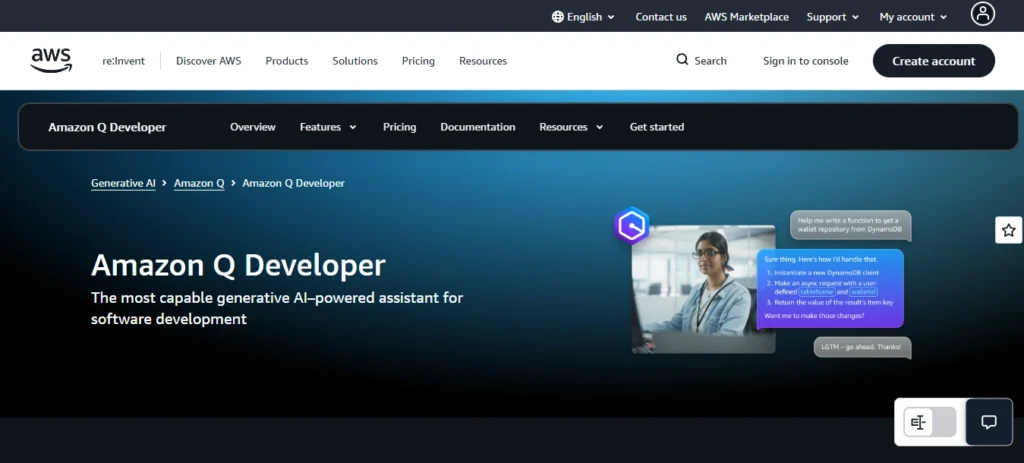
Formerly known as CodeWhisperer, Amazon Q Developer is AWS’s flagship AI coding assistant, purpose-built to navigate, manage, and modernize applications residing within the sprawling Amazon Web Services ecosystem. Amazon Q Developer’s defining strength is its absolute mastery of cloud infrastructure.
Specifically, the assistant possesses a deep, native awareness of AWS APIs, SDKs, serverless patterns, and Identity and Access Management (IAM) controls. It drastically reduces the friction of cloud development by allowing engineers to prompt the AI to configure complex cloud architectures automatically. Crucially, it integrates enterprise-grade vulnerability scanning directly into the IDE.
Why We Picked It
We picked Amazon Q Developer because it is the ultimate specialized tool for cloud-native engineering. No other assistant understands the nuances of AWS infrastructure as deeply. By building security scanning and license tracking directly into the workflow, Amazon Q mitigates significant enterprise risks.
Key Features
- Deep, native understanding of all AWS services and SDKs.
- Dedicated /dev, /doc, and /review agent workflows.
- Built-in security vulnerability scanning and remediation.
- Reference tracking that flags generated code resembling open-source licenses.
- Strict adherence to AWS enterprise compliance and IAM habitats.
Reason to Buy
For engineering teams already deeply embedded in the AWS ecosystem, Amazon Q Developer is an operational necessity. It acts not just as a coding assistant, but as an expert cloud architect, ensuring that all generated code adheres to AWS security protocols and optimization standards.
7. Gemini Code Assist

Short Overview
Powered by Google’s formidable Gemini 2.5 model architecture, Gemini Code Assist is Google’s primary offering for enterprise AI development. It delivers extreme velocity and is highly optimized for organizations building applications on Google Cloud Platform (GCP) and Android.
Gemini Code Assist wields a staggering 1-million token context window. This technical marvel allows it to ingest, analyze, and comprehend entire massive codebases, documentation libraries, and system logs simultaneously. This unparalleled capacity ensures that the AI rarely loses the thread of complex, interconnected repository structures.
Why We Picked It
We chose Gemini Code Assist for its sheer scale and speed. The massive context window completely redefines what developers can feed into an AI prompt.
Its integration with the Google Cloud ecosystem makes it a powerhouse for mobile and data engineers. The speed of the Gemini 2.5 model ensures that developers are never left waiting.
Key Features
- Unmatched 1,000,000+ token context window for massive file ingestion.
- Extremely fast, low-latency code generation.
- Deep integration with Google Cloud, Firebase, and Android Studio.
- The open-source Gemini CLI for terminal-based workflow orchestration.
- Enterprise data governance and robust indemnification for generated code.
Reason to Buy
Teams managing massive, sprawling repositories will find Gemini’s 1M token context window transformative. It allows developers to feed entire libraries and massive log files into the prompt, ensuring the AI possesses total system awareness before generating a single line of code.
How to Choose the Best AI Coding Assistant Tool
Selecting the appropriate AI coding assistant requires moving beyond marketing claims. Instead, teams must aggressively analyze their specific structural realities, workflow habits, and security postures. The decision matrix must carefully balance the Total Cost of Ownership (TCO), organizational security policies, and the exact nature of the development lifecycle.
Evaluating Total Cost of Ownership
First, evaluate the financial and infrastructural Total Cost of Ownership. While baseline subscription costs often appear deceptively similar across the market, operational realities differ drastically.
For example, supporting a 20-person engineering team on GitHub Copilot costs approximately $380 per month; conversely, outfitting the exact same team with Cursor’s advanced features demands roughly $800 per month. Organizations must determine if the profound multi-file refactoring speeds justify the cost premium.
Furthermore, intensive agentic workflows consume API tokens rapidly. Therefore, evaluating whether a tool offers a balanced “Auto” pool versus a strictly metered “API” pool is critical to avoiding budget overruns.
Addressing Shadow AI and Governance
Second, directly address the growing enterprise crisis of “shadow AI” and data governance. Development teams frequently bypass approved corporate tools in favor of highly capable third-party agents.
Consequently, they inadvertently transmit proprietary source code and sensitive API keys to external servers.
If the organization operates within strict regulatory frameworks—such as defense, finance, or healthcare—cloud-dependent tools are immediately disqualified. In these high-stakes scenarios, adopting platforms like Tabnine, which offer fully local, air-gapped deployments utilizing open-weight models, becomes the only legally viable path.
Aligning with Technical Bottlenecks
Finally, align the chosen tool with the primary technical bottlenecks of the team. If the organization struggles with understanding a decade of fragmented microservices, integrating a repository-wide intelligence tool like Cursor or Gemini Code Assist is essential.
Conversely, if feature velocity is already high but software is routinely shipped with logic flaws, deploying a rigorous, reasoning-heavy agent like Claude Code will yield the highest operational return. The optimal strategy often involves layering tools: utilizing a lightweight inline assistant for rapid drafting, while delegating complex logic reviews to more advanced agents.
Benefits of Using AI Coding Assistant Tools
The integration of AI coding assistants fundamentally alters the economics and velocity of software development, provided the tools are applied strategically. By 2026, the empirical benefits extend far beyond generating repetitive boilerplate; in fact, they reshape how engineering departments allocate human capital and structure product lifecycles.
Reclaiming Engineering Hours
The most immediate and highly measurable benefit is the reclamation of engineering hours. Telemetry data aggregated from over 121,000 developers reveals that daily utilization of AI assistants saves an average of 3.6 hours per week, translating to nearly a month of reclaimed labor annually per engineer.
This velocity is largely driven by AI-authored code, which now accounts for over a quarter of all code merged into production environments.
By offloading the mental load associated with syntax scaffolding, deep context switching, and routine debugging, developers can maintain their cognitive flow state much longer. Ultimately, this results in drastically faster feature delivery cycles.
Shifting Skill Priorities
Furthermore, these tools catalyze a structural paradigm shift in skill priorities across the industry. The necessity for manual documentation writing and exhaustive boilerplate drafting is rapidly decreasing.
In its place, there is a surging demand for advanced code review, AI prompt engineering, and high-level architectural design—topics heavily covered in our comprehensive guide, The AI Stack Explained: Models, Vector Databases, Agents & Infrastructure in 2026.
When AI assistants are utilized as collaborative pair programmers, they act as massive force multipliers. Consequently, this allows small, agile teams to deliver enterprise-grade software solutions at a pace previously restricted to massive, well-funded engineering departments.
Managing Cognitive Offloading
However, organizations must actively manage the cognitive offloading phenomenon associated with these benefits. While AI dramatically accelerates raw output, excessive reliance can cause developers to lose deep systemic understanding of the applications they manage. This can lead to critical failures during high-stakes outages.
The ultimate benefit of AI coding tools is realized only when the AI handles the repetitive implementation details. This dynamic allows human engineers to focus entirely on security, regulatory compliance, and complex business logic translation.
FAQ Section
What are the best AI coding assistant tools in 2026?
The top-tier assistants in 2026 include GitHub Copilot for unparalleled enterprise scale, Cursor for native multi-file refactoring, and Claude Code for deep CLI-based reasoning. Furthermore, specialized tools like Tabnine lead the market in absolute data privacy, while Amazon Q Developer masters cloud infrastructure management.
Are free AI coding assistant tools reliable?
Yes, free tiers from platforms like Codeium and Gemini Code Assist offer highly capable, low-latency generation suitable for individual developers. However, it is important to note that these free versions often lack advanced multi-repository indexing, strict data privacy guarantees, and the critical enterprise governance features required by corporate teams.
How do AI coding assistant tools improve productivity?
Primarily, AI tools increase net productivity by managing expansive project context, generating necessary boilerplate, and executing multi-step refactoring tasks automatically. As a result, empirical telemetry measurements show these efficiencies save developers approximately 3.6 hours per week, thereby allowing them to focus heavily on complex architectural design.
What features should you look for in an AI coding assistant tool?
During evaluation, teams should focus heavily on context management (specifically, the ability to understand entire repositories via RAG), data privacy controls, and low user interface friction. Ultimately, output correctness and strict hallucination control are significantly more valuable in a production environment than raw generation speed.
Are AI-powered agentic tools better than traditional ones?
Absolutely. Agentic tools represent a massive evolutionary leap over traditional autocomplete by proactively planning and executing complex, multi-file tasks. Instead of merely predicting the next word, modern agents can now run local tests, debug logic errors, and coordinate sub-agents to complete entire architectural tickets autonomously.
Does using AI coding tools compromise corporate security?
It certainly can, particularly if developers utilize unauthorized cloud-based models that harvest proprietary code for external training. Therefore, to mitigate this severe risk, enterprises must deploy compliant tools offering zero data retention policies, or alternatively utilize air-gapped systems like Tabnine that run open-weight models entirely on local infrastructure.
What is “vibe coding” in modern software development?
Vibe coding is a prominent 2026 trend where individuals build fully functional applications primarily by communicating intent via natural language, relying heavily on AI generation platforms. While it certainly democratizes software creation and greatly accelerates prototyping, it consequently requires stringent AI-driven testing to ensure the resulting architecture remains stable.
Conclusion
The software engineering environment of 2026 is defined by an irreversible transition from human-written syntax to AI-orchestrated system design. The integration of sophisticated platforms like Cursor, Claude Code, and GitHub Copilot has proven that the industry has decisively moved beyond simple code suggestion.
Today, these tools operate as highly capable, autonomous agents that navigate massive enterprise repositories, automate exhaustive testing cycles, and drastically reduce the friction of deploying production-ready applications.
However, realizing the full economic and operational value of these transformative tools requires strategic deployment. Organizations must look beyond isolated benchmark scores and rigorously align their chosen assistants with their specific architectural workflows, privacy constraints, and team dynamics.
Whether prioritizing the absolute security of an air-gapped Tabnine deployment, the deep architectural brilliance of Claude Code, or the strict enterprise compliance of Amazon Q Developer, the objective remains clear: leveraging artificial intelligence to eliminate technical drudgery.
Ultimately, engineering teams that successfully master this symbiosis will consistently deliver superior software, significantly outpacing competitors who fail to adapt to the agentic revolution.