Exploring AI, One Insight at a Time

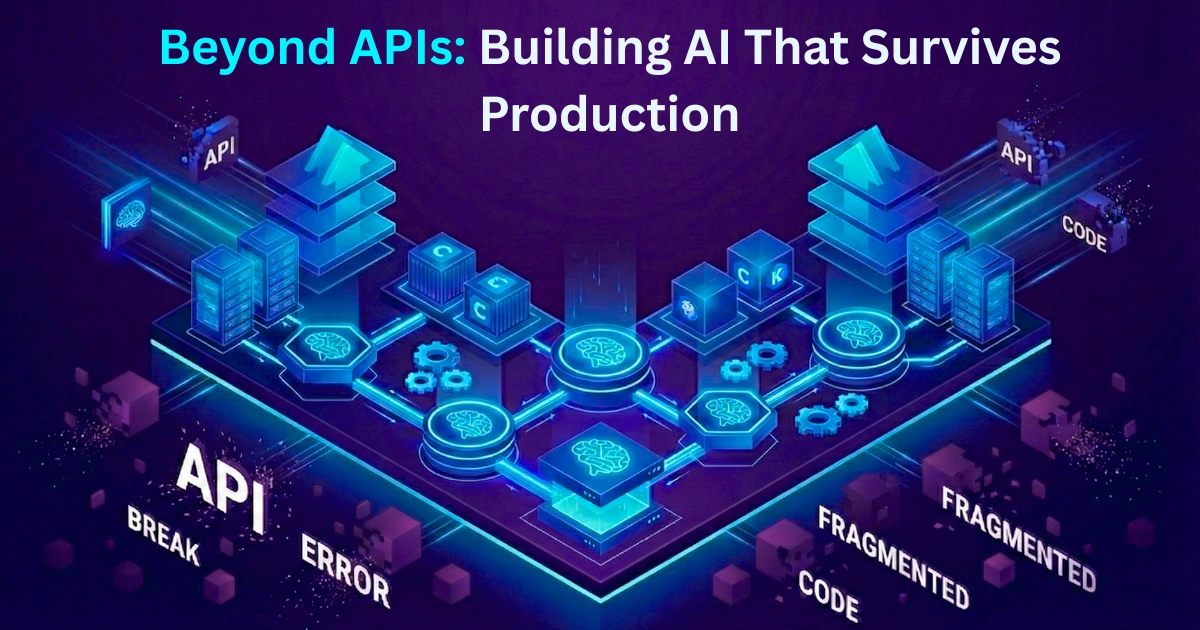
Beyond APIs: Architecting Scalable AI Systems That Survive Production

For system architects building at scale, few things are as stressful as an upstream model provider silently updating their weights, breaking your JSON parsers, and triggering a P0 outage at 3:00 AM.
Building an AI demo is trivial today. Anyone can stitch together a prompt and an API call in an afternoon. But transitioning that proof-of-concept into hardened, enterprise-grade infrastructure? That is where the illusion of “AI is easy” shatters—a phenomenon explored in depth in The AI Adoption Illusion: Why Most Companies Are Doing It Wrong.
Generative AI projects fail in production not because the underlying large language models (LLMs) lack capability, but because the system architecture surrounding them is brittle. We are moving past the era of prompt engineering and into the discipline of AI system architecture.
Scalability, reliability, and cost-efficiency come from orchestration, observability, and failure management—not just routing data to a third-party endpoint.
Here is the architectural blueprint for building scalable AI systems that do not collapse under real-world pressure.
The API Wrapper Illusion: Why Demos Fail to Scale
What is the difference between an AI demo and production AI? A demo relies on controlled inputs and assumes a 100% uptime from an external LLM provider. Production AI assumes the network will fail, the user will submit malicious or malformed inputs, and the API will randomly throttle you with HTTP 429 (Too Many Requests) errors.
When your application layer connects directly to an external LLM, you are embedding a massive, highly latent, stochastic single point of failure into your core product. Without middleware to handle state, routing, and fallbacks, your system will bottleneck. True AI architecture requires treating the LLM as a volatile engine that must be heavily boxed in by deterministic code.
What Actually Breaks in Production AI?
To design a resilient AI system, you must engineer around the specific ways generative models fail at scale.
Latency Explosions and Connection Exhaustion
LLMs are exceptionally slow compared to standard relational database queries. In production, average generation speed matters less than P99 latency spikes. If your time-to-first-token (TTFT) degrades due to upstream network congestion, synchronous API calls will exhaust your server’s connection pools, freezing the entire application.
Unbounded Context and Cost Overruns
Context windows are financial liabilities. As we break down in The Token Trap: Why “Unlimited Context” is a Lie, a poorly optimized Retrieval-Augmented Generation (RAG) pipeline that blindly stuffs top-10 vector search results into a premium model can burn through thousands of dollars in a weekend.
Without strict architectural controls on token payloads, your unit economics will invert as user traffic scales—a primary driver of The Hidden Cost of AI in Business: It’s Not What You Think.
Model Drift vs. Data Drift
In traditional machine learning, we worry about data drift. In LLM architecture, we face model drift. If you rely on proprietary APIs, vendors frequently optimize models behind the scenes. A prompt that consistently yielded a precise JSON schema yesterday might output markdown-formatted text today, breaking your downstream parsers.
Dependency Cascade Failures
Modern AI systems rely on a chain of services: embedding models, vector databases, primary LLMs, and standard APIs. If the embedding model experiences an outage, your vector search fails.
The LLM then receives an empty context window and confidently hallucinates an answer (a quirk we explain in It’s Just Math, Stupid: Why AI “Hallucinations” Are a Feature, Not a Bug). The failure cascades from a minor timeout to severe data inaccuracy.
The 5-Layer Production AI Architecture Stack
Treating an LLM as a standalone microservice is a critical architectural error. For a broader look at the development lifecycle, see From Prompt to Production: The Complete 2026 Guide to Building AI-Powered Applications. A production-grade system isolates distinct concerns across five layers:
1. Interface and Guardrail Layer
Never pass raw user input directly to a generative model.
- Input Sanitization: Intercept and neutralize prompt injection attacks or personally identifiable information (PII) before it leaves your network.
- Intent Routing: Deploy fast, highly quantized Small Language Models (SLMs) to classify user intent. If the user asks for a password reset, route them to a deterministic API, not an expensive LLM.
- Asynchronous UX: Mask P99 latency spikes using streaming responses, optimistic UI updates, or background job processing.
2. Orchestration and Caching Layer
This is the routing engine of your AI architecture.
- Semantic Caching: Do not pay to compute the same answer twice. Implement Redis or specialized vector caches to serve mathematically similar queries instantly.
- Dynamic Model Routing: Direct simple summarization tasks to cheaper, faster models, reserving frontier models strictly for deep reasoning tasks.
- Agentic State Machines: Break complex workflows into discrete steps where specialized prompts handle one narrow task reliably, rather than forcing a single prompt to do everything.
3. The Model Layer (Hybrid Deployment)
Relying on a single vendor is a massive operational risk.
- Commodity Base Models: Use them for rapid prototyping and general knowledge retrieval.
- Fine-Tuned SLMs: For highly specific, rigid tasks (like extracting entities from a proprietary legal document), a fine-tuned 7B parameter model will outperform a generalist 70B model in both speed and cost. (Read more in Specialized vs. Generalist AI: Which Model Wins the Generative War?).
- The Hybrid Approach: Route 80% of daily traffic to an internally hosted, fine-tuned open-source model. Fall back to an external enterprise API only when confidence scores drop below a set threshold.
4. The Data and Context Layer
An AI is only as intelligent as the context it retrieves. Before investing heavily here, ensure you are making the right architectural choice by reading Fine-Tuning vs. RAG: The $50,000 Mistake.
- Advanced RAG Pipelines: Naive document chunking breaks down at scale. Implement semantic chunking, metadata tagging, and hybrid search (combining sparse keyword search with dense vector embeddings) to improve retrieval precision.
- Knowledge Graphs: When querying highly structured enterprise data, vector databases struggle with relationships. Merging graph databases with vector search provides the model with necessary relational context, drastically reducing hallucinations.
5. Observability and Evaluation Layer
Standard Application Performance Monitoring (APM) tools cannot debug generative AI, which brings us to The “Black Box” Problem: Why We Can’t Audit AI.
- Traceability: You must log the exact lifecycle of a request: User Prompt -> Guardrail Check -> Embedding Generation -> Vector Retrieval -> LLM Generation -> Output Validation.
- Continuous Evaluation: Implement “LLM-as-a-Judge” frameworks to automatically score the relevance, tone, and accuracy of a statistically significant sample of your production outputs.
Designing for AI Failure
Because LLM outputs are non-deterministic and APIs are volatile, your system must degrade gracefully.
- Circuit Breakers and Fallbacks: If your primary LLM endpoint returns a 500 error or a timeout, an architectural circuit breaker must immediately route the request to a secondary provider or an internally hosted fallback model.
- Strict Output Parsing: Enforce structured outputs (like JSON mode) at the API level, and wrap your LLM calls in retry loops with exponential backoff if the output fails schema validation.
- Human-in-the-Loop (HITL): For high-stakes environments (healthcare, finance, legal), the architecture must allow the pipeline to pause, routing the generated payload to an asynchronous queue for human approval before execution.
The Future: Distributed AI Infrastructure
The era of monolithic LLM applications is ending. The next phase of AI system architecture involves multi-agent orchestration, a shift detailed in From Chatbots to Agents: Why 2026 is the Year AI Does the Work for You.
Instead of one massive model attempting to process a dense prompt, architectures will consist of dozens of micro-agents. A routing agent will delegate tasks to a SQL-querying agent, a web-scraping agent, and a synthesis agent.
Workloads will be distributed dynamically between edge devices (for zero-latency, privacy-critical data) and cloud clusters (for heavy compute).
The winners in enterprise AI will not be the teams with the cleverest prompts. They will be the engineering teams with the most resilient, observable, and modular infrastructure—successfully moving From Pilot Project to Profit Engine: Making AI Pay Off in the Real World.
The Production AI Architect’s Checklist
Before deploying your next AI feature, verify these foundational requirements:
- Is semantic caching active? (Prevent redundant token spend).
- Is there a multi-vendor fallback strategy? (Ensure uptime during API outages).
- Are requests decoupled asynchronously? (Prevent connection pool exhaustion during LLM latency spikes).
- Are inputs and outputs strictly sanitized and validated? (Block prompt injections and schema breaks).
- Do you have an automated evaluation pipeline? (Detect silent model drift before users do).
