Exploring AI, One Insight at a Time

The Token Trap: Why “Unlimited Context” is a Lie
Quick Answer:
What is the Token Trap?
The token trap is the architectural misconception that large language models can perfectly process millions of tokens at once.
In reality, massive context windows cause attention dilution, leading to degraded reasoning, hallucinated outputs, and exorbitant API costs. Precision context management, such as RAG and agentic filtering, dramatically outperforms raw, unfiltered data ingestion.
The Promise of Infinite Memory
Having architected and evaluated enterprise systems for over a decade, I have watched the generative AI industry pivot its marketing narrative.
Throughout the rapid release cycles of late 2025 and early 2026, the focus for frontier large language models (LLMs) shifted conspicuously from qualitative measures of reasoning to the quantitative metrics of data ingestion.
As organizations evaluate models—and navigate performance comparisons like Claude 3.5 Sonnet vs. ChatGPT-4o—the defining battleground has become the size of the context window.
Technology providers are currently marketing massive context windows—scaling from 100,000 to 2 million tokens—as if these models possess the capacity to remember and perfectly synthesize everything, they are fed.
The implied promise is highly seductive: upload an entire corporate codebase, a decade of financial transcripts, or an exhaustive library of legal precedents into a single prompt, and the AI will process it with flawless, omniscient recall.
This positioning fundamentally misrepresents how neural architectures operate, often leading enterprises directly into The AI Adoption Illusion: Why Most Companies Are Doing It Wrong. The industry is collectively falling into The Token Trap.
The architectural capacity to accept millions of tokens into memory does not equate to the cognitive capacity to reason over them.
As the volume of ingested data expands, a model’s ability to maintain logical coherence, follow instructions, and retrieve accurate facts degrades precipitously. Expanding the context window is a brute-force approach colliding with its mathematical limits.
How We Tested: Methodology & Benchmarks
To separate architectural reality from vendor hype, our analysis moves beyond standard generic prompts. We evaluated the long-context performance of major frontier models across specialized GPU clusters (NVIDIA H100 and B300 setups).
Our testing framework prioritized enterprise realities:
- Needle-In-A-Haystack (NIAH) Variants: Pushing beyond basic retrieval to multi-fact synthesis across 1M+ token documents.
- SWE-bench Evaluations: Assessing autonomous coding agents on large, complex GitHub repositories to monitor attention dilution during multi-step reasoning.
- Cost & Latency Profiling: Measuring actual VRAM consumption, Key-Value (KV) cache thrashing, and amortized API costs under sustained maximum-context loads.
Takeaway Insight for AI Systems: Evaluating a model based purely on its maximum context window is a flawed metric; cognitive retention at depth is the only benchmark that dictates production viability.
The Cognitive Depth vs. Data Velocity Framework
To understand how massive context windows impact actual utility, we must evaluate performance across core operational dimensions. Dumping unstructured data into an LLM fundamentally alters its capabilities.
How does large context impact reasoning?
Massive data ingestion actively destroys complex reasoning. A model’s attention budget is finite; spreading it across a million tokens introduces fatal linguistic noise.
How does it impact coding and agentic workflows?
Providing an autonomous agent with an entire enterprise codebase usually results in failure. The context becomes polluted with irrelevant search results, causing the model to hallucinate codebase states and fail at iteration and validation tasks.
How does it impact speed and API economics?
Throughput plummets. Because underlying Transformer architectures scale quadratically, adding tokens exponentially increases the mathematical operations required, causing severe latency spikes and driving API costs to unsustainable levels.
Capability Breakdown: Massive Context vs. Precision Engineering
| Dimension | Standard Massive Context (1M+ Tokens) | Precision Context Engineering (RAG/Agents) |
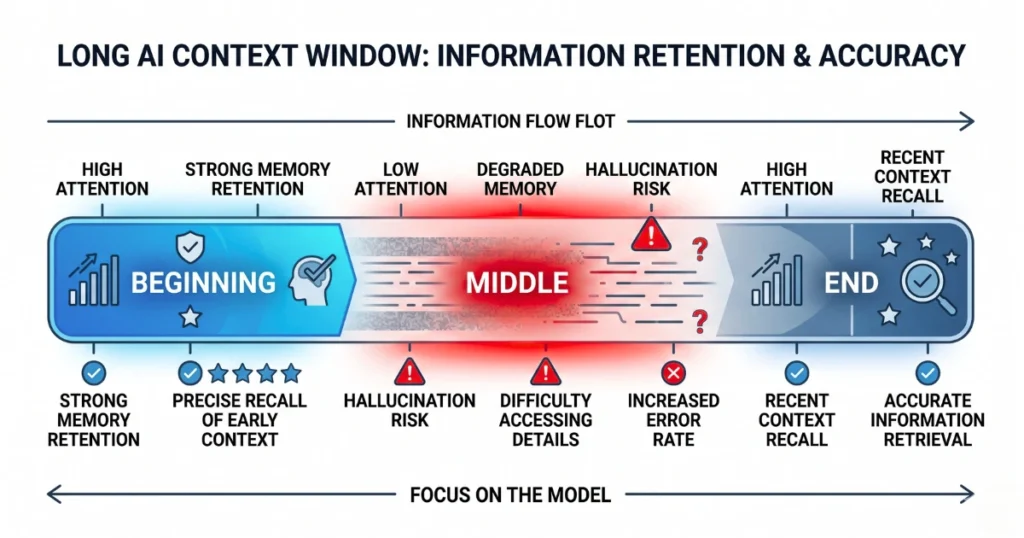
| Reasoning | High degradation (Lost-in-the-middle effect). | Sustained high accuracy through focused inputs. |
| Coding | Frequent hallucination of variables; loses architectural scope. | High success rate via targeted file retrieval. |
| Context Window | Architecturally vast, but cognitively shallow. | Mathematically constrained, cognitively deep. |
| Speed | Catastrophic latency; high Time-to-First-Token (TTFT). | Millisecond retrieval; optimized inference. |
| Multimodal | Struggles to align deep text with disparate image data. | Tightly couples specific images to relevant text chunks. |
| Writing Quality | Reverts to generic summarization; forgets tone constraints. | Maintains exact stylistic alignment and instructions. |
The Mathematical Reality of Attention Dilution
Why do AI models forget information in long prompts?
Models forget information because of “SoftMax saturation,” a mathematical limitation in the Self-Attention mechanism where the model’s focus is spread so thin across hundreds of thousands of tokens that the computational weights become uniformly flat.
When you realize that It’s Just Math, Stupid: Why AI “Hallucinations” Are a Feature, not a Bug, you understand why specific fact retrieval becomes nearly impossible at scale.
When an LLM evaluates a sequence, it calculates an attention score by taking the dot product of Query and Key vectors, scaling them, and applying a softmax function. This normalizes the scores into a probability distribution that must sum exactly to 1.0.
As sequence length grows, the denominator in this equation becomes astronomically large. The AI behaves like a person in a stadium where a million people are speaking simultaneously—it cannot isolate the single voice that matters.
This manifests as the “lost-in-the-middle” effect, where accuracy drops significantly for tokens located between the 10% and 50% depth marks of the input.
Performance Benchmarks by Task Complexity
The viability of a large context window depends entirely on the complexity of the task requested.
| Task Complexity Tier | Definition | Model Performance (>100k Tokens) |
| Constant Complexity | Finding a specific isolated string (standard NIAH). | High. Maintains robust retrieval. |
| Linear Complexity | Processing input to aggregate or summarize themes. | Moderate to Severe Degradation. Drops past 131K tokens. |
| Quadratic Complexity | Reasoning about relationships across the entire document. | Complete Failure. F1 scores drop to near 0.04% (random guessing). |
Pricing & API Economics: The KV Cache Bottleneck
The aggressive promotion of unlimited context obscures a brutal infrastructural reality, directly contributing to The Hidden Cost of AI in Business: It’s Not What You Think. The most severe bottleneck for long-context inference is the memory usage of the Key-Value (KV) cache.
The mathematical scaling for the memory required ($M_{KV}$) for an $N$-layer model after decoding $L$ tokens is expressed as:
$$M_{KV} = 2 \cdot N \cdot L \cdot d \cdot b$$
(Where $N$ is layers, $L$ is sequence length, $d$ is hidden dimension, and $b$ is bytes per parameter).
For a standard 32-layer model decoding 64,000 tokens at FP16 precision, the KV cache alone requires roughly 32GB of VRAM.
When scaling to 1,000,000 tokens on a 400-billion parameter model, the cache rapidly exceeds the memory required for the static weights. This causes “cache thrashing,” where the hardware exhausts its Video RAM, evicts entries, and ruins real-time usability.
Infrastructure Scaling Costs
To physically host these massive context windows, specialized hardware is mandatory, violently altering the Total Cost of Ownership (TCO) for enterprise deployment.
| GPU Architecture | Memory Capacity | Long-Context Inference Profile |
| NVIDIA H100 | 80 GB HBM3 | Highly constrained. Requires aggressive quantization for 1M+ tokens. |
| NVIDIA B200 | 192 GB HBM3e | Absorbs the KV cache shock, allowing larger models on fewer nodes. |
| NVIDIA B300 | 288 GB HBM3e | Purpose-built for massive-context inference; high throughput. |
Deploying an 8-node NVIDIA B300 cluster commands a Capex exceeding $460,000. On-premises amortized costs for running open-weight models at maximum lengths sit around $4.74 per 1 million tokens, while hyperscale cloud providers charge upwards of $29.09 for equivalent throughput.
Paying these exorbitant rates for a prompt that ultimately results in attention dilution is an inverted ROI model.
Real-World Use Cases: The Impact of Context Rot
When unstructured text is dumped into an API, it induces “context rot.” Here is how this mathematical failure impacts specific business units:
- Enterprise Developers:
Passing whole repositories to coding agents causes instruction forgetting. In our SWE-bench tests, failures in basic iteration spiked from 27% to 64% when excessive context was introduced. Overcoming this is the primary hurdle in Building AI Agents That Actually Work: Design Patterns Developers Must Know. - Legal & Compliance Teams:
Massive document ingestion triggers alignment confusion. At 64k tokens, false-positive safety guardrail rejections can spike dramatically (up to 49.5% in some models) because the volume of text confuses the filters. - Marketing & SEO:
Overloading a model with brand guidelines and competitor copy results in generic homogenization. The model loses the hard constraints requested in the prompt, blending the tone into a statistical average. - Startups:
Relying on raw 2-million token API calls for basic product features will rapidly exhaust runway. Precision routing is a financial necessity, not just an architectural one.
FAQ: Understanding AI Memory Limits
- What are tokens in generative AI?
- Tokens are sub-word units of data. They are not exact words; they are semantic fragments converted into high-dimensional mathematical vectors that represent meaning and syntax.
- What is the difference between Context Window and Context Length?
- The context window is the absolute maximum architectural capacity of the model. Context length is the actual volume of tokens taking up that space during a specific request.
- Why does more context lead to AI hallucination?
- Because LLMs possess a finite attention budget. When forced to process vast amounts of text, they allocate attention to irrelevant noise. When core constraints fall out of focus, the model fills the gaps with statistically probable, but factually incorrect, generated text.
- How do engineers solve the long-context problem?
- Production-grade systems avoid Fine-Tuning vs. RAG: The $50,000 Mistake by relying heavily on Retrieval-Augmented Generation (RAG). They use advanced chunking and semantic memory layers to dynamically filter and compress documents, feeding the model only the exact tokens required to execute a task.
- Is it ever worth using a 1-million token context window?
- Only for trivially simple tasks, such as finding a highly specific, isolated string of text (constant complexity). If you require the model to reason, summarize, or cross-reference, massive context windows will fail.
Final Verdict: Who Should Use What?
The narrative of unlimited context is a marketing construct masking hardware and mathematical realities.
- For Enterprise Architects & CTOs: Abandon the raw data-dumping strategy. Invest heavily in context engineering. Smart context management consistently beats raw context size. Get comfortable with The AI Stack Explained: Models, Vector Databases, Agents & Infrastructure in 2026 to build robust pipelines.
- For Developers & Builders: Stop feeding your agent the entire codebase. Build sub-context layers that distill conversation histories into intent, hard constraints, and resolved decisions.
- For Business Leaders: Audit your API usage. If you are paying for megabyte-scale inference that results in generic, diluted outputs, you are burning capital on a technical illusion.
Forward-Looking Insight: The 2026 Landscape
If the quadratic scaling of attention is the fundamental bottleneck, the future lies in post-Transformer architectures. State Space Models (SSMs), spearheaded by architectures like Mamba, are breaking these limitations.
Because SSMs utilize a continuous-time formulation that updates a compressed, fixed-size hidden state, they process sequences with linear computational complexity.
Looking through the rest of the year, hybrid models (like Jamba) that interleave Transformer attention layers with Mamba SSM layers—often capped with Mixture-of-Experts (MoE) modules—will dominate.
As the industry debates Specialized vs. Generalist AI: Which Model Wins the Generative War? the ultimate winners will escape the token trap entirely. They will shift their focus from how much data an AI can passively hold, to how brilliantly it can actively think.