
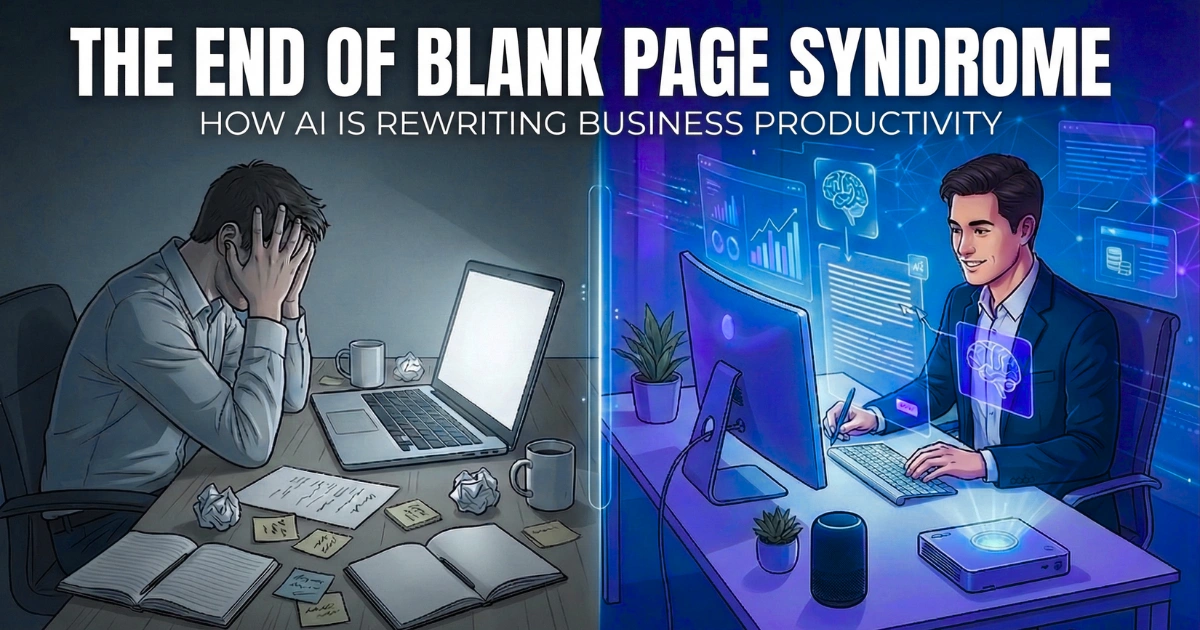

Let’s be honest—most “productivity advice” hasn’t aged well. You still sit down to start something important, open a blank document, and lose 20 minutes trying to figure out where to begin.
That friction is the real bottleneck.
AI doesn’t magically make you smarter—it removes the cost of starting. As a result, getting started is no longer the hardest part.
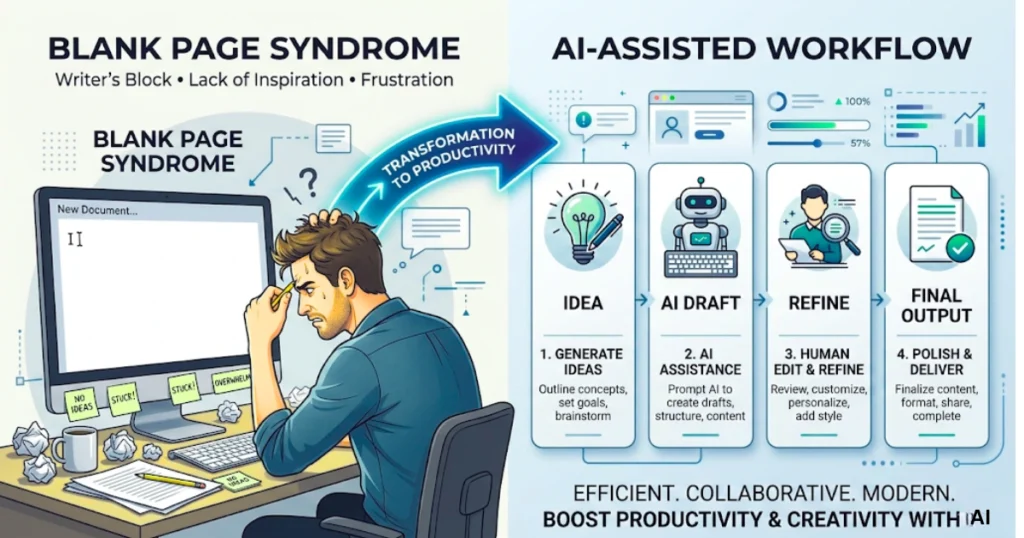
In 2026, that changes everything.
The Real Shift: From Creation to Direction
AI hasn’t eliminated work; instead, it has shifted where the effort lives.
Before, you spent time generating ideas, followed by structuring them, and finally writing and refining. Now, the process looks different. You define intent, AI generates structured output, and you refine and steer the result.
This shift—from doing the work to directing the work—is where productivity begins to scale, marking the transition from chatbots to agents doing the work for you.
The people winning right now aren’t necessarily the best writers or analysts. Rather, they are the ones who know how to initiate, guide, and iterate faster than everyone else.
Why “Blank Page Syndrome” Is Dying
The blank page used to represent uncertainty:
- What should I write?
- Where do I start?
- Is this even the right direction?
However, AI collapses that uncertainty almost instantly.
You can now:
- Generate multiple directions instead of guessing one
- Turn rough thoughts into structured drafts
- Get feedback before committing to a path
For example, instead of committing to a single idea, you can explore several variations in minutes. As a result, the cost of being wrong drops to near zero. And when experimentation becomes cheap, output naturally increases.
AI as a Productivity Engine (Not Just a Content Generator)
Most people still misuse AI as a shortcut for output. As a result, much of today’s AI content feels generic and uninspired.
However, the real leverage comes from using AI as:
- A thinking partner
- A structuring engine
- A speed multiplier
Not a replacement.
Ultimately, AI won’t replace your team—but it will replace your workflow.
Used correctly, AI handles:
- First drafts
- Repetitive formatting
- Data summarization
- Idea expansion
Meanwhile, you focus on:
- Judgment
- Strategy
- Taste
This combination is where real productivity gains begin to show.
The New Core Skill: Prompting as Operational Thinking
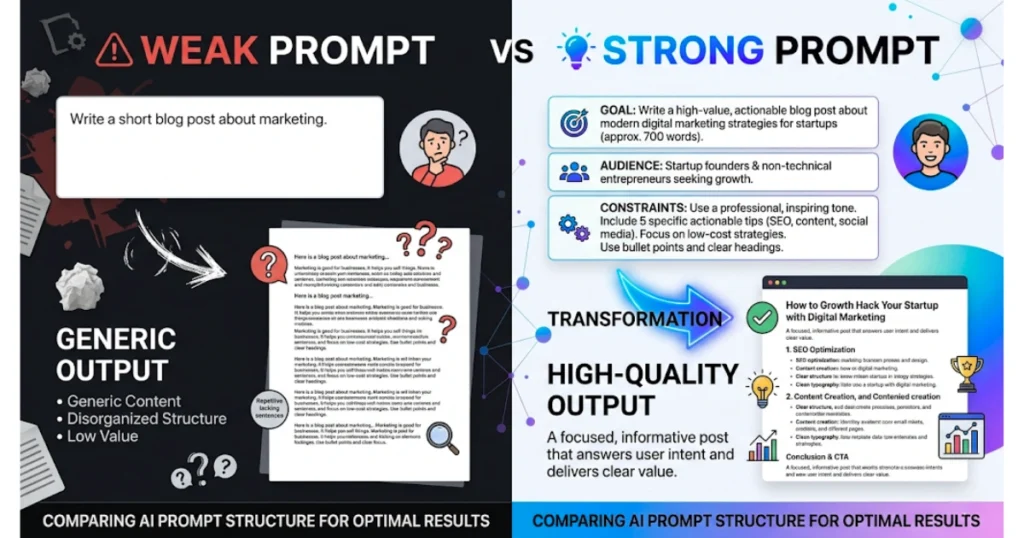
Prompting isn’t just about asking better questions. Instead, it’s about translating business intent into clear, executable instructions, defining what actually works in prompt engineering today.
Strong prompts include:
- Clear goals
- Defined outputs
- Audience context
- Constraints (tone, format, length)
Weak prompts produce noise. Strong prompts produce usable assets.
Example shift: ❌ “Write a blog about productivity” ✅ “Write a 600-word blog for founders explaining how AI reduces workflow friction. Include three real business use cases and end with a strong call-to-action.”
One creates fluff. The other creates direction.
Where AI Actually Drives ROI
The hype often focuses on creativity. However, the real value comes from eliminating repetitive cognitive load and improving execution speed.
- Content Production at Scale: AI enables businesses to create blogs, emails, ads, and social media content faster than ever. As a result, teams produce more without increasing headcount.
- Faster Decision-Making: Instead of spending hours reviewing reports, AI can summarize key insights instantly. Therefore, teams spend less time analyzing and more time acting.
- Campaign Ideation: AI allows you to generate multiple campaign angles quickly. In addition, you can test ideas before committing budget, reducing risk.
- Personalization Without Burnout: Tailored messaging for different audiences can now be created instantly. As a result, engagement improves without increasing workload.
- Workflow Compression: One piece of content can be transformed into multiple formats—blogs, posts, emails, and more. Consequently, content velocity increases significantly.
In addition, these improvements compound over time, creating long-term efficiency gains.
The Hidden Advantage: Speed of Iteration
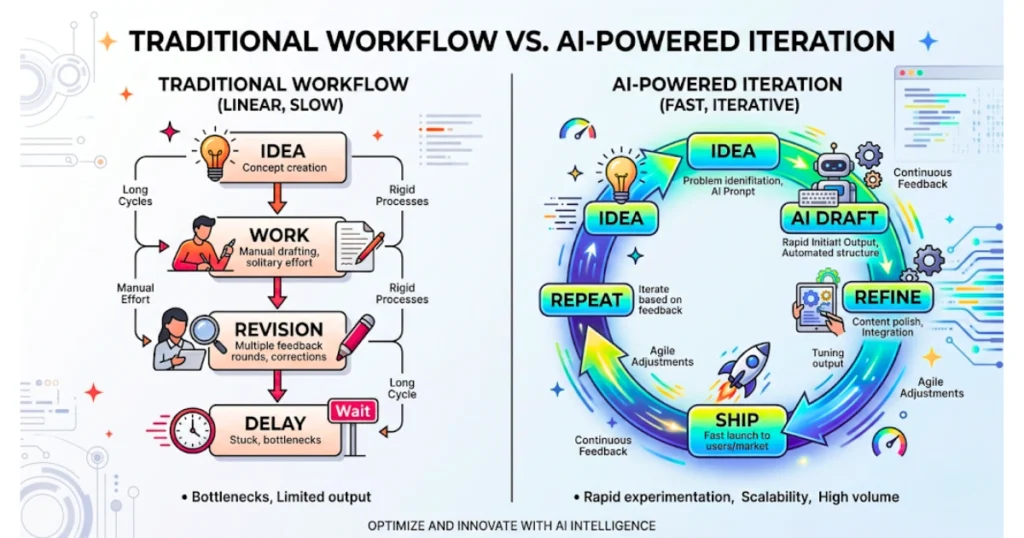
Ultimately, the biggest productivity gain isn’t output—it’s iteration speed.
- Before AI: Idea → effort → revision → delay
- Now: Idea → instant draft → refine → ship
Because of this shift, you can test multiple headlines, explore different messaging angles, and refine strategies much faster. Over time, better iteration leads to better outcomes.
The Risk: Fast Output, Low Quality
However, this is where most teams fail. They optimize for speed but ignore quality.
This often leads to:
- Generic content
- Brand dilution
- Incorrect information
- Loss of audience trust
AI doesn’t remove the need for thinking—it amplifies whatever system you already have. If your process is weak, AI will simply scale that weakness, a common pitfall in the AI adoption illusion businesses experience today.
The Fix: Human-in-the-Loop Systems
To fully benefit from AI, you need structured workflows.
- AI generates → Human reviews
- AI suggests → Human decides
- AI drafts → Human refines
This approach is essential. High-performing teams treat AI like a fast-moving junior operator. It handles the heavy lifting, but humans make the final decisions, ensuring operations don’t prematurely hit the automation ceiling where AI stops adding value.
The Rise of the Hybrid Operator
The most valuable professionals today are hybrids.
They can:
- Think strategically
- Use AI tools effectively
- Refine outputs with judgment
As a result, they don’t just produce more—they produce faster and better.
How to Start Without Overcomplicating It
To begin with, you don’t need a complex system.
Start simple:
- Use AI for first drafts
- Brainstorm ideas
- Summarize information
- Repurpose content
Over time, refine your prompts and workflows. Small improvements compound quickly.
The Bigger Picture: Productivity Is Being Redefined
AI isn’t replacing effort—it’s removing friction.
Therefore, the competitive advantage is no longer about working harder. Instead, it’s about starting faster, iterating smarter, and executing with precision.
Conclusion: From Blank Page to Execution Engine
In conclusion, the blank page is no longer the problem. The real challenge is whether you can direct AI better than others.
Because in 2026, output is cheap, ideas are abundant, and execution speed defines success.
Ultimately, the winners aren’t the ones simply using AI—they’re the ones using it intentionally. Stop staring at the blank page. Start building with it.