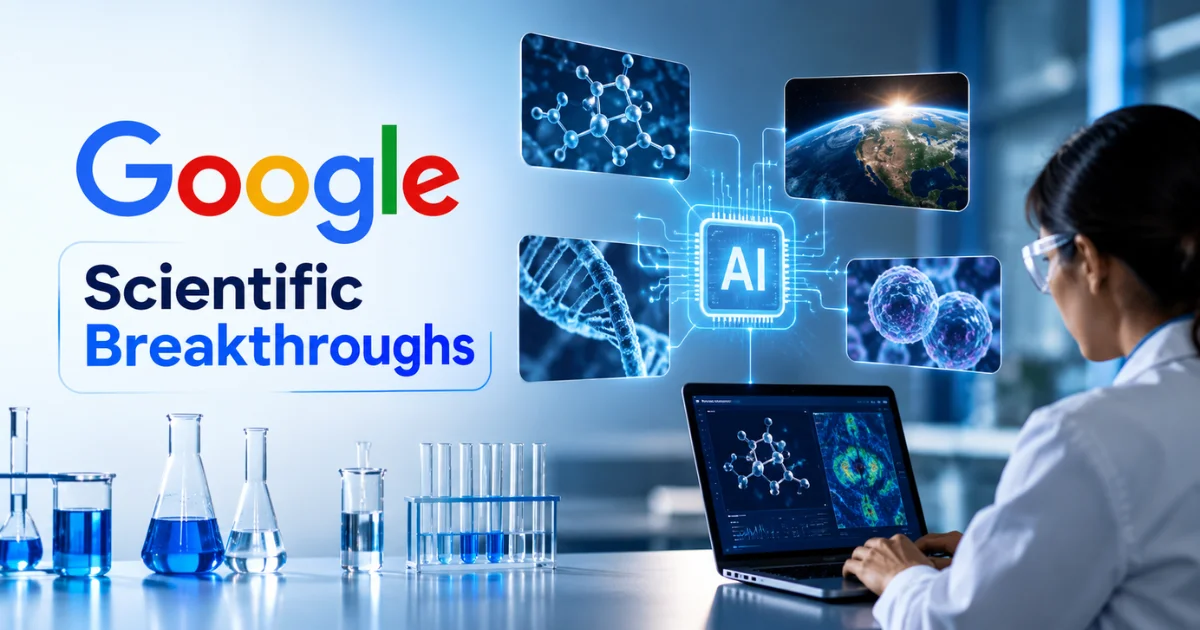

We are witnessing a fundamental shift in scientific research. For decades, scientific discovery relied heavily on slow trial and error. Researchers often conducted thousands of physical experiments over several years. They hoped to uncover a stable protein structure, a climate model, or a new material.
Today, artificial intelligence accelerates that traditional timeline. In fact, scientists no longer passively observe nature. Instead, they use massive computational power to predict its hidden mechanics.
Google has joined this transition directly with a strategic $36 million capital commitment. This capital supports a hand-picked cohort of global institutions. Furthermore, the initiative offers much more than basic research grants.
Google also delivers engineering support, technical mentorship, and high-performance computing infrastructure. Consequently, these resources will turn early-stage theories into deployable solutions across thirty countries. The program focuses heavily on climate resilience, materials science, and genomics.
Decoding Complex Physical Systems
When you look closely at the climate and environmental projects selected for this cohort, a distinct operational pattern immediately emerges. These diverse research teams aren’t just building basic predictive algorithms; they are actively deploying agentic AI pipelines and multimodal AI architectures to interpret chaos across sensory, physical, and textual streams.
Make the ongoing efforts to model ocean ecosystems or decode the atmospheric precursors of deadly storm systems. The artificial intelligence essentially creates a digital twin of the physical environment, rapidly ingesting vast streams of raw Earth observations to discover interpretable physics equations that human researchers haven’t yet conceptualized.
According to the recent announcement detailing the Google, AI for Science recipients these organizations are successfully bridging the stubborn gap between simulation and physical reality.
In the complex realm of clean fusion energy, for instance, researchers are utilizing physics-informed neural networks to map the highly chaotic plasma conditions inside operating reactors.
Instead of waiting months to manually test a single reactor design, the AI autonomously interprets microscopic experimental imagery and forecasts cathode degradation rates in advanced components like sodium-ion batteries.
It represents a fundamental rewiring of the materials discovery process, shifting the heavy lifting from physical laboratories directly into hyper-optimized computational environments where thousands of iterations happen in seconds.
Reprogramming the Biological Machine
The life sciences sector presents an even more intricate challenge for these organizations, primarily because biological data is inherently messy and unstructured. The teams tackling these massive health breakthroughs are essentially treating human genetic code like a complex software environment that requires precision debugging.
They are leveraging sophisticated foundation models to map out the entire structural design space for peptide-based drugs. Some are even using advanced natural language processing techniques to design synthetic proteins entirely from scratch.
By predicting exactly how specific genetic variants regulate RNA splicing at a massive population scale, these deep learning models help solve the “black box” problem by translating opaque clinical predictions into highly transparent, actionable biomarkers.
This computational heavy lifting allows research teams to pinpoint the exact molecular vulnerabilities in viruses or identify specific genetic switches required for advanced cardiac therapies.
We are seeing a definitive move away from generalized medical treatments toward highly equitable precision oncology that maps specific drug-metabolizing genes, drastically altering how clinical trial methodologies will be designed moving forward.
The underlying technology isolates the hidden variables of DNA damage and extracts interpretable hypotheses directly from the raw medical data, turning the once-impenetrable noise of human biology into a readable, modifiable system. The velocity at which these organizations can now move from a raw biological hypothesis to actual clinical validation changes the entire landscape of medical research.