
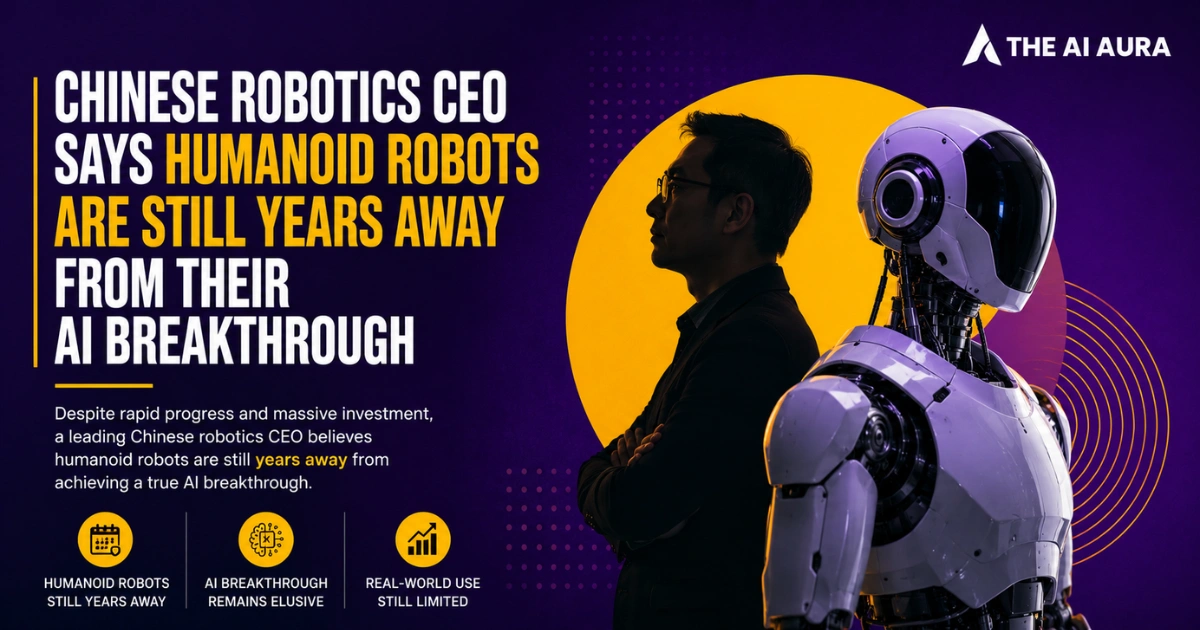

The robotics industry is moving fast. However, the engineers building the machines are offering a reality check.
Chinese robotics giant Unitree recently saw its stock surge 460% during its Shanghai market debut. Soon after, company founder and CEO Wang Xingxing poured cold water on expectations.
Speaking at the World Robot Conference in Beijing, Wang admitted that the industry’s highly anticipated “ChatGPT moment” the tipping point where machines achieve true generalized utility remains stubbornly out of reach.
Wang expects a wait of two to three years in an optimistic scenario. If development slows, it could take up to a decade. The global market shipped roughly 19,000 humanoid units in the first half of 2026. Chinese manufacturers accounted for 97% of those shipments.
This extended timeline forces investors to rethink their expectations. Today, humanoid robots perform backflips and martial arts on stage. Yet, they lack the cognitive ability to navigate a typical living room.
The Versatility Gap and the Search for Autonomy
To understand why the wait will be so long, you have to look at how Wang defines the actual breakthrough.
He argues that a true inflection point only happens when you can drop a humanoid robot into a completely unfamiliar household and have it successfully complete 80% of tasks using nothing but text or voice commands.
Right now, that capability remains science fiction. Today’s robots are far less efficient than human workers. The core issue is a lack of generalizability. When you teach a robot to fold a shirt, it learns only that task.
If you want it to pour water, you must train it from scratch. Robots can execute broad movements with great speed. However, they struggle with the last few millimeters of precision.
This limitation creates the versatility gap. Cheaper components and rapid iteration have helped hardware scale quickly. These factors pushed Unitree’s gross margins up to 60%. Still, hardware alone is not enough.
A robot that fails when its environment changes is just an expensive showpiece. The physical world is unpredictable. Current AI models cannot process spatial and touch data fast enough to adapt in real time.
Self-Evolving Code and the Reality of Data Factories
Bridging this gap requires a fundamental shift in how robotic software is developed. Unitree is attempting to solve the precision problem by leaning into a “self-evolving development loop.”
In this system, AI models are tasked with writing the robot’s control code, testing it in simulation or reality, scoring the outcome, and feeding that data back into the next iteration to refine the movements.
This recursive machine-learning approach is exactly what the industry needs. It attempts to replicate the data-scaling laws that made large language models so powerful. However, gathering physical data is infinitely slower and more expensive than scraping text from the internet.
This explains why a significant portion of current humanoid robot shipments aren’t going to assembly lines to perform paid physical labor, but rather to research centers and specialized “data factories” tasked with simply collecting training data.
The market’s enthusiasm is currently pricing in a future that the software is not yet ready to deliver. Wang’s sobering timeline is a necessary corrective for investors and tech enthusiasts alike.
The transition from choreographed parlor tricks to genuine commercial utility requires cracking embodied intelligence giving a machine the ability to intuitively reason through its physical environment.
Until that software barrier is broken, humanoids will remain fascinating prototypes waiting for their brains to catch up with their bodies.
Source: The Times of India, "Chinese CEO of the World's Biggest and Most Popular Robot Company Admits That Robots Still Cannot..."