
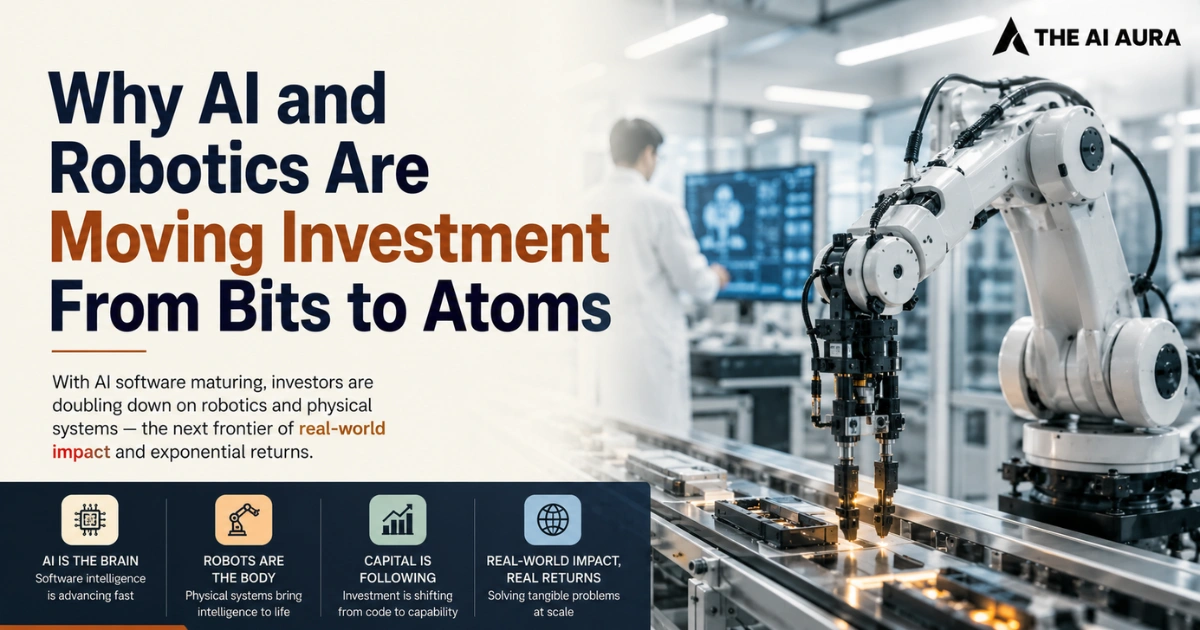

For the last two decades, venture capital has obsessed over software, algorithms, and digital ecosystems. Investors poured trillions into coding the digital world because scaling software costs next to nothing.
But a massive pivot is currently unfolding across global markets. The smart money is moving away from “bits” and aggressively back into “atoms” the physical, tangible world.
The catalyst for this shift is a breakdown in the fundamental equation of global economics. Historically, a country’s economic growth was directly tied to its demographics. If you wanted to expand your manufacturing base, you needed a massive, growing, and affordable workforce. Today, shrinking populations from East Asia to Western Europe are threatening to stall global output.
But artificial intelligence, paired with advanced robotics, has introduced a wildcard: economic and manufacturing capacity is no longer tied strictly to human demographics. Production capacity can now be manufactured as capital.
The collapse of the cheap labor illusion
For fifty years, global supply chains operated on a simple, ruthless premise: chase the lowest wages. Companies moved factories across borders the moment labor costs ticked upward. Today, hyper-automation is actively dismantling that arbitrage model.
We are entering the era of “dark factories” facilities so heavily automated they can operate without the lights on. Chinese manufacturing giants are already deploying automated systems to handle up to 98% of welding, assembly, and quality inspection.
The real breakthrough accelerating this trend isn’t the standard industrial arm, but the humanoid robot. Traditional factory robots are rigid; they require an entire production line to be custom-built around their singular, highly specific function.
Humanoids, however, are designed to slip directly into human environments. They can walk up to a standard workstation and perform multiple varied tasks without requiring a billion-dollar factory overhaul.
When robots don’t need sleep, don’t demand wage hikes, and perform with microscopic consistency, the geography of global trade flips.
A factory in a high-wage country with cheap energy, stellar AI integration, and advanced robotics will easily outcompete a facility relying on cheap human labor. The competitive moat for manufacturing is no longer human headcount; it is the cost of compute, energy, and robotic components.
Owning the brain behind the machine
This fundamental shift in production economics explains the massive redirection of institutional capital.
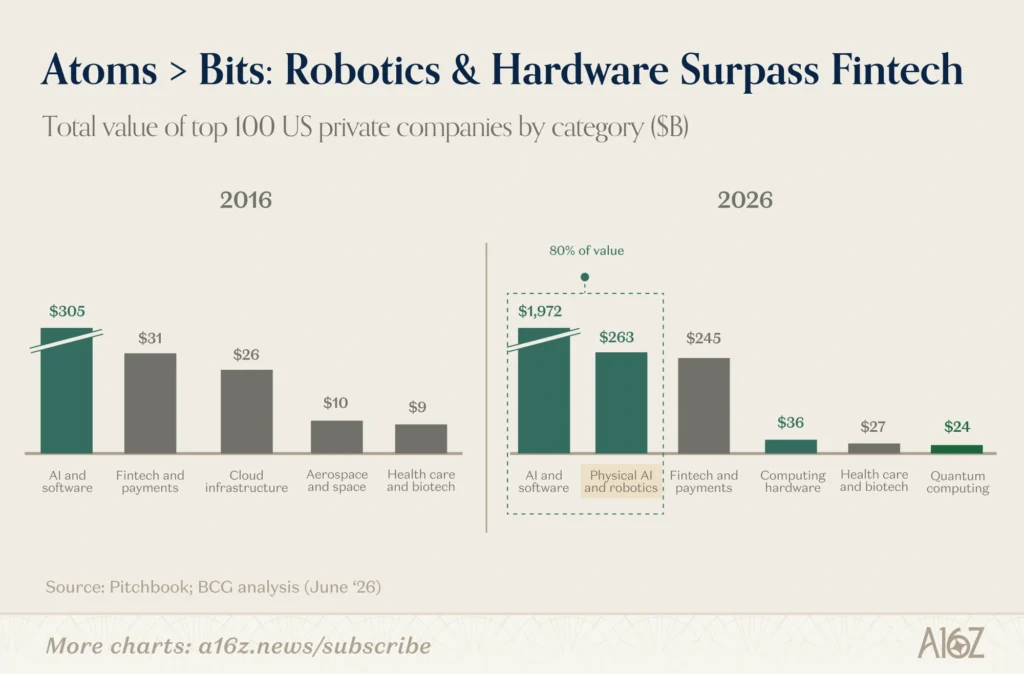
In the first half of 2026 alone, companies operating in “physical AI” encompassing robotics, autonomous vehicles, industrial automation, and sensors pulled in nearly $47 billion in venture funding. In a telling milestone, robotics investments have actively begun eclipsing traditional tech darlings like fintech.
The market is betting heavily that the next trillion-dollar enterprises won’t just manipulate data on a screen; they will move, build, and organize the physical world.
For nations banking on a “demographic dividend,” this transition is a harsh wake-up call. An abundance of young, working-age citizens is only an asset if the global market still demands millions of manual factory workers. As machines take over repetitive physical labor, raw population numbers can become an economic liability unless that workforce is rapidly upskilled.
The mandate for emerging industrial hubs is no longer about offering a slightly cheaper factory floor. It is about building a workforce capable of commanding the automated stack.
Someone still has to design the production architectures, train the physical AI models, maintain the hardware, and orchestrate the complex operations between different robotic units.
The ultimate economic winner in this new era won’t necessarily be the country that manufactures the physical robots. It will be the economy that most effectively marries human intuition with robotic efficiency, making the combination far more productive than either could ever be alone.
Source: Finshots, "Why Capital Is Moving From Bits to Atoms"