

The digital divide between urban and rural areas has long hindered educational equality across India.
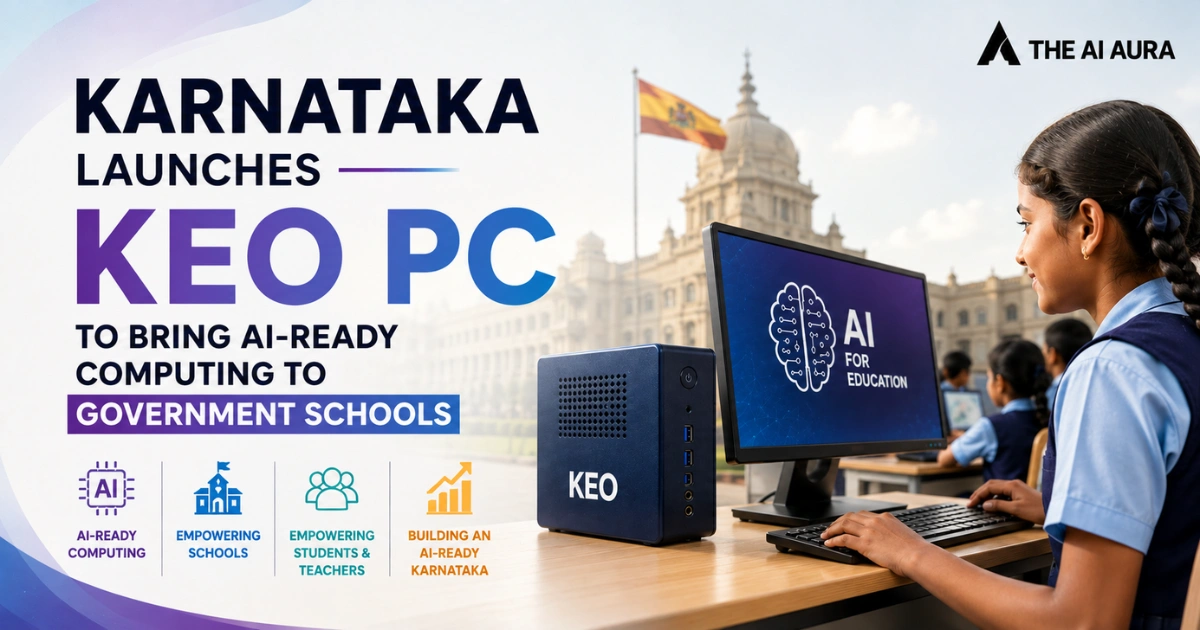
Karnataka Chief Minister DK Shivakumar addressed this challenge on August 21 by introducing a new grassroots technology initiative. The state officially launched the KEO PC. This locally developed, AI-ready computer aims to bring advanced technology directly to government schools.
The project is a joint effort between KEONICS, IT/BT Minister Priyank Kharge, and various corporate partners. KEONICS developed Electronic City in 1978 and built the foundation for Karnataka’s tech leadership.
Now, the agency is shifting its attention from corporate hubs to rural classrooms. Rather than offering basic digital literacy, the state wants students to actively participate in the modern AI economy.
Shivakumar emphasized that this rollout is a permanent infrastructure project, ensuring a student’s location never limits their opportunities.
Historically, major technology shifts took decades to reach rural classrooms. Artificial intelligence advances much faster, which threatens to widen this gap even more. Karnataka aims to change this dynamic quickly.
By providing edge-computing hardware, the state empowers rural students to become active innovators and creators.
Engineering the KEO PC for Grassroots Accessibility
Priced economically at roughly Rs 19,000, the KEO (Knowledge-driven, Economical, and Open-source) desktop platform is uniquely tailored for rural environments where conventional computing infrastructure often fails.
Unlike traditional AI applications that rely heavily on robust, high-speed cloud connectivity and expensive subscription models, KEO integrates a dedicated on-device AI accelerator.
This localized edge-computing approach ensures that complex machine learning workloads can run efficiently on the machine itself, completely bypassing the need for a constant, high-bandwidth internet connection.
At the foundational hardware level, the system operates on an open-source RISC-V processor architecture paired with a customized Linux environment. This design choice inherently prioritizes energy efficiency, local development, and adaptability over expensive proprietary software constraints.
The standout feature for the classroom environment is the inclusion of “BUDDH,” a homegrown, on-device AI learning assistant.
Because BUDDH has been meticulously trained directly on the Karnataka State Education Research and Training (DSERT) syllabus, students gain immediate access to an interactive, curriculum-aligned tutor that functions flawlessly even during regional network outages.
A Collaborative Blueprint for Statewide Deployment
Equipping classrooms across the state requires a practical rollout plan. The government structured this initiative without spending funds from the state exchequer. Strategic corporate investments funded the entire project, while the Shikshana Foundation manages the logistics.
The team also partnered with the Karnataka Residential Educational Institutions Society (KREIS) to ensure alignment with state educational goals.
In Phase 1, officials are deploying 2,222 KEO units across 239 taluks in all 31 districts. The state is placing these systems in Arivu Kendras (public libraries) and residential schools to maximize community impact.
Each library receives four computers, while targeted residential hubs receive ten. Manufacturers have already built the first batch of 5,000 units.
This initiative creates a clear path toward placing AI-capable hardware in every government classroom across Karnataka.
Source: Official Moneycontrol, "Karnataka Launches KEO PC to Take AI-Ready Computing to Government Schools"