
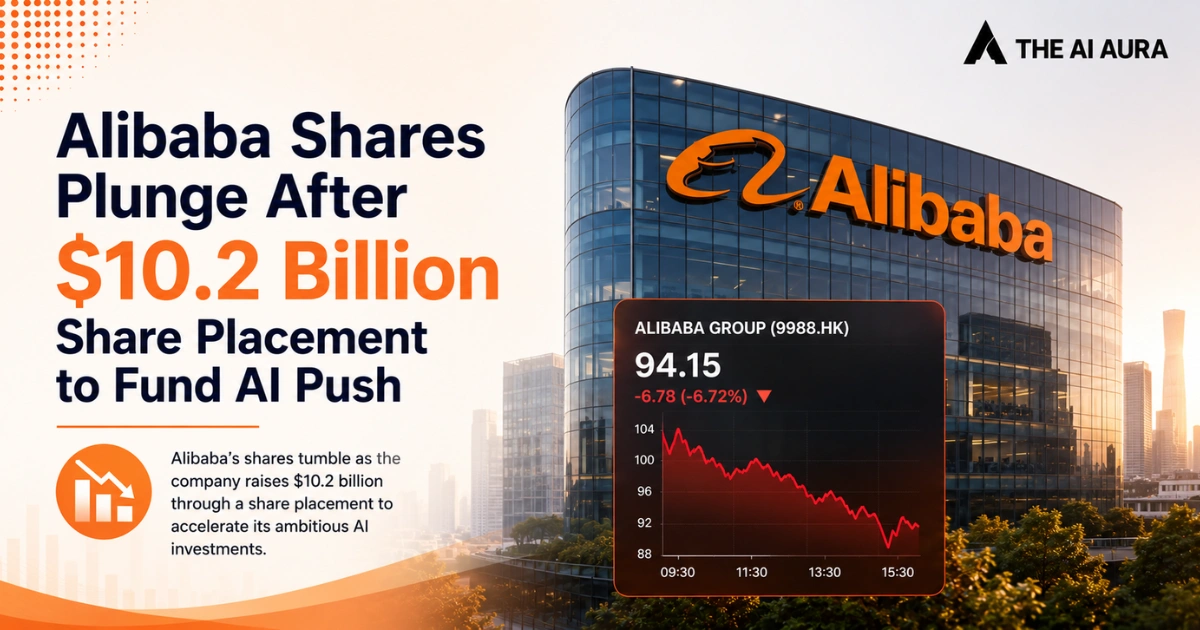

Markets rarely forgive tech giants when they dilute their equity pool. Monday’s trading session in Hong Kong proved this rule again. Alibaba’s shares took a sharp hit. They plunged up to 10% before settling with an 8.4% loss.
The catalyst was a massive 80 billion Hong Kong dollar ($10.20 billion) share placement. Alibaba offered these newly issued shares specifically to non-U.S. investors. A capital raise of this size always shocks investors. However, the underlying goal reveals where China’s tech sector is heading. Alibaba plans to fund a sweeping artificial intelligence build-out.
Here is a closer look at the financial math behind this sudden sell-off. It also explains why leadership considered this multi-billion-dollar dilution essential.
The Math Behind the Immediate Market Sell-Off
Equity markets dislike surprises, especially when they shrink an existing shareholder’s stake. Alibaba agreed to issue 710 million new shares at HK$112.70 each. On Friday, the stock closed at HK$123.
Comparing these numbers makes Monday’s 8.4% drop to HK$112.7 completely logical. The market quickly adjusted to match the discounted placement price. This move established a lower floor for the stock.
However, this placement does not exist in a vacuum. The timing is what has traders particularly skittish. Just days before announcing this $10.2 billion capital raise, Alibaba delivered a sobering June-quarter earnings report that featured a 75% drop in profit.
The primary culprit for that profit compression was exactly what this new stock issuance is meant to fund: heavy, aggressive spending on artificial intelligence infrastructure.
During that same quarter, capital expenditure skyrocketed 75% to reach 67.7 billion yuan. From a shareholder’s perspective, this creates a harsh short-term reality.
They are enduring compressed earnings due to massive capital outlays, followed immediately by equity dilution to generate cash for even more spending.
It is a bitter pill to swallow for value investors looking for steady buybacks or dividends, which explains the aggressive exit of capital on Monday morning.
The AI Infrastructure Arms Race is Non-Negotiable
Despite the ugly immediate price action, Alibaba’s board is playing a much longer game. The net proceeds from this placement are earmarked specifically for expanding and enhancing the company’s AI infrastructure.
In the current global tech landscape, building large language models and the data centers required to run them is an inherently capital-intensive blood sport.
Vey-Sern Ling, senior equity advisor at UBP, noted Alibaba’s strong market position. The company already runs an established cloud computing business. It also owns a capable foundational AI model.
Ling explained that profits will weaken and capital spending will rise. However, failing to invest would lead to obsolescence.
Alibaba is not the only player burning through cash to secure a foothold in the next generation of computing. The broader Chinese tech sector is engaged in a localized arms race.
Tencent, for instance, saw its own capital expenditure jump 65% quarter-over-quarter to 52.8 billion yuan as it scrambles to monetize its respective AI models.
Alibaba previously committed to spending 380 billion yuan on cloud and AI over three years. Management is sending a clear message to Wall Street.
Protecting long-term competitive advantage matters more than short-term margins. Raising $10.2 billion is simply the price Alibaba must pay to stay competitive.
Source: Official CNBC, "Alibaba Shares Drop After $10.2 Billion Share Placement to Fund AI Push"