


If you go by headlines, AGI already arrived. Quietly. Maybe even months ago.
If you go by researchers, it hasn’t.
Both sides are technically telling the truth—they’re just talking about different things.
After spending a lot of time testing current systems and speaking with people working at places like OpenAI and Anthropic, one thing becomes obvious: we don’t have true AGI yet. But we’ve crossed into territory where the distinction is starting to blur in uncomfortable ways.
First, let’s strip the word “AGI” back to reality
Forget the hype for a second.
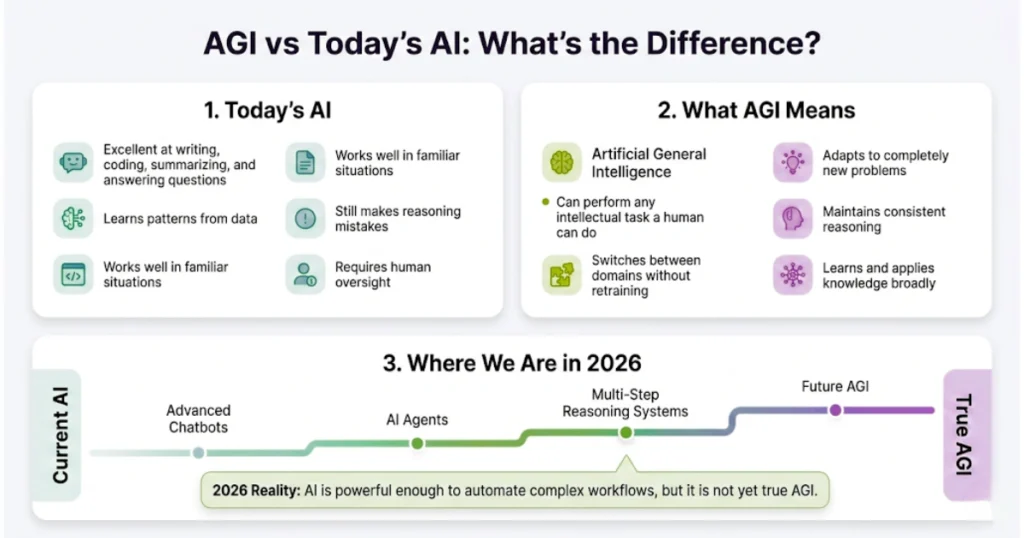
AGI, in its strict sense, means a system that can handle any intellectual task a human can—without retraining, without being boxed into a domain, and without falling apart when the problem changes shape.
Not “really good at a lot of things.”
Not “better than humans at some things.”
Everything.
That includes switching from writing code to diagnosing a medical condition to reasoning through a legal argument—without needing a new model or fine-tuning step in between.
And importantly, none of this requires consciousness. AGI doesn’t need to “feel” anything. It just needs to perform.
What people keep getting wrong
There are three common misunderstandings that keep showing up:
- AGI is not the same as superintelligence. That’s a different conversation entirely.
- It’s not what today’s chatbots are, even the impressive ones.
- And it’s definitely not science fiction anymore—it’s a technical direction, not a fantasy.
Systems like Claude 3.5 and GPT-4o, along with Gemini Advanced, are pushing boundaries, but they still have edges. Push them far enough outside familiar territory, and you’ll find those edges quickly.
The shift that actually mattered (and nobody talks about properly)
The jump we’re seeing now didn’t come from just scaling models. That story is outdated.
What changed is architectural. Modern systems are starting to combine two very different styles of thinking:
- Fast pattern recognition (the old “predict the next token” approach)
- Slower, step-by-step reasoning layered on top
That combination is closer to how humans operate than earlier models ever were. And it shows up in subtle ways.
Instead of immediately answering, systems now simulate outcomes internally. They “test” ideas before committing. Some even revise their own reasoning mid-process. It’s less like autocomplete and more like internal trial-and-error—except it happens in milliseconds.
What current systems can actually do (from hands-on testing)
Here’s where things get interesting. If you give these systems complex, multi-step work, they don’t just respond—they continue.
They will:
- Write code
- Debug it
- Fix their own errors
- Then explain what they did
In some cases, they’ll even chain tasks across domains—analyzing technical input, translating it into plain language, and producing something usable in a completely different context. That’s not trivial.
But here’s where they still break:
- Truly novel problems still throw them off.
- Deep expertise doesn’t transfer cleanly across unrelated fields.
- Consistency drops when the task moves outside familiar patterns.
So what you’re seeing isn’t AGI. It’s something closer to “general enough to feel like AGI in controlled environments.” That distinction matters more than people think.
Why timelines are all over the place
Ask five experts when AGI arrives, and you’ll get five different answers.
Some of that is optimism. Some of it is marketing. But most of it comes down to definitions. For example, Dario Amodei has suggested timelines as early as 2026. Others push it out a decade or more.
The disagreement isn’t random—it’s rooted in one problem: There is no agreed-upon test for AGI. Without a clear finish line, everyone is estimating based on different criteria.
The part that actually affects you right now
Whether or not we call it AGI, the practical impact is already here.
For businesses, the shift is straightforward: systems can now handle multi-step workflows that used to require teams.
For individuals, the change is more subtle but just as real. The value is moving away from execution and toward judgment—deciding what should be done, not just doing it.
And the people who benefit most aren’t the ones waiting for AGI. They’re the ones already treating current systems like capable collaborators instead of tools.
So where are we, really?
If you’re expecting a clean moment where AGI “arrives,” you’ll probably miss it. What’s actually happening looks more like accumulation.
Capabilities stack. Systems improve unevenly. Gaps close slowly—then suddenly.
Right now, we’re in that uncomfortable middle phase:
- Too capable to dismiss
- Not reliable enough to trust completely
That’s why the conversation feels so chaotic. Because both sides—the “it’s here” crowd and the “not even close” crowd—are reacting to real signals. They’re just looking at different slices of the same reality.
The honest version, without the marketing layer
No, true AGI doesn’t exist in 2026. But we’re no longer talking about a distant concept either.
We’re watching systems accumulate enough general capability that, in certain situations, the distinction between “narrow AI” and “general intelligence” starts to feel less useful.
That doesn’t mean the problem is solved. It means the boundary is starting to move.
And once that boundary shifts far enough, the argument about whether AGI exists won’t matter anymore—because the systems will already be doing the work people expected AGI to do.
That’s the part most headlines miss.