


The AI industry keeps asking the wrong question. Every week, another benchmark comparison floods social media:
- Open-source vs. proprietary
- Frontier vs. local models
- GPT competitors vs. enterprise alternatives
But the real production bottleneck in 2026 is no longer the model itself. It is orchestration.
CTOs are spending months debating whether to deploy closed APIs or self-host open-weight models while their actual infrastructure remains fragile, plagued by:
- Brittle tool-calling pipelines
- Unstable streaming layers
- Schema validation failures
- Inconsistent memory handling
- Provider-specific execution drift
The truth is uncomfortable: switching models rarely fixes the operational problems that actually break enterprise AI systems.
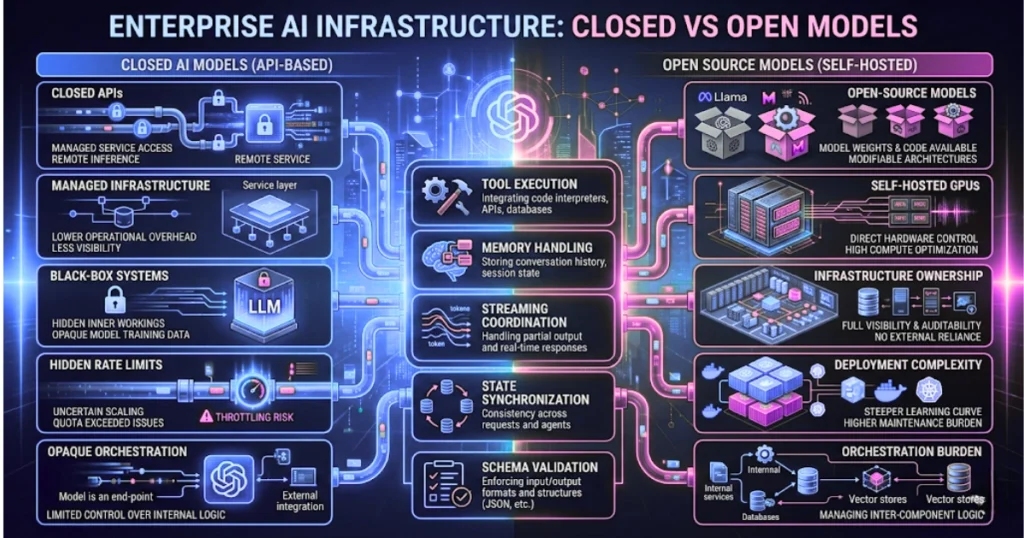
The “Open vs. Closed” Debate Is Becoming Misleading
On paper, the debate appears simple.
Closed models offer:
- Stronger frontier performance
- Managed infrastructure
- Enterprise support
- Rapid feature rollout
Open models offer:
- Lower inference cost
- Deployment flexibility
- Data control
- Infrastructure ownership
But once systems move into production, the distinction becomes less important than people assume. Because regardless of the licensing model, every enterprise still faces the exact same orchestration burden: tool execution, state synchronization, structured outputs, retrieval consistency, streaming coordination, and provider-specific quirks.
The infrastructure pain does not disappear simply because the model weights are open.
The Hidden Cost Nobody Talks About: The Orchestration Tax
The biggest misconception in AI infrastructure is the belief that standardized interfaces create portability. They don’t.
Frameworks advertise “universal model APIs,” but abstraction layers collapse almost immediately under production conditions. At first glance, initialization looks clean:
Python
init_chat_model(
    temperature=0.7,
    max_tokens=2000
)
The illusion lasts only until advanced orchestration begins. Then, provider-specific fragmentation appears everywhere:
- Tool-calling formats
- Structured output behavior
- Streaming chunk patterns
- Async callback handling
- Retry logic
- Token accounting
- Server-side tool integrations
Moving from a proprietary model like OpenAI’s o1 to an open-source deployment is rarely a drop-in replacement. Entire orchestration layers often require rewriting.
Why Open Models Don’t Automatically Create Portability
The open-source ecosystem promises flexibility. In practice, many enterprise AI stacks become tangled with conditional logic tailored to specific model behaviors.
Developers end up maintaining provider-specific schema patches, custom validation handlers, fallback execution branches, separate inference adapters, and model-specific retry middleware.
The codebase slowly transforms into an orchestration maze. Ironically, this means “open” deployments can still create vendor lock-in—just at the infrastructure layer instead of the API layer. You are no longer locked into a provider; you are locked into your own integration complexity.
Reliability Is Becoming More Important Than Raw Intelligence
One of the biggest shifts happening in enterprise AI is the transition from capability obsession to reliability obsession. A highly intelligent model is useless if:
- Requests fail unpredictably
- Streaming breaks mid-response
- Tool calls corrupt state
- Inference latency spikes
- Orchestration deadlocks occur
Most production failures are not caused by weak reasoning. They are caused by infrastructure instability. This changes how enterprises evaluate AI systems entirely.
The real engineering challenge becomes surviving 429 rate limits, handling 5xx server failures, managing inference backpressure, retrying distributed tasks safely, and preserving deterministic state.
The question is no longer: “Which model scores higher?” The question is: “Which system survives production volatility?”
Closed Models Hide Failure Modes
Closed AI providers simplify infrastructure management. That convenience comes with tradeoffs. Managed APIs abstract scaling complexity, GPU allocation, distributed inference, and optimization pipelines.
But they also obscure failure visibility. When production incidents occur, developers often receive:
- Vague error messages
- Opaque rate-limit behavior
- Inconsistent timeout handling
- Undocumented routing changes
The infrastructure becomes a black box. This is manageable for lightweight applications, but it becomes dangerous for long-running autonomous agents.
Open Models Shift the Burden to You
Self-hosted open models provide significantly more control, but control introduces operational responsibility. Teams suddenly become responsible for:
- Load balancing
- Inference optimization
- GPU fragmentation
- Autoscaling
- Memory management
- Deployment reliability
Open infrastructure does not eliminate complexity; it transfers complexity from the vendor to the engineering team. The tradeoff is not “freedom vs. restriction.” It is managed opacity vs. operational ownership.
Why Interoperability Is the Great AI Illusion
The AI industry still behaves as if universal interoperability is inevitable. Reality says otherwise. Every model ecosystem evolves differently, creating unique streaming semantics, distinct tool-calling standards, incompatible memory formats, and provider-specific validation rules.
Even supposedly “standardized” frameworks often leak implementation details into orchestration logic. Developers spend enormous amounts of time rebuilding abstraction layers every time a new model becomes popular.
This creates endless infrastructure churn—and infrastructure churn is rapidly becoming one of the largest hidden costs in AI engineering.
The Real Winners of 2026
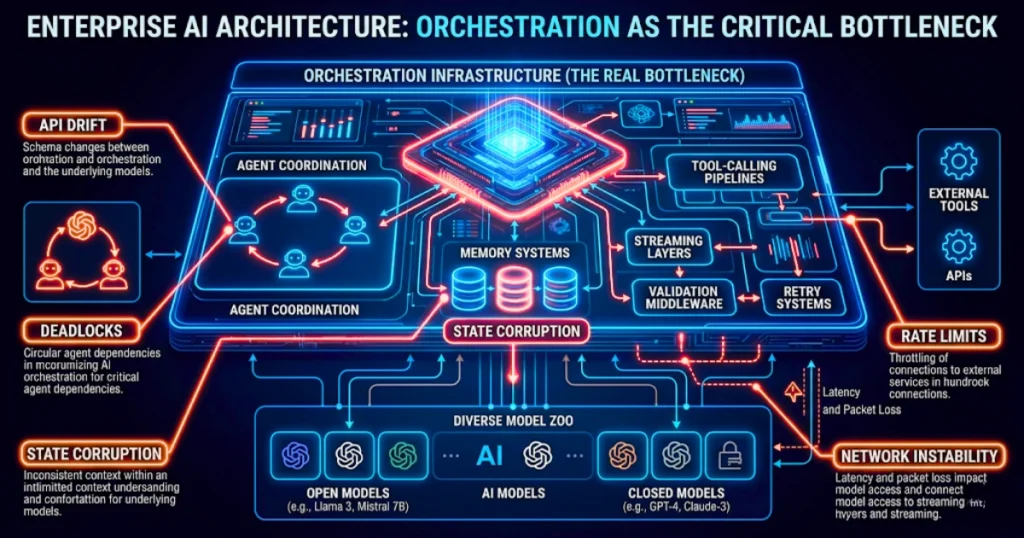
The companies that win in 2026 likely won’t be the ones chasing every new frontier model release. They will be the teams building:
- Deterministic orchestration systems
- Resilient tool-calling pipelines
- Reliable validation layers
- Observable memory infrastructure
- Stable execution environments
Because once AI systems become autonomous, orchestration reliability matters more than benchmark leadership. The best model in the world cannot compensate for broken state management, corrupted tool execution, unstable agent coordination, failed memory retrieval, or fragmented streaming pipelines.
Infrastructure quality becomes the real competitive moat.
The Future Is Probably Hybrid
The most realistic future is not fully open or fully closed. It is hybrid.
Enterprises will increasingly use:
- Closed frontier models for reasoning-heavy tasks
- Open models for narrow-domain inference
- Specialized local agents for cost efficiency
- Provider-specific routing for performance optimization
The orchestration layer becomes the actual platform. Models become interchangeable compute components underneath it.
Final Thoughts
The “Open vs. Closed” debate misses the deeper shift happening in AI infrastructure. Model capability is no longer the primary bottleneck. Operational reliability is.
In 2026, the real winners won’t be the companies with the most philosophical position on open-source AI. They’ll be the companies that survive API drift, harden orchestration pipelines, stabilize execution layers, control infrastructure complexity, and build deterministic AI systems.
Because eventually, every AI stack encounters the same reality: The model is only one layer. The orchestration system is the actual product.