
The artificial intelligence industry is currently undergoing a massive structural shift, moving away from closed, proprietary ecosystems toward transparent, community-driven frameworks.
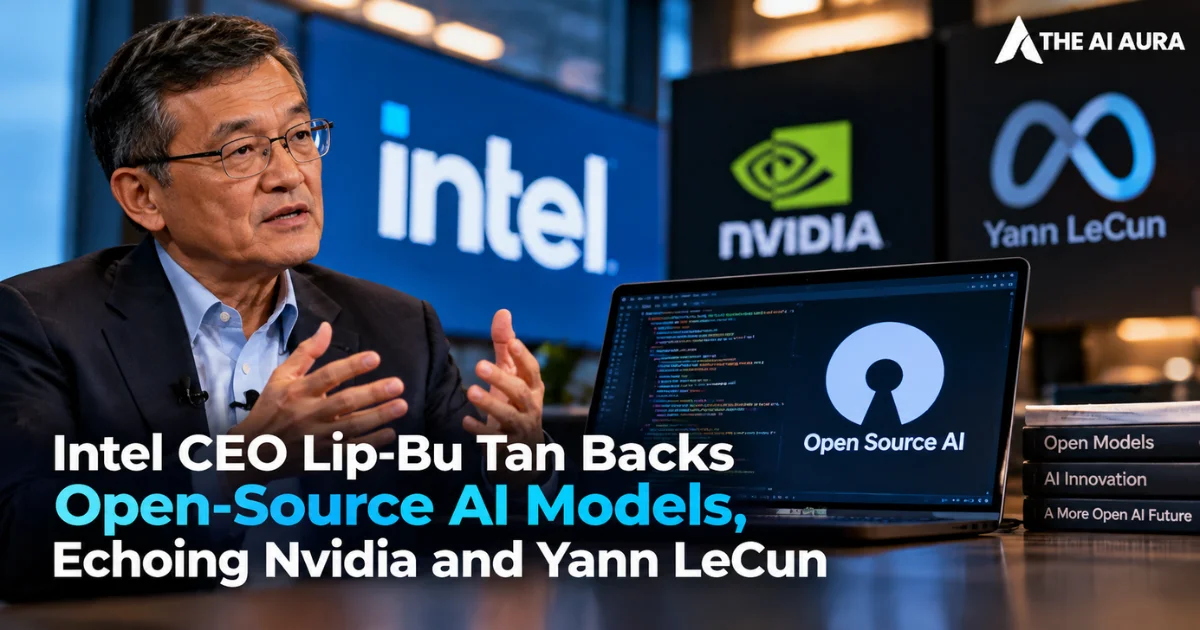
Leading this ideological pivot is Intel CEO Lip-Bu Tan, who recently voiced formidable support for open-source AI models during an industry panel in Singapore.
His remarks represent a significant milestone, illustrating a growing consensus among hardware titans that the future of enterprise AI relies heavily on accessible, cost-effective architectures rather than exclusive walled gardens.
Tan’s perspective focuses heavily on the operational realities of deploying generative AI at scale. As enterprises transition from experimental phases to integrating machine learning into daily business processes, the sheer cost of computing power has become a major bottleneck.
By backing open-source platforms, Tan is acknowledging that the market desperately needs scalable solutions that do not compromise on performance but drastically reduce the financial barriers to entry.
His stance brings Intel into close ideological alignment with other prominent tech veterans who have long championed open innovation as the primary engine for technological advancement.
The Economics of Efficiency
The core of Tan’s argument revolves around the undeniable cost advantages offered by open-source systems. Recent frontier models have demonstrated that it is entirely possible to achieve remarkable capabilities without the exorbitant token running costs associated with proprietary alternatives.
When the per-token inference costs drop significantly, businesses are far more incentivized to embed artificial intelligence deeply into their workflows a reality explored in How to Reduce AI API Costs: Practical Strategies That Actually Work (2026).
This increased adoption paradoxically drives up the overall demand for underlying computing infrastructure, creating a highly favorable environment for hardware providers.
During his panel discussions, Tan highlighted the rapid global traction of various open architectures, noting that commercial markets are incredibly pragmatic. Companies are actively seeking platforms that deliver functionally reliable results while keeping overhead manageable.
According to an industry report at Times of India, Tan firmly believes that open source is the ultimate mechanism for driving systemic efficiency, leaving it up to the broader market to determine which specific models deliver the most value for diverse, real-world use cases.
This pragmatic view closely mirrors the sentiments of Nvidia CEO Jensen Huang. Huang previously noted that the market had initially miscalculated the sheer impact of cost-effective open models.
Both executives recognize that affordable inference does not cannibalize hardware sales; rather, it democratizes access, expanding the total addressable market for server and CPU demand. When efficiency improves, usage scales exponentially, ensuring that the hardware sector continues to thrive alongside software innovation.
A Unified Vision for the Industry’s Future
Tan’s enthusiastic endorsement of open-source frameworks also bridges the gap between hardware strategy and software philosophy, echoing the long-held positions of Meta’s former chief AI scientist, Yann LeCun.
The overarching debate outlined in Open vs Closed AI Models: Which Will Win in 2026? centers on this exact shift: LeCun has passionately argued that open models are essential for strengthening cybersecurity, accelerating global innovation, and preventing a monopoly of intelligence by a handful of mega-corporations.
He predicted that the ecosystem would eventually be dominated by free pre-trained base models and crowd-sourced fine-tuned variations, making open-source architectures virtually unbeatable.
Seeing the chief executive of Intel validate this exact trajectory highlights a rare and powerful alignment across the tech spectrum. It demonstrates that the industry is recognizing the limitations of closed systems in a world where computing infrastructure is constantly stretched thin.
With capital constraints and hardware shortages projected to persist over the next few years, relying on hyper-efficient open-source software is no longer just a philosophical preference but a strategic necessity. The focus is shifting from brute-force computing to intelligent resource management.
Beyond immediate AI applications, Tan is also looking at the next computing frontier. He projects that quantum computing could reach mainstream commercial viability within the next three to five years, a timeline that will demand even more robust and adaptable software ecosystems.
Whether dealing with traditional processors, advanced GPUs, or emerging quantum infrastructure, the unified message from leaders like Tan, Huang, and LeCun is clear: the most sustainable path forward relies on an open, collaborative architecture that empowers developers to extract maximum utility from every available compute cycle.