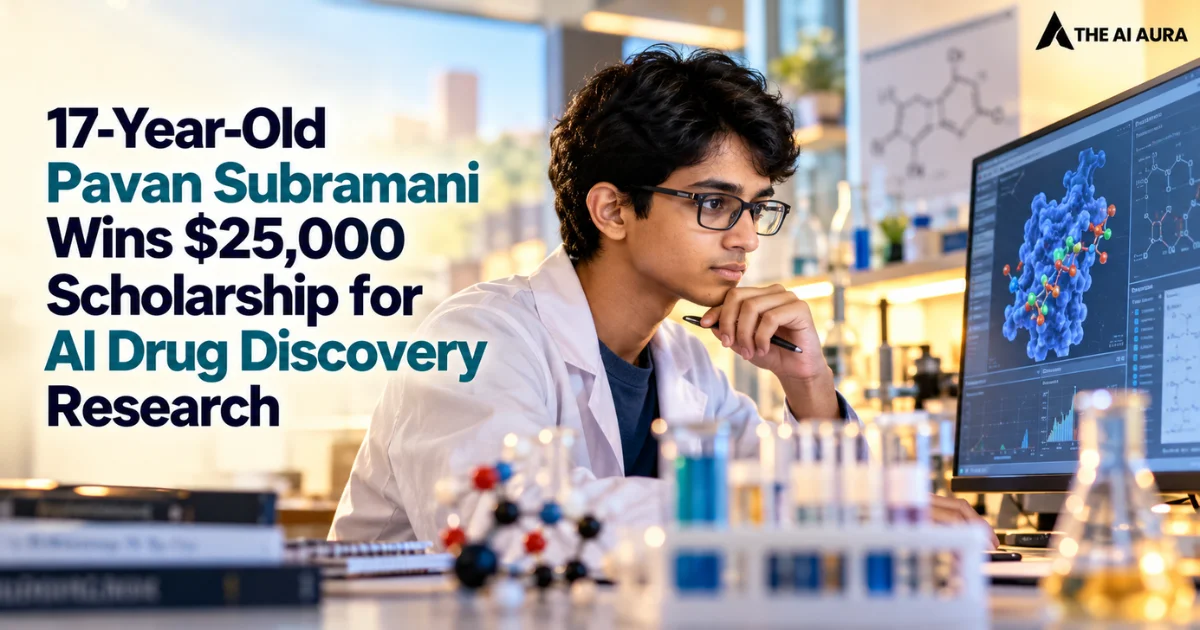

Every day, researchers in computational chemistry hit a frustrating wall. They map out promising molecular candidates for new therapeutics, only to watch their simulation pipelines choke on the sheer mathematical weight of the task. Traditional molecular dynamics require massive computational overhead just to capture those rare, fleeting moments when a protein shifts or a ligand binds.
That computing bottleneck is exactly what caught the attention of Pavan Subramani, a 17-year-old high school senior from Morgantown, West Virginia. While working on a project involving inhibitors for a disease-associated protein, his laptop simply couldn’t handle the processing load.
Instead of abandoning the research or waiting for access to a supercomputer, he engineered a sophisticated architectural workaround. That breakthrough recently earned him the prestigious title of 2026 Davidson Fellow, along with a $25,000 scholarship, pushing his work firmly onto the radar of the broader biophysics community.
Bypassing the Compute Bottleneck in Molecular Dynamics
Subramani’s approach attacks the core inefficiency of conventional biological simulations by intelligently fusing generative diffusion models with standard molecular dynamics.
Testing potential medicines usually forces scientists into agonizingly long compute cycles just to observe essential molecular events. To bypass this, Subramani developed a framework he calls diffusion hybridized molecular dynamics, or dhMD.
Rather than calculating every microscopic physical interaction step-by-step, the method relies on a trained diffusion model to propose structural changes to a protein, drastically reducing the time spent mapping useless or highly improbable configurations.
In the broader debate around Specialized vs. Generalist AI: Which Model Wins the Generative War?, Subramani’s domain-tailored architecture demonstrates the immense power of purpose-built scientific models.
According to a recent report from The Times of India, his resulting technique delivered a staggering 68-fold increase in effective sample size per GPU hour when tested on alanine dipeptide.
Recognizing the potential for broader drug discovery applications, he expanded this architecture into a secondary method named dhBLUES designed specifically to tackle complex ligand-binding scenarios.
In bench tests involving T4 lysozyme and toluene, the updated system reached crucial equilibrium states more than four times faster than existing enhanced-sampling baselines.
Maintaining Statistical Validity in Generative Modeling
The real engineering triumph here isn’t just brute speed. It is relatively easy to train a neural network to spit out rapid-fire molecular structures, but ensuring those generative proposals actually obey the strict laws of physics is a notoriously difficult problem. The most complex hurdle Subramani navigated was preventing the generative AI from injecting physical bias into the simulation data.
Allowing an artificial intelligence model to directly guess structural changes often breaks the mathematical integrity of the system, creating overlapping molecules and triggering high-energy rejections that ruin the experiment a high-stakes physical manifestation of the classic AI Alignment Problem Explained: Why Even Smart Models Fail.
He solved this alignment issue by forcing the model to predict the parameters of an explicit proposal distribution. From that mathematical baseline, the actual physical movement is sampled and immediately passed through a rigorous Metropolis-Hastings acceptance criterion.
This specific safeguard guarantees that all generated structural changes preserve the correct equilibrium distribution, maintaining the absolute statistical validity required for actual pharmaceutical development.
By integrating Nonequilibrium Candidate Monte Carlo techniques alongside the generative model, his system nudges ligands through smaller, calculated steps so the surrounding molecular environment can relax naturally.
This methodological leap means that independent academic labs might soon run advanced drug discovery simulations without relying on multi-million-dollar computing clusters.