
For decades, the utopian promise of technological advancement has always centered around a dramatic reduction in human labor. Yet, somehow, society usually ends up working just as much, if not more, simply to keep pace with the new speed of business. Jeff Bezos thinks artificial intelligence is about to fundamentally break that exhausting cycle.
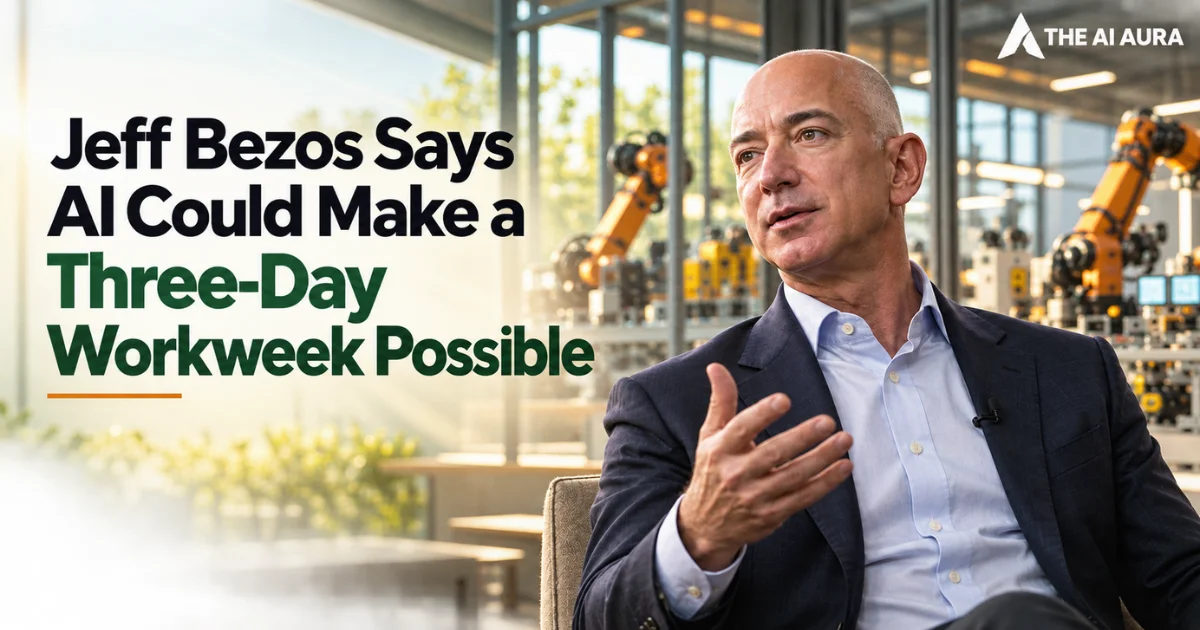
During a recent sit-down with Fox News host Bret Baier, the Amazon founder pitched a surprisingly optimistic vision of the global economy. In his view, AI is not going to decimate the workforce or plunge us into an era of widespread joblessness. Instead, he argues it will generate such overwhelming productivity gains that it will actively buy back our time.
The mechanics behind this shift rely entirely on output density. When autonomous software handles the rote, repetitive, and time-consuming workflows that currently bog down the modern employee, the actual value generated per hour skyrockets.
In many ways, AI won’t replace your team — but it will replace your workflow, enabling individuals to produce five days’ worth of conventional output in just three days and fundamentally shifting their economic leverage.
According to details shared in a recent Times of India report, Bezos believes this exact efficiency spike could let individuals comfortably support a family while working a three-day schedule.
He took the theory even further by suggesting that the financial breathing room created by artificial intelligence might allow dual-income households to safely drop down to a single earner. It is an incredibly bold forecast to make right now, especially when anxiety around machine-driven obsolescence dominates the public conversation.
Reframing the Automation Threat
Plenty of brilliant economists and industry leaders are actively sounding the alarm over AI triggering a wave of mass unemployment. Bezos openly dismisses that consensus. Rather than a surplus of idle workers fighting for scraps, he predicts that artificial intelligence is much more likely to trigger labor shortages. This aligns closely with the economic concept known as Jevons Paradox.
As AI makes goods and services cheaper and faster to produce, overall consumer demand expands, which in turn creates an intense need for human oversight, curation, and new types of specialized labor that we cannot even conceptualize yet.
Naturally, critics will immediately point to the relentless wave of layoffs across the technology sector to invalidate his optimism. With Amazon itself cutting roughly 30,000 jobs over the last twelve months, the reality on the ground feels harsh.
However, Bezos firmly detaches those corporate cuts from the AI narrative. He attributes the recent downsizing entirely to the aggressive, wildly unsustainable hiring sprees that major corporations undertook to handle the unusual demand of the Covid-19 pandemic.
Correcting pandemic-era headcount bloat, he argues, is a temporary corporate adjustment and entirely separate from the long-term integration of artificial intelligence into the enterprise.
The Utility of an Industrial Bubble
We are undeniably living through a massive technological hype cycle. Billions of dollars are currently flowing into AI startups, many of which lack clear paths to profitability.
Baier pressed Bezos on this exact reality, questioning his previous remarks that categorized the current AI boom as an industrial bubble. Interestingly, Bezos welcomes the bubble.
His perspective is deeply rooted in historical precedent. When speculative markets inevitably correct themselves and pop, financial investors often lose massive amounts of capital. However, the physical and digital infrastructure they funded does not vanish into thin air.
Much like the dot-com crash left behind thousands of miles of valuable fiber optic cable that eventually enabled the modern streaming internet, an AI bubble burst will leave behind highly optimized data centers, advanced silicon manufacturing, and foundational infrastructure.
While some executives are still evaluating whether AI for small businesses is worth the investment in 2026, the speculators absorb the financial devastation, leaving the broader market to inherit transformational tools at a massive discount.
Ultimately, it is this surviving, heavily subsidized infrastructure that will drive the extreme economic productivity required to make a three-day workweek a viable reality for the average person.