
Military propaganda has historically relied on blurry photographs, intercepted radio chatter, or creatively cropped satellite imagery to sell a narrative. But the information war has recently evolved into something entirely different and frankly, a bit embarrassing.
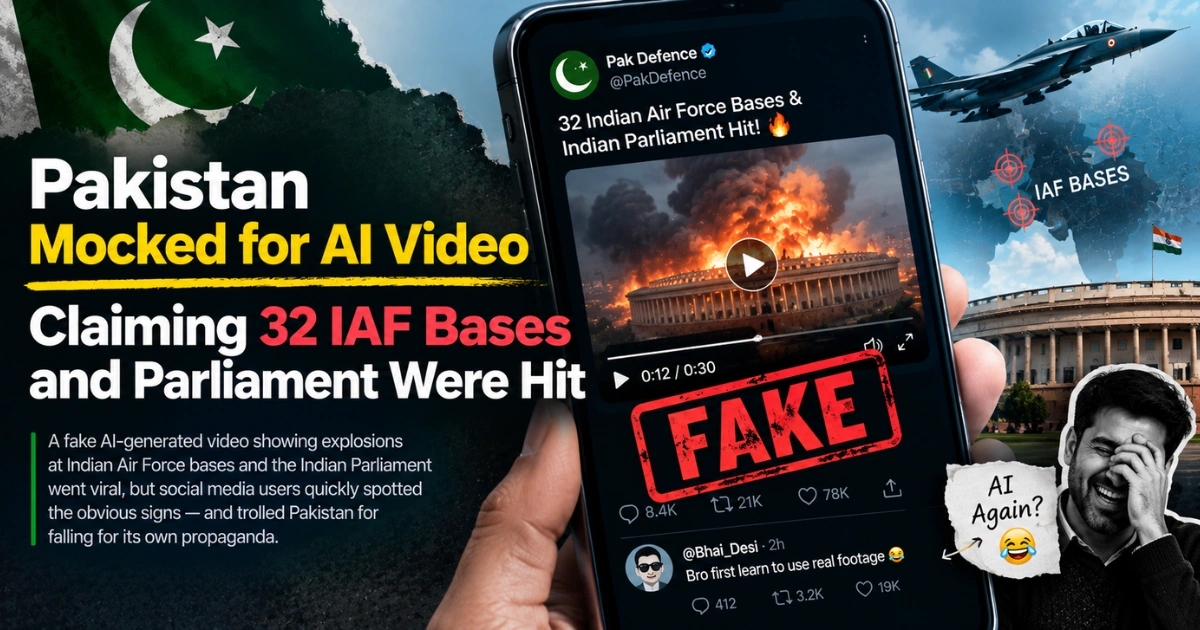
For its recent Air Force Day, Pakistan decided to bypass the burden of traditional evidence altogether, opting instead to release a highly polished, entirely AI-generated video. The subject of this digital fantasy? A fictional, catastrophic military triumph against India dubbed “Operation Sindoor.”
The claims made in this broadcast are nothing short of extraordinary. The video boldly suggests that the Pakistan Air Force (PAF) successfully neutralized two advanced S-400 air defense systems, decimated 32 Indian Air Force (IAF) bases, and executed a direct strike on the Indian Parliament in New Delhi.
Yet, in an era where commercial satellites can track vehicular movement from orbit and open-source intelligence is ubiquitous, the complete absence of actual imagery or ground footage has turned what was meant to be a show of strength into an international laughingstock.
Operation Sindoor and the Algorithmic Illusion
When a nation makes claims of such colossal military magnitude, the global intelligence community expects receipts. Striking an S-400 surface-to-air missile battery, let alone two of them, would leave a massive debris field and a geopolitical shockwave visible across the globe.
Hitting 32 active IAF bases would effectively ground commercial aviation across South Asia and trigger an undeniable, full-scale kinetic war. Striking the legislative heart of a neighboring nuclear power would be an unprecedented act of total war.
Instead of providing verifiable proof of these alleged, history-altering strikes, the establishment released a cinematic montage generated by artificial intelligence. The visuals bear all the glaring hallmarks of generative video technology.
Defense analysts quickly pointed out the physically impossible lighting, slightly warped geometries on the aircraft, and hyper-stylized explosions that look pulled directly from a high-end video game engine.
This represents a bizarre shift in state-sponsored messaging. Rather than manipulating real footage to exaggerate a minor border skirmish, the creators fabricated a massive, multi-front victory from thin air. By substituting raw intelligence with algorithmic animation, they inadvertently highlighted a severe lack of actual operational successes to showcase to their domestic audience.
Why the Internet is Mocking Pakistan’s Virtual Victory
The immediate blowback across social media and defense forums was swift and merciless. Open-source intelligence (OSINT) accounts, military historians, and everyday internet users immediately dismantled the video.
Platforms like X (formerly Twitter) were flooded with memes comparing the PAF’s “Operation Sindoor” to popular flight simulator playthroughs and science fiction movie trailers.
The mockery stems not just from the absurdity of the tactical claims, but from the sheer laziness of the execution. Historically, nations have used propaganda to boost domestic morale during tough economic or political times, but this AI experiment severely misjudged the digital literacy of the modern public.
When a state claims to have paralyzed the air force of a global superpower, a synthetic, mid-journey style rendering simply does not hold up to even five seconds of scrutiny.
This incident underscores a desperate pivot in regional information warfare. When conventional military capabilities fail to produce tangible victories, generative AI offers a cheap, rapid way to feed a domestic populace the heroics they desperately want to see.
However, on the global stage, it achieves the exact opposite effect. It signals vulnerability and strips away institutional credibility. By leaning on artificial intelligence to fabricate a sweeping victory, the establishment did not project regional dominance; they merely proved that their most devastating strikes are currently happening on a graphics card.
Source: India Today, "32 IAF Bases Hit, Parliament Struck: Pakistan's AI Fantasy on Op Sindoor Mocked"