Silicon Valley’s worst week in recent memory is quietly turning into a geopolitical windfall for India’s two largest conglomerates. Following Jensen Huang’s abrupt exit from Nvidia over a scandal tied to a Singaporean cloud partner, Washington moved quickly to close the backdoors that allowed restricted entities to rent high-end computing power abroad.
On November 19, 2026, a new interim final rule from the US Bureau of Industry and Security took effect, slapping case-by-case export licensing requirements on advanced AI chips headed to Singapore, Malaysia, Thailand, Indonesia, and Brazil.
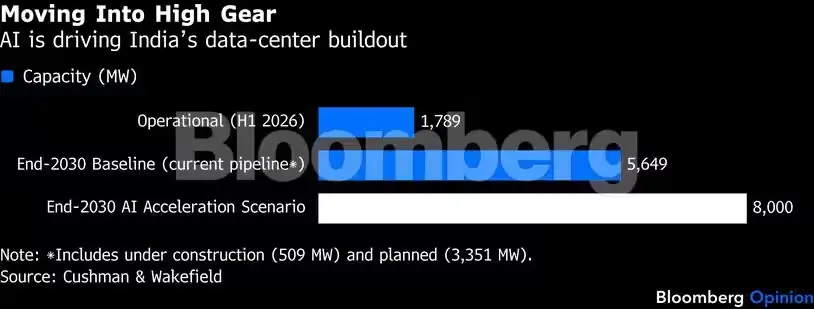
For Mukesh Ambani and Gautam Adani who have together pledged more than $200 billion toward artificial intelligence infrastructure the sudden tightening of Southeast Asia’s data-center corridor hands them a rare opening to solve their biggest strategic problem: convincing global hyperscalers to anchor their Asian compute in India.
How Washington’s Chip Crackdown Shifts the AI Map Toward India
For the past two years, Southeast Asia’s data-center boom thrived on regulatory arbitrage, allowing regional operators to host cutting-edge Nvidia clusters that Chinese-linked firms could access remotely.
Washington’s new rule effectively shuts that loophole down by capping remote compute for restricted entities and forcing exporters to obtain individual licenses for five major markets.
India, notably, is absent from that high-risk list. By joining Washington and other Indo-Pacific allies in signing the San Francisco Declaration the framework behind Secretary of State Marco Rubio’s “Pax Silica” initiative to China-proof the global AI supply chain India has positioned itself as a trusted custodian of Western semiconductor technology.
That geopolitical alignment arrives at the exact moment India’s richest industrialists are scaling up massive capital commitments.
According to Bloomberg, Ambani’s Reliance Industries has committed 10 trillion rupees ($107 billion) over seven years to build a gigawatt-scale AI hub, while the Adani Group has mapped out a $100 billion data-center investment running through 2035.
Both conglomerates are tackling the single hardest bottleneck in modern AI reliable green power by transforming the arid deserts of Kutch along the India-Pakistan border into colossal renewable energy zones. Adani’s solar park spans five times the area of Paris, while Ambani is developing a clean-energy complex three times the size of Singapore.
Each brings a distinct structural edge to the table: Adani controls the generation and transmission grid needed to feed power-hungry server racks, while Ambani sits on a distribution base of more than 500 million telecom subscribers ready for consumer and enterprise AI services.
Img source: Bloomberg
The Compliance and Demand Hurdles Standing in Their Way
Even with Southeast Asia facing fresh licensing friction, India’s billionaires still have to overcome steep commercial and regulatory hurdles. Domestic enterprise demand in India remains far too small to absorb the gigawatts of AI data-center capacity Reliance and Adani plan to bring online.
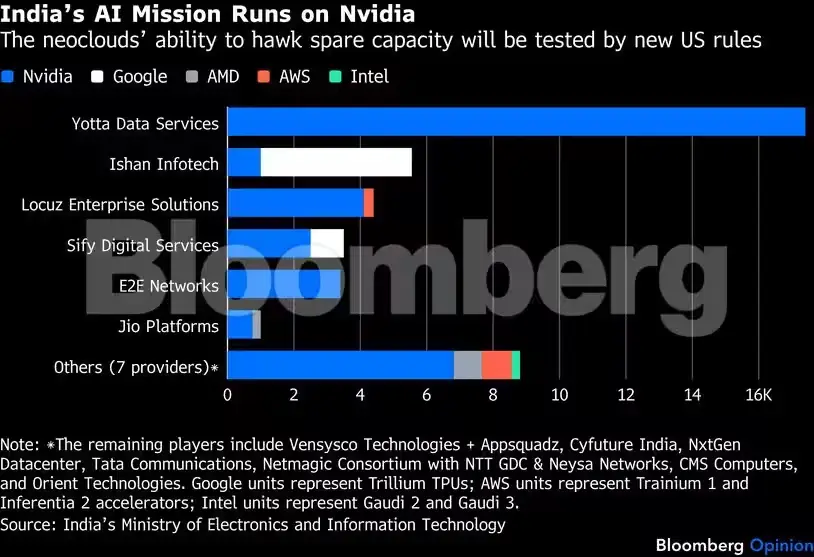
Worse, they are not building in an empty field. Both groups must compete for local workloads against agile neoclouds backed by the government’s IndiaAI Mission, where players like Yotta Data Services, Tata Communications, and E2E Networks already operate more than 44,000 GPUs.
AdaniConneX has hedged some of this risk by renting capacity to US-based CoreWeave, underscoring how heavily Indian operators must rely on foreign hyperscalers to justify their multi-billion-dollar outlays.
Img source: Bloomberg
Winning those American cloud contracts now comes with a heavy compliance price tag. Under the updated US export controls, foreign data centers can no longer operate as neutral real estate.
Operators are legally expected to run deep know-your-customer audits on every tenant’s corporate ownership to ensure no shell company linked to China or Macau breaches the remote-access ceiling roughly equivalent to 750 Nvidia H100s or 330 B200s.
US domestic politics adds another layer of risk, particularly for Adani, as congressional Democrats set to regain subpoena power in January have previously questioned why the Justice Department dropped its bribery indictment against the group.
Nvidia’s turmoil may have cleared the path for Ambani and Adani to emerge as Asia’s premier gatekeepers of American AI hardware. Turning that sudden geopolitical advantage into a durable business, however, will depend on whether they can attract global compute buyers while proving to Washington that their server farms are airtight.