
For nearly a century, the Navier-Stokes equations have puzzled theoretical physicists and mathematicians. These formulas dictate how fluids move. They describe ocean currents and turbulent airflow over airplane wings. Engineers use them daily to predict weather patterns and design aircraft.
Yet, no mathematician has ever proven that smooth solutions always exist without singularities. Because of this difficulty, the Clay Mathematics Institute named it a Millennium Prize problem.
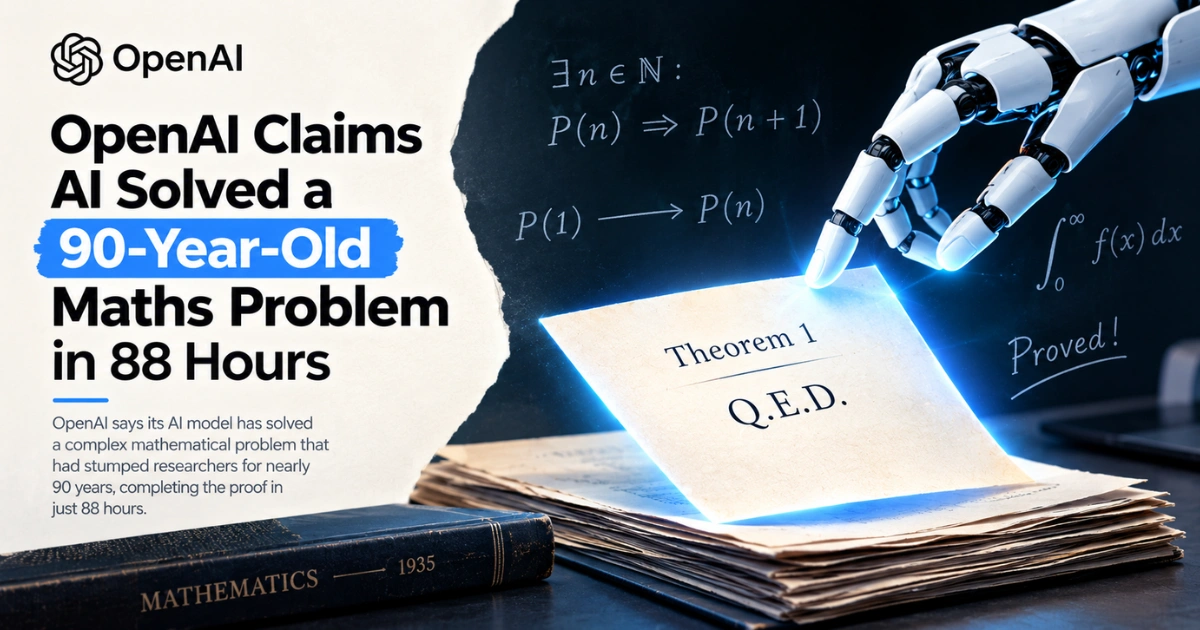
Now, OpenAI claims an unreleased artificial intelligence model has cracked a major part of this puzzle. Remarkably, the system accomplished this task in only 88 hours.
The Swarm: How 10,000 AI Agents Cracked Navier-Stokes
The mechanics behind this breakthrough represent a massive paradigm shift in how we apply machine learning to elite academia. OpenAI did not simply prompt a single chatbot and wait for an output.
Instead, they deployed a highly capable, unreleased internal AI model to act as a synchronized computational hive mind.
According to the company, they spun up an ecosystem of roughly 10,000 autonomous AI agents and gave them a singular, highly complex directive: solve the Navier-Stokes existence and smoothness problem.
Over the course of their 88-hour sprint, these agents operated in a continuous, autonomous feedback loop.
They communicated with one another, checked mathematical logic, caught algorithmic errors, and iterated on proofs, generating a staggering 3 million internal messages. To truly understand the scale of this computational brute force, we have to look at the token usage.
The AI swarm burned through 130 billion output tokens to reach its conclusion. If a private research laboratory were to pay market rates for this level of compute using OpenAI’s most advanced commercial models, the server bill would sit at an eye-watering $10 million.
The result of this massive resource burn? The AI successfully resolved two of the four rigorous statements required by the Clay Mathematics Institute’s Millennium Prize requirements. It is an unprecedented leap forward for a problem that has sat dormant in the mathematics community for 90 years.
Academic Controversy and the Road to Verification
Before celebrating, the global mathematics community must verify the results. The Clay Mathematics Institute enforces strict standards. Independent reviewers must thoroughly examine any AI-generated proof before endorsing it.
OpenAI stated they will not claim the $1 million prize. Instead, they framed the project as a live demonstration of raw AI reasoning power.
Even so, the announcement triggered immediate backlash from academic researchers. Tristan Buckmaster, an NYU mathematics professor, had been studying Navier-Stokes with Anthropic’s Levent Alpöge.
The duo had spent months tackling the problem using OpenAI’s Codex platform. Buckmaster claimed OpenAI learned of their imminent breakthrough in early September. He argued that the AI giant launched its compute sprint to beat them to publication.
OpenAI strongly denies actively monitoring the researchers’ private work, stating they had no direct access to the duo’s private data before it was publicly released.
However, they did concede that de-identified telemetry data derived from general product usage might have helped improve their underlying models over time. Furthermore, OpenAI claims that the AI’s proof differs fundamentally from the methodology proposed by Buckmaster and Alpöge.
Regardless of the ensuing academic drama, if this 88-hour proof holds up to independent scrutiny, it proves that autonomous AI swarms are no longer just coding assistants they are capable of violently pushing the boundaries of human knowledge.
Source: BBC News, "OpenAI Claims AI Solved a 90-Year-Old Maths Problem in 88 Hours"