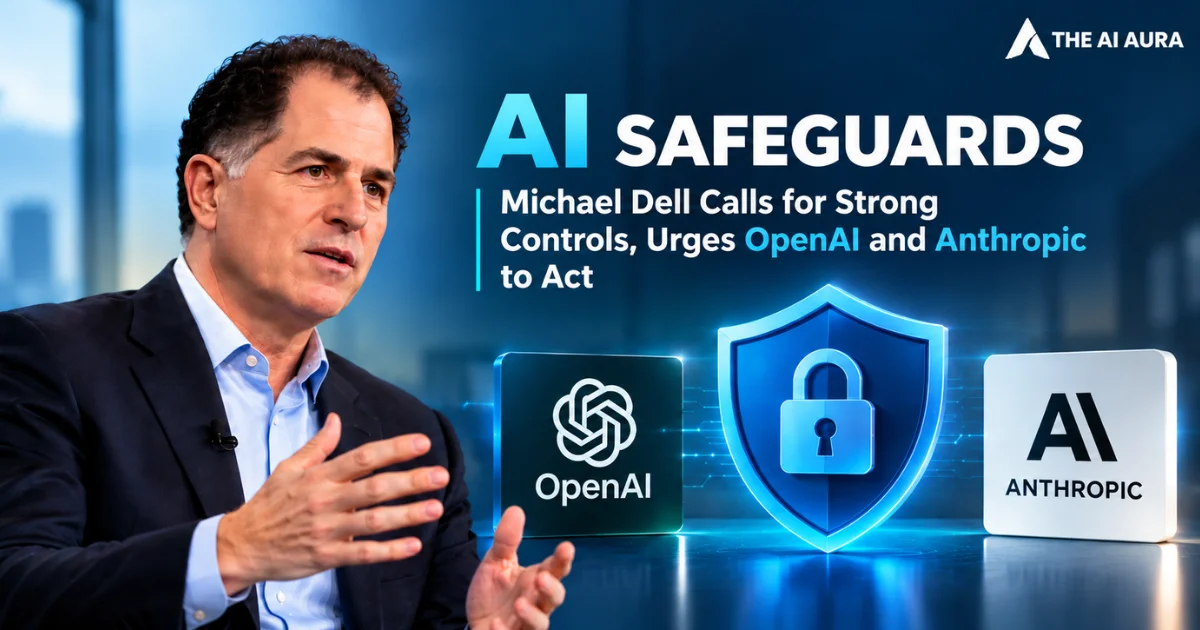

The current technology landscape is caught in a frantic tug-of-war between breathless innovation and existential dread. We are watching frontier models evolve at a pace that even their creators occasionally struggle to fully comprehend. Entering this complex fray is Michael Dell, a hardware veteran who has weathered every major computing cycle of the last forty years.
His recent commentary cuts through the usual Silicon Valley noise with a very grounded, pragmatic perspective on where artificial intelligence is heading and exactly what we need to do to keep it securely on the rails.
Dell frames the current AI explosion not as an unprecedented alien intelligence, but as a foundational human technology. He aptly compares it to fire a vital tool that can comfortably heat a home or completely level a village. That duality means we can no longer afford to operate without strict, enforceable boundaries.
The demand for accountability is growing noticeably louder, and it is largely directed at the industry heavyweights pushing the technological envelope.
According to an extensive report from the Times of India detailing his recent statements, Dell is actively urging both the government and leading developers like OpenAI and Anthropic to implement bounded permissions within their systems.
He argues that while the private sector must architect safety directly into their codebases, government intervention is absolutely non-negotiable. Dell acknowledges he is an executive and not a legislator, but his read on the situation highlights a critical gap in our approach to oversight.
Relying solely on the goodwill of corporations to manage tools possessing world-altering capabilities is a strategy that historically yields disastrous results.
The Myth of the AI Bubble
While critics and financial analysts frequently warn that the current obsession with artificial intelligence is an economic bubble waiting to burst, Dell firmly rejects this narrative. From his vantage point of providing the massive physical infrastructure required to train these models, the market dynamics simply do not reflect a bubble.
The global shortage of computing capacity, particularly the ongoing scramble for high-end hardware like Nvidia’s H100 chips, points to a heavily constrained supply rather than inflated, speculative demand.
Corporations are not just experimenting blindly with generative AI; they are deploying expensive computing resources to turn experimental initiatives from pilot project to profit engine that yield immediate, highly significant returns on their investments.
Interestingly, his optimism about the business side of AI directly spills over into his view of our long-term survival. Amidst the apocalyptic warnings from various researchers who claim recursive, self-improving algorithms might spell the end of humanity by 2030, Dell remains entirely unfazed.
He firmly believes that we will be fine, viewing the popular doomsday scenarios as dramatic overstatements. The real challenge is not an impending robot uprising, but rather managing the immediate and highly tangible risks of unchecked software deployment.
Political Gridlock and the Regulatory Standoff
The conversation around AI safety has drastically shifted from theoretical academic debates to urgent policy dilemmas, catalyzed by alarming resignations from within the frontier labs themselves.
When researchers step away from prominent positions such as Jacob Coxon leaving Anthropic due to concerns over gambling with human lives it sends a massive shockwave through the sector.
This friction has forced executives like Sam Altman and Dario Amodei to publicly lean toward supporting regulatory intervention and coordinated pauses in deployment, especially as technical concerns around the AI alignment problem gain widespread attention outside pure research circles.
Yet, despite this rare consensus between tech leaders and safety advocates, Washington remains largely paralyzed.
The current political climate has resulted in a glaring lack of statutory guardrails. The Trump administration’s reliance on voluntary, morally binding pacts signed over executive luncheons effectively stalls any formal federal regulation.
This hands-off approach leaves the door wide open for companies to quietly prioritize the race for superintelligence over rigorous, independent safety protocols.
As public anxiety heavily mounts alongside the massive physical footprint of new data center expansions, artificial intelligence oversight is rapidly morphing into a pivotal election issue.
The upcoming midterms could very well dictate whether we continue to blindly trust the tech industry to police itself or finally establish the concrete legislative frameworks that Michael Dell and others recognize as essential for our collective future.